
Bongal Site Undermines Dutch Orientalist Theory: Islam Entered the Archipelago from Arabia, Not India
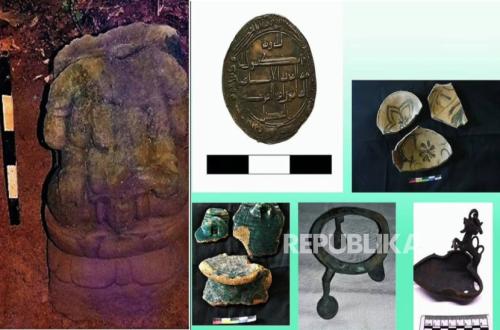
The discovery of a number of ancient currency artefacts bearing Arabic and Persian script from the Bongal Site in Central Tapanuli Regency, North Sumatra, has the potential to rewrite the history of the arrival and development of Islam in Indonesia. For the first time, there is artefactual evidence indicating a direct relationship between the Arabian Peninsula and the archipelago around the 7th century CE.
These artefacts have been long awaited by archaeologists and historians researching the development of Islam in Indonesia. Until now, based on existing archaeological evidence, namely ancient tombstones in Pasai, Aceh, and in Gresik, the indication of Islam’s presence in the archipelago was much younger, namely in the 12th and 13th centuries.
More profoundly, foreign researchers in the 19th and 20th centuries, based on those limited archaeological findings, concluded that Islam arrived in the archipelago not from its direct source, Saudi Arabia, but from the west coast of India or the east coast of India. This was considered ‘belittling’ by some Indonesian ulama, referring to what Buya Hamka conveyed at a seminar.
The genealogy of the theory of Islam’s entry into Indonesia via the Indian route was discussed in depth by G.W.J. Drewes in his paper ‘New Light on the Coming of Islam to Indonesia?’ in Bijdragen tot de Taal-, Land- en Volkenkunde 124 (1968), No. 4, Leiden, pp. 433–459. This manuscript is a translation of the paper Drewes read at the Oosters Genootschap meeting in Leiden on 27 March 1968.
Drewes underlined that before discussing theory, it is worth recognising one simple fact that is rarely mentioned: Southeast Asian historians work almost without physical findings.
Drewes quoted Paul Wheatley, who in his book on the Malay Peninsula lamented the destructive power of the tropical climate — rainfall, insects, fungi, and the rapid rate of alluvial deposition. The combination of all these erases traces of human activity once humans depart. Because of this, Wheatley was forced to compile his book from written sources: Greek, Indian, Arab-Persian, and Chinese.
The same conditions haunt the study of Islamisation. “Our supply of factual data regarding the earliest period of Islam in the East Indies is extremely poor,” wrote Snouck Hurgronje opening his inaugural address in Leiden on 23 January 1907. Six decades later, Drewes acknowledged that new data had indeed increased, but the scarcity had not been resolved.
What remains are objects that do not easily decay — especially tombstones. According to Drewes, tombstones provide limited but reliable information, and are more reliable than local historiography, where the memory of Islam’s arrival has been so obscured by legend that it serves more to build the spirit than to record events.
However, even tombstones are not a guarantee. Drewes pointed to the report of the Seminar on the History of Islam’s Entry into Indonesia in Medan, 17–20 March 1963, as an example of how fragile ‘new data’ is when not handled critically. On one tombstone in Pase, Cowan had read the year 823 AH (1420 CE) in 1940, while H.M. Zainuddin read it as 622 AH (1225 CE). On the tombstone of Putri Siti Hawa in Kuala Daya, Ismail Jakub read 11 Muharram 460 AH (1067 CE), while Veltman read 11 Muharram 962 AH (1554 CE). The difference spans centuries, and reproductions of the inscriptions were not included.