
Bondowoso students offer integrated disaster management solution
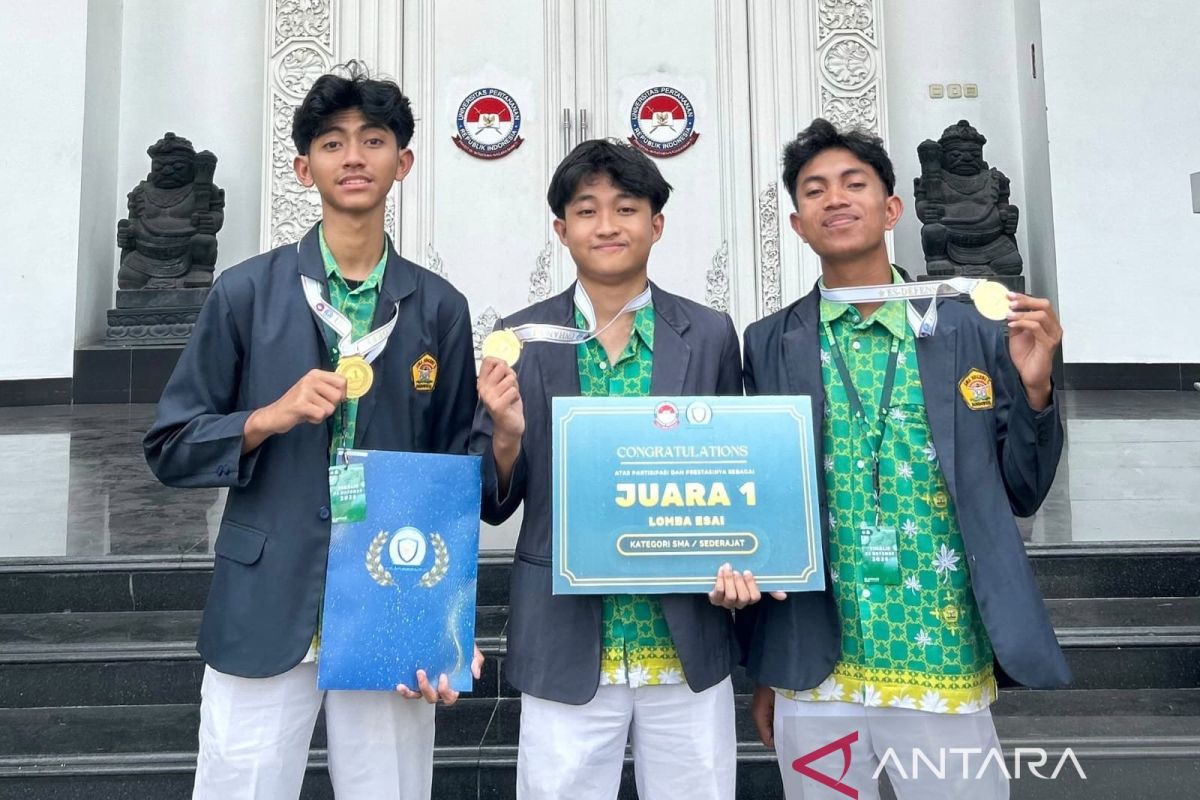
An essay on integrated disaster management has led a team from SMA Negeri 2 Bondowoso, East Java, to first place in a national essay competition organised by the Indonesian Defence University (Unhan) in Bogor. The three students—Wijdan Shafly Maysa Putra, Gareno Danadyaksa, and Mochammad Abdy Faiza Bahary—presented an essay titled ‘BENCANAKU: A Crowdsourcing Application Integrated with an AI-Based Priority Algorithm and Unified Command System for Optimising Rapid Natural Disaster Response’.
In the competition, the team initially submitted only an abstract, competing alongside university student groups. Their essay was declared to have passed and then advanced through the semi-final stage. To reach the final, they were required to submit a complete essay, but were then judged only against fellow high school students. In the final round, the Smada students had to present before a panel of judges.
In their essay, they offered an innovative mobile application-based solution that integrates participatory public reporting with a unified command system. The students, who have frequently participated in writing competitions, observed that Indonesia’s disaster management system still faces serious structural challenges, including fragmented cross-agency coordination, delays in information flow from affected locations to command centres, and low public participation in post-disaster reporting, despite various strategic policies initiated by the government.
The application proposed by the students allows citizens to report post-disaster conditions through multimedia features and emergency status updates. These reports are then processed by an artificial intelligence-based priority algorithm that considers severity variables. The system automatically allocates the nearest resources from BNPB, BPBD, TNI, Polri, and PMI through an integrated dashboard. This system integration has the potential to accelerate response times by up to 40 per cent, improve the accuracy of aid targeting, and optimise cross-sector coordination.
The BENCANAKU essay presents a new paradigm of disaster management that is participatory, adaptive, and data-based, aimed at strengthening national resilience and contributing to Sustainable Development Goals 11, 13, and 17.
According to the students, one innovation previously developed for early detection and mitigation of natural disaster impacts in Indonesia is the use of crowdsourcing-based reporting applications and integrated disaster information systems for remote monitoring and emergency response coordination. Various platforms have been developed collaboratively by local governments and communities, such as PetaBencana.id, which harnesses crowdsourcing through social media to support humanitarian response and disaster recovery, and TiTaTu from the Bandung Regency Government, which allows the public to report disaster events in real time from affected locations.
In addition, BNPB has launched an application for reporting environmental degradation to strengthen the national disaster information system. However, these approaches still operate within a partial reporting paradigm and are not yet fully integrated with a unified command system. Consequently, all these applications have not yet addressed the multidimensional challenges of disaster management in Indonesia, including fragmented cross-agency coordination, limited public access in remote areas to integrated digital reporting platforms, the high complexity of coordination among stakeholders that often results in aid not reaching those in need, and the lack of integration of artificial intelligence-based priority algorithms capable of analysing severity and allocating resources in real time.
Therefore, a new, more holistic approach based on a unified command system is important to address these challenges. The integration of participatory reporting, AI-based priority algorithms, and a virtual command centre dashboard in the BENCANAKU system can deliver several advantages. First, early detection and verification of disaster reports through multimedia monitoring (photos, videos, and emergency status) as well as automatic filtration using Natural Language Processing and Computer Vision help decision-makers and response teams understand actual conditions on the ground and determine intervention priorities based on measurable scientific evidence.
Second, automatic prioritisation and resource allocation through an algorithm that considers variables such as severity level, affected population density, the presence of vulnerable groups, and location accessibility, which is dynamically updated as new data arrives from the field. Third, techno-economic simulation of the potential acceleration of response times and optimisation of aid distribution, along with projections of economic benefits for the national disaster management system through reduced casualties and lower economic losses.
Nevertheless, the integration of crowdsourcing, AI, and a unified command system is not a single solution. The success of a system like BENCANAKU still depends on investment in disaster literacy and digital literacy education for the public and officials at the regional level, the availability of information technology infrastructure that ensures accessibility without reliance on heavy internet connections in frontier, outermost, and disadvantaged (3T) regions, and the government’s commitment to strengthening regulations on the use of AI-based and crowdsourcing disaster technology through ministerial regulations and institutional strengthening targeted to accommodate innovation.
Source: jawawa.id (https://jawawa.id/newsitem/bondowoso-students-offer-integrated-disaster-management-solution-1787374291)
Originally published by Antara (Indonesian) (https://www.antaranews.com/berita/5706291/siswa-sman-2-bondowoso-tawarkan-solusi-penanganan-bencana-terintegrasi), translated from Indonesian