
Bolivia's Chaos Update: Crisis Deepens, National Emergency Declared, Air Force Plane Crashes
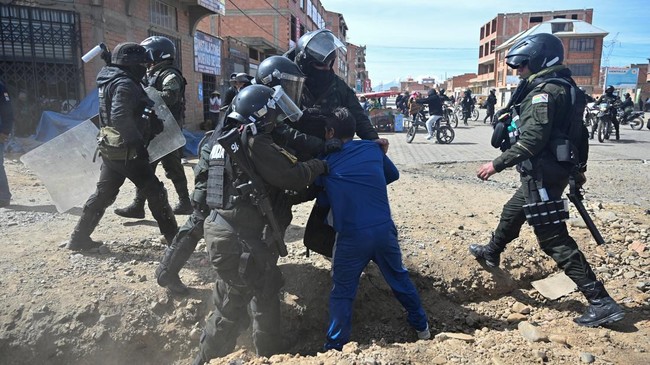
The Bolivian government’s efforts to end a 50-day social and political crisis showed important progress on Sunday (21/6/2026), as several road blockades that had paralysed the country began to be lifted. However, the development was overshadowed by the tragedy of a military support plane crash that killed six people amid crisis management operations. Bolivia’s highway authority reported, as relayed by Reuters, that the number of ongoing blockades had fallen to 28 points following a series of breakthroughs in negotiations with protester groups. This development came a day after Bolivian President Rodrigo Paz declared a state of emergency to address the crisis triggered by anti-government blockades that for weeks had closed major transport routes, trapping lorries and hindering the distribution of food, fuel, and medicine to various regions. On Sunday morning, Bolivia’s Legislative Assembly approved Paz’s emergency decree by a majority. The parliamentary approval coincided with several positive developments on the ground. In the Santa Cruz region, government officials and protest leaders signed an agreement to lift a key blockade in the city of San Julian, one of the points that had been a major obstacle to distribution flows. Meanwhile, the influential Tupac Katari farmers’ federation in the La Paz region announced a temporary suspension of their protests. However, the organisation stressed that their demands remained in place and had not been withdrawn. The group’s demands cover various issues, ranging from economic relief measures and the revocation of several government decrees to political and labour protections and fuel quality concerns. Most of the demonstrators involved in the blockade actions are known to have political ties with former President Evo Morales, a leftist figure who still wields significant influence in the country. Morales claimed via social media on Sunday that the Tropic of Cochabamba region, a tropical agricultural area in central Bolivia that is the main political base of his movement, was experiencing public service disruptions. According to Morales, the area is facing power cuts, telephone service disruptions, and restrictions on banking services. The wave of unrest shaking Bolivia began after President Rodrigo Paz took the controversial step of slashing long-standing fuel subsidies. The policy was pursued to curb the budget deficit amid dwindling US dollar reserves and ongoing government talks with the International Monetary Fund (IMF) regarding an economic rescue package. Bolivia’s economy is currently under severe pressure due to a foreign exchange crisis, reduced export revenues, and growing public dissatisfaction with economic conditions. Although the government subsequently took several steps to stabilise fuel prices and reversed an unpopular agrarian reform, the protests have instead widened. Labour unions and other community groups are demanding wage increases, a resolution to fuel and US dollar shortages, and are urging President Paz to resign. Amid this progress, Bolivia was shaken by tragic news after an Air Force plane conducting a support flight crashed. The Ministry of Defence said in a statement that a military jet heading to Cochabamba from the city of El Alto, near La Paz, crashed and killed all six people on board. The victims consisted of four civilians and two crew members. The Cessna FAB-409 aircraft was found in a remote mountainous area in the high Andes region, in the Department of Cochabamba, west of Cochabamba City. The ministry did not explain the cause of the accident and stated that an investigation is ongoing. The government also did not detail the mission the aircraft was undertaking when the incident occurred. However, the ministry revealed that in recent weeks the same aircraft had been used to transport children with cancer to treatment centres during the road blockades across various regions of Bolivia.