
Bojonggede Skybridge Escalators Out of Order and the Responsibility for Public Services
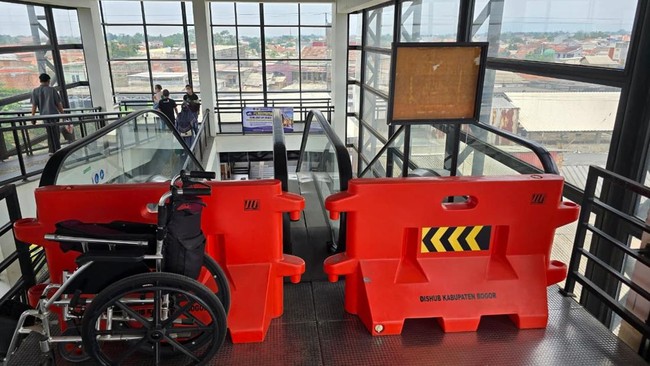
Repeated escalator failures at Bojonggede Station’s skybridge have raised questions about the maintenance of public assets and how the government responds to residents’ complaints. Since January 2026, one escalator at the skybridge has been out of service. In October, another also stopped working. According to Radar Bogor, three escalators in the area are due to be repaired, at an estimated cost of around Rp800 million.
On Tuesday, 20 October 2026, staff from the Bogor Regency Transportation Agency finally came to inspect the facility, after residents’ complaints gained traction on social media.
There is something worth noting in the sequence of events. The escalators remained broken for months, residents complained, the Transportation Agency initially cited limited funds, and an inspection took place once the problem attracted public attention. The presence of officials is, of course, necessary.
But why should damage to a facility used by the public every day have to go viral before it receives serious attention? This is not simply a matter of machines stopping. The incident at Bojonggede shows how public services can lose their responsiveness when the government is more occupied with dealing with complaints after they escalate than preventing problems in the first place.
Lack of maintenance
Bojonggede’s skybridge is not a peripheral facility used only occasionally. Tens of thousands of people pass through it every day. Bojonggede Station is one of the busiest commuter stations in Greater Jakarta. Escalators operating for hours every day are inevitably subject to wear and tear. Components have a limited service life, spare parts must be available, and certain faults can be anticipated through regular inspections.
Maintenance should therefore be included in planning from the moment a facility is handed over to its operator. Service schedules, component replacement needs, operating costs and procurement mechanisms for spare parts should all be taken into account. The local government should not have to wait for residents to complain before recognising that machinery used by thousands of people each day requires maintenance.
The history of failures at Bojonggede underlines the problem. The skybridge was built in 2022 with around Rp16.5 billion in central government funding, plus approximately Rp4 billion from the local government for land acquisition.
The facility began operating in late 2023. In June 2024, its escalators stopped for almost three weeks because spare parts were unavailable. Four months later, the asset was transferred to the Bogor Regency Government.
This means that the problem of spare-part availability is not entirely new. The experience in 2024 should have informed a better maintenance system. When similar damage recurred in 2026, the public should question not only the condition of the machinery but also what the local government did while managing the asset.
A transfer of ownership does not mean an absence of responsibility
KAI Commuter has explained that repairs to the escalators fall under the local government’s authority because the skybridge is now an asset of the Bogor Regency Government. Administratively, this explanation is understandable. The party receiving a transferred asset does bear responsibility for managing and maintaining it in accordance with the applicable rules.
However, an asset transfer should not end with paperwork and a change of authority. It also entails budgetary and technical consequences, as well as service obligations. If the local government accepts a facility without providing adequate funds for its operation and maintenance, residents bear the risks of that planning failure.
The response that the government has no funds must also be examined closely. Budget constraints may be a real problem, but they do not remove the obligation to explain plans, spending priorities and available interim measures. For users, a dispute over who holds the asset does not make the stairs any easier to climb.
The estimated Rp800 million to repair three units also needs to be explained transparently. Divided evenly, that would amount to around Rp267 million per unit. This simple calculation is not evidence that the budget is excessive or unreasonable.
Such a judgement can only be made once technical and cost details are available. The public needs to know how much is allocated for spare parts, technicians’ services, and the repair or replacement of major components.
The warranty period and the original contractor’s maintenance obligations should also be reviewed. Since the skybridge began operating in late 2023, the government should explain the warranty clauses and handover records, and whether the supplier may be responsible if the damage relates to work or components still covered by the contract. If an obligation that should still apply has not been used, the repair costs risk being passed on to the public without an adequate explanation.
Rights affected
The consequences of the breakdown are not shared equally by all users. People who are physically fit may be able to use the stairs or take another route. For older people, people with disabilities and users with limited mobility, those options may not be available.
The longer ramp requires more time and effort, while dedicated routes have to accommodate more users when the escalators are out of service. Workers returning home late must also navigate difficult access after a day spent working, standing and travelling in crowded trains.
The Disability Law guarantees accessibility as a right. This principle makes public facilities part of the state’s obligation to enable everyone to move safely and independently. When an accessibility facility remains out of service for months without adequate alternative services, the problem goes beyond convenience. Access to public transport is also disrupted.
The local government should disclose the repair budget to the public and the regional legislature, set a restoration deadline and publish regular progress updates. While the escalators remain out of service, the Transportation Agency should provide staff to assist older people and people with disabilities, along with clear directions to alternative routes. Contracts, warranties and handover documents should also be reviewed so that each party’s responsibilities do not end in a dispute over who has authority.
More broadly, the Bojonggede case should prompt a review of other public assets managed by local governments. Audits should not have to wait until a facility breaks down or complaints grow louder. Maintenance schedules, asset condition, budget allocations and responses to complaints should be part of routine oversight that the public can scrutinise.
The escalators may eventually operate again once the components have been replaced and technicians have completed their work. But public services cannot be judged solely by whether the machinery eventually moves. What must also be assessed is how long residents were left to cope with the damage, why earlier warnings did not lead to prevention, and why a response became visible only after complaints attracted attention.
The Bogor Regency Government should not treat virality as its maintenance alarm. Residents use the skybridge to reach their trains, not to find out how much they must complain before the government acts. The facility was built with public money and handed over for public use. The responsibility to maintain it should be discharged every day, including when there are no cameras, viral posts or pressure from online users.
Source: jawawa.id (https://jawawa.id/newsitem/bojonggede-skybridge-escalators-out-of-order-and-the-responsibility-for-public-services-1792536635)
Originally published by CNBC Indonesia (https://www.cnbcindonesia.com/opini/20261021045811-14-777992/eskalator-skybridge-bojonggede-mati-tanggung-jawab-pelayanan-publik), translated from Indonesian