
Bogor and Cianjur Hit by Related Earthquakes: Should Jakarta and West Java be on High Alert?
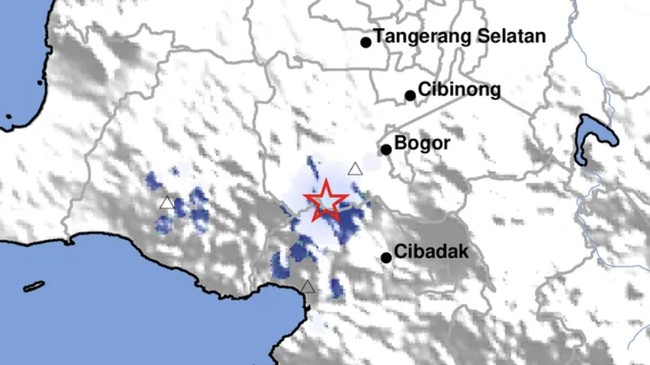
A shallow earthquake with a magnitude of M2.3 struck the Bogor region on Thursday (3/9/2026, at 11:24:22 WIB). According to the BMKG, the epicentre was located on land 26 km southwest of Bogor City, at a depth of 3 km.
The tremor was reported to be felt in Kabandungan, Sukabumi, West Java, with an intensity of II MMI, meaning vibrations were felt by some people and light hanging objects swayed.
Daryono from the Indonesian Disaster Expert Association (IABI) revealed that this earthquake is linked to a shallow earthquake that also struck the Cianjur region two days earlier. He stated that the Bogor earthquake on 3 September was triggered by activity in the active fault zones of the Awi Bengkok and Cianten-Muara fault segments.
Meanwhile, the Cianjur earthquake was triggered by energy release in the Cisokan Fault, an active segment within the Cimandiri Fault Zone system that traverses Cianjur, Sukabumi, and Rajamandala, with tremors even distributed as far as Jakarta and Bandung.
Daryono noted that the seismic activity shaking West Java in early September 2026 reaffirms the active tectonic dynamics of this region. For context, a magnitude M4.3 shallow earthquake struck the Cianjur Regency, West Java, on Tuesday, 1 September 2026, at 17:53:11 WIB. BMKG analysis showed the epicentre was located on land 10 km southwest of Cianjur at a depth of 4 km.
“Although the vibrations were felt at Intensity Scale II MMI in Kabandungan and Bogor without causing building damage or aftershocks, this event follows the M4.3 shallow crustal earthquake on Tuesday, 1 September 2026,” said Daryono on Friday (4/9/2026).
“This series of events illustrates the geological reality that West Java and DKI Jakarta sit directly atop a highly dynamic tectonic transition zone,” he added.
The seismicity characteristics of this area, he explained, are shaped by the subduction process of the Indo-Australian Plate beneath the Eurasian Plate. This geodynamic complexity creates two main earthquake threats: intraplate deformation and a network of shallow crustal faults on land, alongside the megathrust zone off the southern coast.
“On land, the continuous accumulation of strain is distributed across a network of active faults that flank densely populated areas. The Lembang Fault north of Bandung is identified as an active fault. This network is expanded by the existence of the Cimandiri, Cugenang, Cileunyi-Tanjungsari, Cipamingkis, South Garut (Garsela), and Baribis Faults,” he said.
“Specifically for the Baribis Fault segment spanning Jakarta-Bekasi-Purwakarta to Cirebon, potential danger lurks as it traverses industrial areas and dense settlements,” Daryono added.
He further noted that shallow crustal earthquakes from these faults, even with moderate magnitudes ranging from M5.0 to M6.5, are capable of producing high peak ground acceleration.
“The shaking effect has the potential for significant amplitude amplification due to the presence of soft alluvial sediment layers,” he said.
“Meanwhile, in the offshore southern domain, the seismic gap threat lies in the Sunda Strait megathrust zone, which holds the potential for interplate rupture up to magnitude M8.7,” he continued.
Based on the recurrence interval concept, he added that the long-term accumulation of unreleased tectonic energy increases the risk of long-period ground motion and tsunami threats that could have systemic impacts on the mainland of West Java and Jakarta.
“Facing this geological inevitability, integrated structural and non-structural mitigation steps are key to disaster risk reduction. The implementation of earthquake-resistant building codes based on microzonation data is crucial to mitigate local ground acceleration impacts,” he concluded.
“Furthermore, the strengthening of early warning systems, continuous disaster education, and the mapping of adaptive evacuation routes in densely populated areas must be continuously improved to achieve community resilience in facing these active tectonic dynamics,” said Daryuno.
Source: jawawa.id (https://jawawa.id/newsitem/bogor-and-cianjur-hit-by-related-earthquakes-should-jakarta-and-west-java-be-on-high-alert-1788501556)
Originally published by CNBC Indonesia (https://www.cnbcindonesia.com/news/20260904114513-4-764945/bogor-cianjur-diguncang-gempa-berkaitan-dki-jabar-harus-siaga-1), translated from Indonesian