
Boediono Discusses Economic Policy Effectiveness, Reflecting on the 2008 Crisis
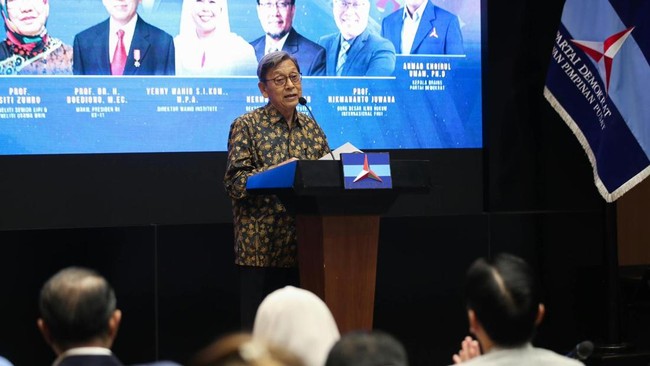
Jakarta, CNBC Indonesia - The 11th Vice President of the Republic of Indonesia, Professor Boediono, was a keynote speaker at the 25th Anniversary Seminar of the Democratic Party at the party’s headquarters in Jakarta on Tuesday (1/9/2026). On this occasion, Boediono discussed the effectiveness of economic policies and lessons learned from the 2008 global crisis.
“Economic policy will only be effective if supported simultaneously by two pillars: the existence of a rational policy concept formulated systematically and technocratically, and the support of political authorities to implement it on the ground,” Boedrag Boediono stated, as quoted from a press release.
Also in attendance were the Chairman of the Democratic Party, who also serves as the Coordinating Minister for Infrastructure and Regional Development, Agus Harimurti Yudhoyono (AHY), and various experts, including Professor Burhanuddin Muhtadi from UIN Syarif Hidayatullah.
Boediono drew upon the experience of President Susilo Bambang Yudhoyono’s (SBY) administration in facing the 2008 global financial crisis as a lesson. At that time, according to him, a solid and competent economic team was able to formulate a technocratic response, while President SBY provided the necessary political support to ensure various policies could be executed immediately.
“A policy concept that is logical, good, and rational, but lacks political support, will remain nothing more than a beautiful concept on paper that has no impact on real life,” said the Professor of Economics and Business at Gadjah Mada University and alumnus of the Wharton School, University of Pennsylvania, USA.
Conversely, political power that is not guided by policy rationality also risks producing ineffective decisions. It will only produce slogans and grand dreams without reality, according to the former Governor of Bank Indonesia. Therefore, Boediono believes that technocracy and politics should not negate each other; both must complement each other to produce effective policies.
“Only when the two fundamental elements of every policy—rationality and authority—unite, will policy bring the desired results,” he said.
Boediono then summarised this lesson in a single message regarding the essence of government leadership: “Synergising rationality and authority is not an easy task. This is where the role of leadership lies.”
AHY’s Message
In his speech, AHY emphasised three main agendas that the Democratic Party must continue to fight for: advancing the economy, upholding justice, and maintaining democracy. In the economic field, AHY stressed the importance of delivering growth that is not only high but also capable of creating widespread prosperity for the community.
“We want to build an Indonesian economy that is equitable and sustainable. High economic growth is incomplete if it is not accompanied by shared prosperity,” said AHY.
According to him, economic development must ensure that the community has jobs, income, and decent purchasing power. Indonesia must also be able to escape the middle-income trap, while simultaneously eradicating poverty and reducing social inequality and regional disparities.
AHY stated that infrastructure and regional development, which are currently part of his duties in the government, must also culminate in the improvement of public welfare.
“Empowering people, connecting regions, sustaining generations. Sustainability is also a package deal. Environmental issues must not be a peripheral issue. In every development agenda, we must ensure equality,” he explained.
Regarding justice, AHY asserted that justice is not solely about legal matters. The Democratic Party also wants to ensure that every member of society has equal economic opportunities to improve their standard of living.
“The Democrats must always fight for that, especially for the vulnerable. Justice does not only mean before the law, but also how the Indonesian people have equality in accessing good economic opportunities so they can move up the social ladder,” said AHY.
He mentioned that farmers, fishermen, teachers, labourers, MSME owners, and even housewives must receive better opportunities to improve their welfare. Access to education and health must also be part of the effort to deliver justice.
According to AHY, the public might be able to accept a lack of prosperity, but injustice is a much harder issue to accept.
“In truth, the community may still be able to accept when their lives are not yet prosperous. But it is difficult to accept when treated unfairly. Therefore, justice is fundamental, and we must fight for it together,” he asserted.
Regarding democracy, AHY assessed that democracy is not merely an end goal, but a path to lead the nation towards progress and shared prosperity. Therefore, the Democratic Party is committed to continuing to maintain democratic life in Indonesia so that it becomes increasingly mature and civilised.
“We want to ensure that democracy in Indonesia remains fertile and mature so that our nation becomes more dignified and civilised,” said AHY.
AHY added that freedom must continue to be guaranteed and exercised responsibly in accordance with ethics and the constitution, including providing wide space for the aspirations of the younger generation.
“The Democrats do not want to be left behind, especially given our name. It is impossible for democracy not to be an important part, or an important agenda, of our future struggle,” he concluded.
Source: jawawa.id (https://jawawa.id/newsitem/boediono-discusses-economic-policy-effectiveness-reflecting-on-the-2008-crisis-1788354121)
Originally published by CNBC Indonesia (https://www.cnbcindonesia.com/news/20260902155315-4-764401/boediono-bicara-efektivitas-kebijakan-ekonomi-singgung-krisis-2008), translated from Indonesian