
BNPT: Terrorism Remains a Persistent and Adaptive Global Threat in the Digital Space
Jakarta (ANTARA) - The National Counter-Terrorism Agency (BNPT) has affirmed that terrorism remains a persistent and adaptive global threat in the digital space.
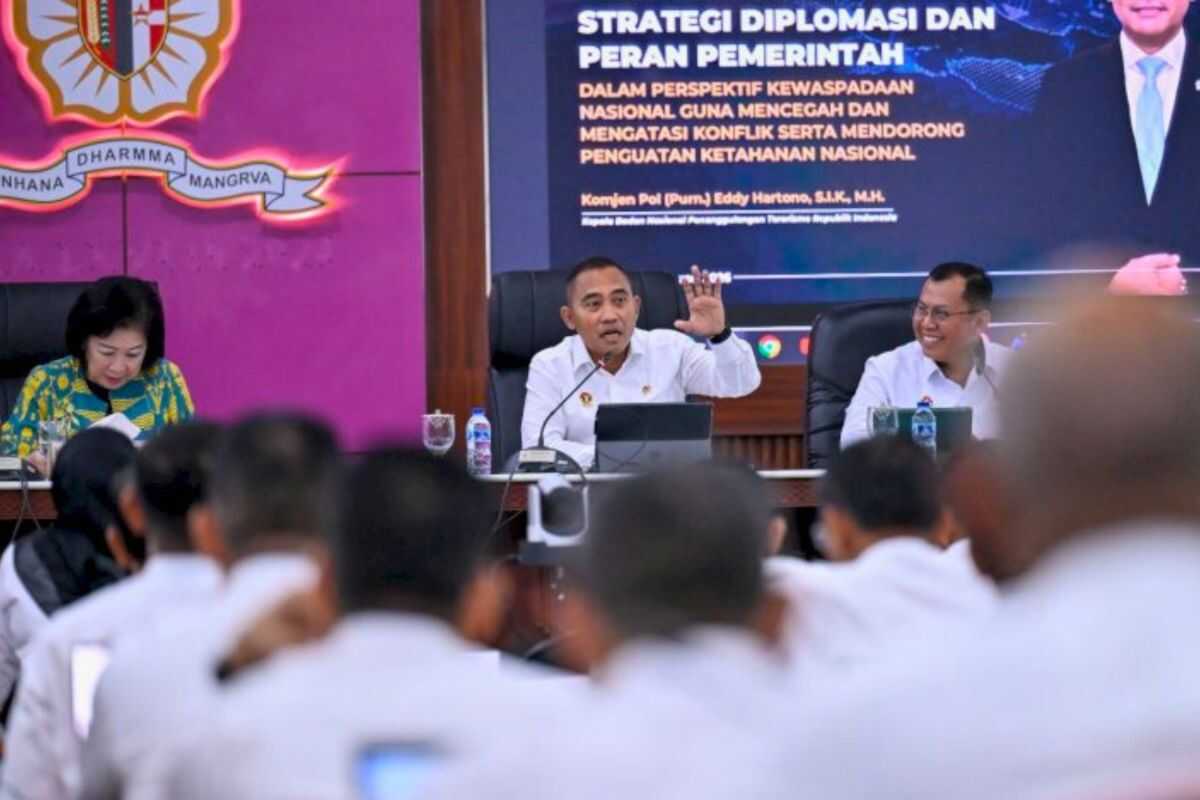
Speaking as a panellist at a discussion in Jakarta on Wednesday (18 February), BNPT chief Commissioner General of Police Eddy Hartono said terrorism is a matter of serious concern for the international community due to its continually evolving nature and ability to adapt to changing times.
“The United Nations considers terrorism to remain a global threat,” said Commissioner General Eddy, as confirmed in Jakarta on Thursday.
He explained that the UN uses the terms “persistent” and “adaptive,” meaning terrorist networks remain a latent danger, posing a continuous threat whilst adjusting to current developments, thereby adapting their strategic patterns of movement accordingly.
As such, he noted, whereas their strategy previously relied on physical means, utilising various information media such as producing leaflets and magazines for propaganda, incitement and the like, they have now shifted to the digital space.
Eddy identified a transformation in the movements of global terrorist groups, which have become decentralised from previously centralised command-and-hierarchy structures, have moved into the digital space from previously holding territorial control, and have adopted lone wolf or independent cell characteristics from previously organised formations.
Furthermore, he emphasised that Indonesia has taken strategic steps in responding to these evolving threats by referring to the global strategy established by the UN.
Indonesia implements four pillars that form the policy or UN Global Counter-Terrorism Strategy, such that following the first Bali bombing tragedy, Indonesia had already established regulations, albeit through a government regulation in lieu of law (perppu).
“Subsequently, various institutions were also established to handle counter-terrorism, one of which serves to elaborate the four pillars contained within the UN Global Counter-Terrorism Strategy,” he said.
The four UN Global Counter-Terrorism Strategy pillars comprise addressing the conditions conducive to the spread of terrorism, preventing and combating terrorism, building state capacity and strengthening the role of the UN, and ensuring respect for human rights and the rule of law.
He added that the counter-terrorism approach is not solely through law enforcement but also prioritises prevention through strengthening dialogue and in-depth study of root causes.
Similarly, in the context of preventing violent extremism, Eddy continued, there are seven pillars, whereby every country must continue to engage in dialogue, particularly in counter-terrorism, and examine the underlying causes of terrorism.
The seven pillars in the context of preventing violent extremism consist of national preparedness, counter-radicalisation, deradicalisation, law enforcement, community protection and empowerment, cooperation and partnerships, and international cooperation.
Beyond the domestic level, the BNPT chief conveyed that Indonesia is also actively strengthening global collaboration, with Indonesia’s empirical experience in handling terrorism serving as a reference for various countries.
“Several international collaborations have emerged because of Indonesia’s strengths in handling matters empirically, so many countries learn from Indonesia about strategies for counter-terrorism,” Eddy added.
The panel discussion was entitled “National Vigilance” as part of the National Leadership Preparedness and Consolidation Education (P4N) programme, organised by the National Resilience Institute (Lemhannas).
Through the strategic P4N Lemhannas forum, which runs for approximately five months and 15 days and includes participants from the Indonesian Armed Forces (TNI), the National Police (Polri), civil servants and non-civil servants, Eddy expressed hope that a comprehensive understanding of national vigilance would be built, particularly in facing increasingly complex and multidimensional terrorism threats.
The BNPT chief’s presence at the forum also underscored the importance of cross-sector synergy in strengthening national resilience and ensuring that counter-terrorism efforts proceed in an integrated, sustainable manner, adaptive to developments in the global strategic environment.