
BNPT: Patterns of Extremist Exposure Evolve with the Digital Ecosystem
Jakarta (ANTARA) - The National Counter-Terrorism Agency (BNPT) says the patterns through which children and adolescents are exposed to extremism are evolving in step with changes in the digital ecosystem.
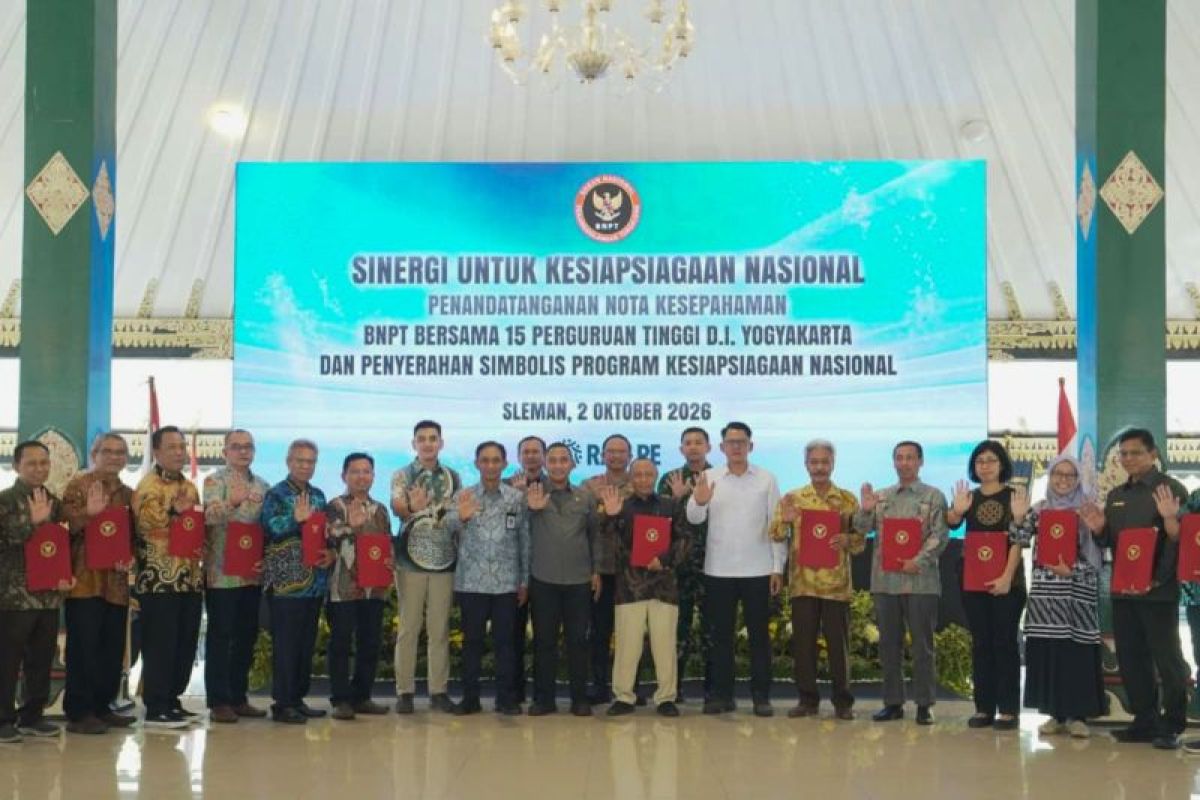
At a memorandum of understanding (MoU) signing event in Sleman, Yogyakarta, on Friday (2 October), BNPT head Eddy Hartono revealed that 620 children aged 11 to 18 across 34 provinces had been identified as exposed to extremism and violent ideologies through digital spaces between January and August 2026.
“They were found in various digital forums and communities, including the True Crime Community (TCC) ecosystem,” Eddy said, as confirmed in Jakarta on Thursday.
He stressed that the TCC is not, in essence, a terrorist network. However, changes in behaviour, such as when children begin to normalise or glorify violence, are among the things that must be watched closely.
Eddy said the situation shows that prevention must begin as early as possible, viewing children not only as individuals but as part of their social environment.
“We first approach these children through rehabilitation, using a child-focused microecological approach. This means involving the child’s closest environment, including parents, schools or universities, and the surrounding community,” he said.
He explained that this approach is in line with the importance of intervening at an early stage, when behavioural changes leading towards the normalisation of violence first appear.
The Special Detachment 88 Anti-Terror unit of the National Police had previously also emphasised the need for a collaborative approach to the growing violence-based extremism in digital spaces that targets children and adolescents.
Eddy said digital spaces have become an inseparable part of the lives of young people. At the same time, the same spaces can serve as a gateway to exposure to violent and extremist content.
In response to this challenge, BNPT has partnered with 13 universities in the Special Region of Yogyakarta (DIY) to strengthen the prevention of violence-based extremism that leads to terrorism.
This commitment was formalised through the signing of an MoU between BNPT and the heads of the 13 universities in DIY.
The collaboration is intended to strengthen the role of universities as spaces for education, dialogue and the development of critical thinking, as well as environments capable of building resilience among young people and vulnerable groups against the influence of violent ideologies.
Eddy stressed that prevention cannot be carried out by the government alone. Universities hold a strategic position because they are in direct contact with young people and have the knowledge capacity to read social change, including emerging threats in digital spaces.
“Let us protect Jogja, and make sure our children are not exposed. Their generation is active in this digital space, and we need to protect them together through collaboration and the intellectual contributions of rectors, so that these mitigation efforts are effective and not in vain,” Eddy said.
Meanwhile, the head of the DIY Office for National Unity and Politics (Kesbangpol), Lilik Andi Aryanto, welcomed BNPT’s collaboration with the universities.
In his view, the partnership brings together two important forces: the capacity of the state to protect society, and the capacity of universities to develop knowledge and understand human dynamics.
“This activity is meant to reaffirm our shared commitment to counter-terrorism. Today is an effort to bring together two important activities, namely the state’s capacity to protect society and knowledge in understanding human beings,” Lilik said.
He added that universities play an important role in shaping how society responds to difference. Campuses are spaces where knowledge is tested, differences are brought together, and arguments are debated in a healthy manner.
According to him, strengthening character education and critical thinking is an essential part of building a generation able to face various influences amid changing social and digital environments.
He expressed hope that universities in Yogyakarta will produce a generation that is not only intellectually capable, but also clear-thinking, humane in outlook, and steadfast in upholding communal life.
The MoU signing marks the first step towards a more concrete collaboration between BNPT and universities in DIY.
The partnership covers strengthening the capacity of educational environments, support for vulnerable groups, and building community resilience against the threat of violence-based extremism.
Through this collaboration, universities are not merely recipients of programmes but strategic partners of BNPT in building a prevention system grounded in knowledge, the social environment and community participation.
BNPT and the universities in DIY will continue to promote educational environments that can serve as safe spaces where young people can learn, engage in dialogue, develop critical thinking and respect difference.
The collaboration is expected to strengthen community resilience and ensure that efforts to prevent extremism begin as early as possible, before exposure develops into violent behaviour.
Together with the universities, BNPT aims to protect the younger generation not only from the threat of violence, but also by strengthening their ability to think critically, respect difference and uphold communal life.