
BNPT: Enhancing officials' competence builds national preparedness
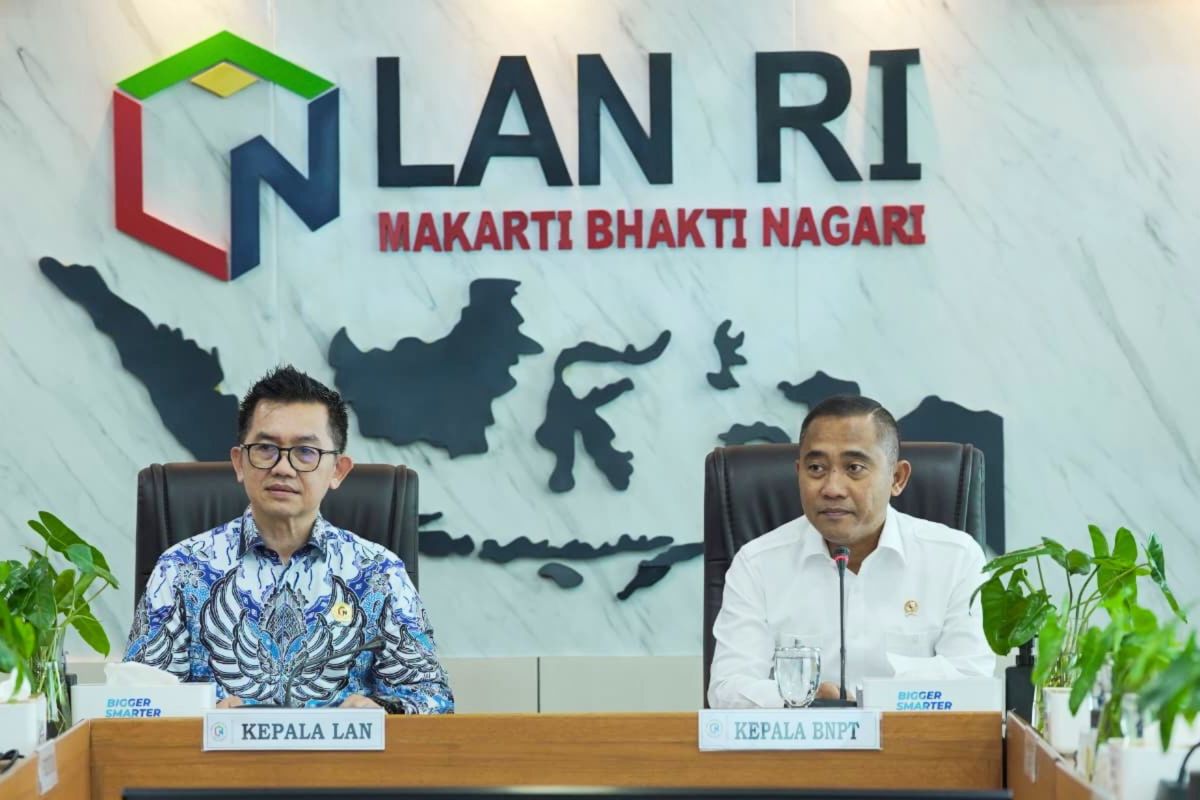
Jakarta (ANTARA) - The National Counterterrorism Agency (BNPT) has stated that enhancing the competence of state officials is an important part of building national preparedness.
BNPT Head Eddy Hartono said that in the context of national preparedness, one of the main focuses is improving the capability of officials, encompassing civil servants (ASN), the Indonesian National Armed Forces (TNI) and the Indonesian National Police (Polri).
“Officials need not only be equipped with technical counterterrorism skills, but they also require managerial capability so that not a single member of staff is exposed to radical terrorist ideology,” Eddy said when contacted in Jakarta on Tuesday.
Accordingly, he believes efforts to prevent terrorism require not only the readiness of security forces, but also state officials with competence, ideological resilience and the ability to recognise and respond to various potential threats at an early stage.
To reinforce this, BNPT and the National Institute of Public Administration (LAN) have signed a memorandum of understanding (MoU) on strengthening cooperation in the field of official competence development, improving policy quality and strengthening national preparedness.
The cooperation is expected to contribute to the realisation of state officials who are increasingly professional, adaptive and adequately versed in the prevention of radicalism and terrorism.
To that end, Eddy said, prevention efforts can be carried out earlier rather than relying solely on handling threats after they emerge.
He noted that LAN is a strategic partner in strengthening officials’ competence, which ultimately benefits not only government institutions but also the public.
Officials with good knowledge and capability, he said, will be better prepared to carry out public service duties whilst supporting the state’s efforts to prevent various potential threats to public security.
“LAN is a strategic partner as a place to develop careers and enhance the competence of ASN members,” he said.
Similarly, LAN Head Muhammad Taufiq welcomed the cooperation. He believes terrorism prevention requires cross-sector collaboration, including strengthening the resilience of officials and the bureaucratic environment.
“Caring for the nation is our shared task through collaboration. Terrorism may appear to have low intensity on the surface at present, but its patterns of dissemination continue to evolve. Therefore, officials must always remain vigilant,” Taufiq said.
He assessed that the evolving patterns of radical ideology and violent extremism require an approach oriented not only towards enforcement, but also towards strengthening policy and human resource capacity.
To that end, BNPT and LAN are encouraging cross-sector studies to map the various factors that can influence the resilience of the government environment against radical ideology and violent extremism.
The cooperation between BNPT and LAN is also directed at developing learning materials on terrorism prevention that can be used in building officials’ competence.
These materials will be developed in various formats, both conventional and digital, so they can be studied more easily and flexibly.
Taufiq said BNPT and LAN could jointly develop the learning materials, to be delivered during character foundation strengthening, in the form of physical books or digital e-learning.
“These prevention materials can later be easily accessed by civil servants, and it is not impossible they could also be designed to be accessible to the wider public,” he said.
He noted that this step is important because terrorism prevention requires the involvement of all elements of society.
A society equipped with knowledge about the threats of radicalism and violent extremism, he said, will be better able to recognise potential threats, respond appropriately and resist narratives that incite hatred and violence.