
BNPP Strengthens Civil Servant Capacity to Drive Border Area Spatial Planning
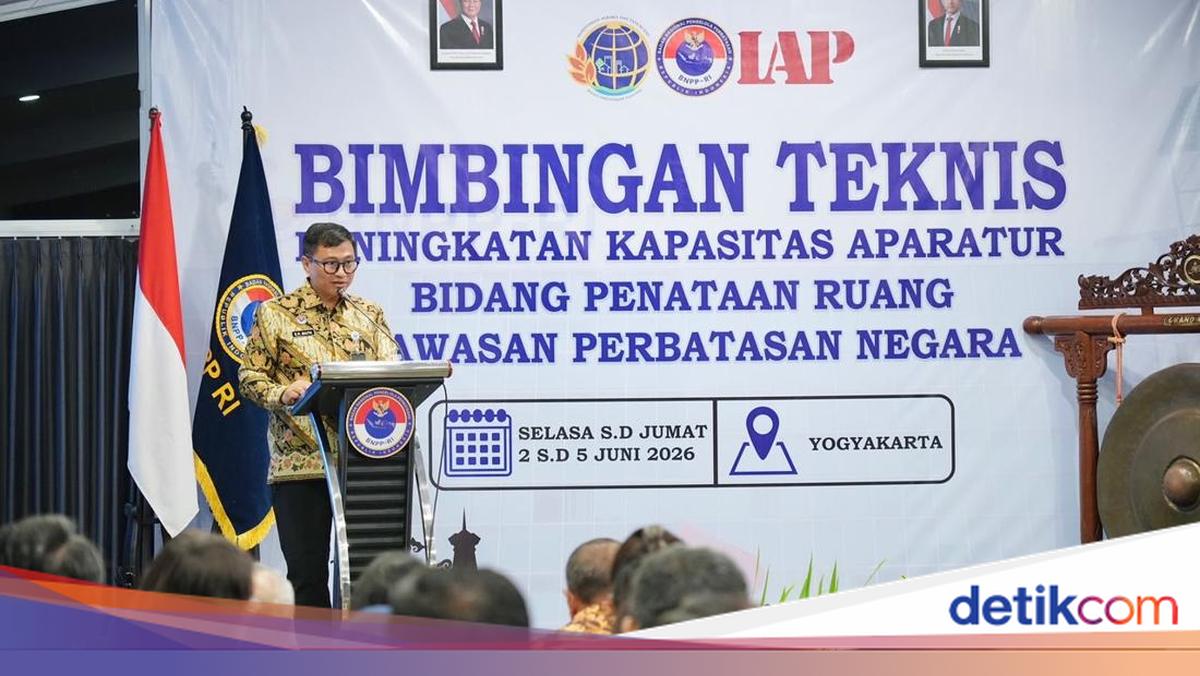
This initiative serves as a strategic step for the BNPP to strengthen the quality of human resources among central and regional apparatus to increase the effectiveness of spatial planning implementation in border areas.
Opening the event, the Deputy for Border Area Management of the Indonesian BNPP, Police Inspector General Edfrie R. Maith, emphasised that the technical guidance is designed as a continuous development effort to improve the quality of civil servants (ASN) handling border area spatial planning. According to Inspector General Edfress, the quality of spatial planning policies and their implementation is heavily determined by the capacity of the officials executing them in the field.
“Through this technical guidance, we are encouraging the improvement of quality and effectiveness in border area spatial planning, both those organised by the central government and local governments,” stated Inspector General Edfrie in a written statement on Wednesday (3/6/2026).
Inspector General Edfrie also encouraged participants from various regions to engage actively in discussions and absorb experiences from resource persons so that the learning outcomes can be implemented concretely.
Meanwhile, the Assistant Deputy for Border Area Spatial Planning, Ismawan Harijono, explained that the technical guidance is conducted using a blended learning method, combining online and classical learning. This method was chosen to ensure the capacity-building process is effective, adaptive, and reaches the needs of participants from various regions. Ismawan added that the activity includes structured learning modules, concluding with monitoring and evaluation as part of measuring the achievement of official capacity enhancement.
On the same occasion, the Chairperson of the Indonesian Planning Experts Association (IAP), Adriadi Dimastanto, stated that IAP, as a professional association for regional and urban planners, plays a vital role in preparing spatial documents such as Regional Spatial Plans (RTRW) and Detailed Spatial Plans (RDTR). Adriadi hoped this programme could broaden shared insights regarding a border area spatial planning approach that is outward-looking and competitive.
“IAP is honoured to be involved in this activity. We hope that collaboration with the Indonesian BNPP can continue, and IAP is ready to play an active role in the planning, utilisation, and control of spatial planning in the country’s border areas,” said Adriadi.
Furthermore, appreciation for the technical guidance was expressed by the Secretary of the Human Resources Development Agency (BPSDM) of the Ministry of Agraria and Spatial Planning/National Land Agency (ATR/BPN), Deni Prasetyo, representing the Head of BPSDM ATR/BPN. Deni assessed that the BNPP’s consistency in placing human resource development as an integral part of border area management is a crucial step.
According to Deni, spatial planning in border areas carries broader strategic consequences than in other regions, as it concerns national competitiveness and the state’s effectiveness in maintaining sovereignty. “Spatial planning in border areas is not merely a document, but a state instrument to manage territories and various simultaneous interests,” explained Deni.
Deni emphasised that the main challenge currently lies not only in regulations or planning documents but in the capacity of officials to translate these instruments into effective decisions on the ground. Therefore, this technical guidance is expected to serve as a space for sharing experiences, broadening perspectives, and strengthening cross-sector professional networks.
Through this programme, the BNPP reaffirms its efforts to continuously drive the strengthening of official capacity as the foundation for integrated, collaborative, and sustainable border area management. The improvement of human resource quality is believed to be reflected in decisions that are increasingly accurate, coordinated, and capable of safeguarding the nation’s strategic interests in the country’s border regions.