
BNPP RI Partners with Neighbouring Nations to Develop Border Regions
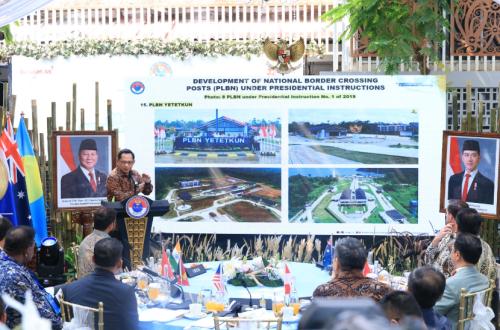
Border regions are not merely points for territorial security but also possess the potential to be developed as spaces for the economic and social activities of the community. The National Border Management Agency of the Republic of Indonesia (BNPP RI) is encouraging the development of these areas to become more productive through cooperation with neighbouring countries.
These efforts were discussed during the Indonesia Border Partnership Coffee Morning held at the BNPP RI Permanent Secretariat Office in Jakarta on Wednesday (16/09/2026). The forum, which brought together BNPP RI and representatives from several neighbouring nations, addressed border area development programmes and the enhancement of economic and social relations within these regions.
The forum was led by the Minister of Home Affairs, Muhammad Tito Karnavian, in his capacity as the Head of BNPP RI. Tito stated that border management extends beyond territorial security to include regional development and increasing benefits for the local population.
“Essentially, we are reviewing the functions and roles of BNting BNPP. I am introducing the agency in depth, as this body may not yet be widely known by our partners. I presented the functions, the role of this agency, and our future development programmes,” said Tito.
Indonesia shares borders with ten neighbouring countries. Three share land borders—Malaysia, Papua New Guinea, and Timor-Leste—while seven share maritime borders, namely Singapore, Australia, the Philippines, Vietnam, Thailand, India, and Palau.
This situation gives border development a cross-border dimension. Trade activities, population mobility, and social and cultural relations occur on both sides of the border, meaning regional development must consider relationships with neighbouring nations.
Tito noted that cooperation in border areas should be directed towards providing benefits for the communities of both countries. “We also discussed how to ensure that relations between Indonesia and neighbouring countries, especially in border regions, can continue to be developed together for the welfare of the people in both nations,” he said.
Opportunities for cooperation include trade, culture, and other fields related to the activities of border communities. According to Tito, these relationships can support regional development while strengthening economic benefits for people living in border areas.
“I am very pleased because all representatives of friendly nations welcomed and were willing to strengthen partnership relations, whether in trade, culture, or other fields, for the mutual prosperity of the people and the progress of countries in the border regions,” said Tito.
The Ambassador of Timor-Leste, Roberto Sarmento de Oliveira Soares, noted that the meeting opened opportunities to strengthen cooperation between Indonesia and Timor-Leste, including human resource development.
“This is an extraordinary opportunity that Minister Tito Karnavian has facilitated a warm, open, and very profound dialogue among neighbouring countries,” said Roberto.
Representing Australia, the Australian Border Force Adviser for Indonesia, Ian Kelly, mentioned that cooperation between the two nations can still be expanded to maintain regional stability and meet the needs of the community. This indicates that border management is closely linked to the economic and social interests of the region.
Developing border regions is vital because community activities do not always follow the administrative boundaries of a country. Trade, kinship, culture, and population mobility create unique dynamics that require governance capable of supporting productivity.
With this approach, border development is aimed not only at strengthening territorial security but also at creating more productive economic and social activities. The success of regional development will depend on inter-agency coordination within the country as well as cooperation with nations that share direct borders with Indonesia.