
BNPP and BRIN Discuss Adaptive Decentralisation Model for Border Region Management
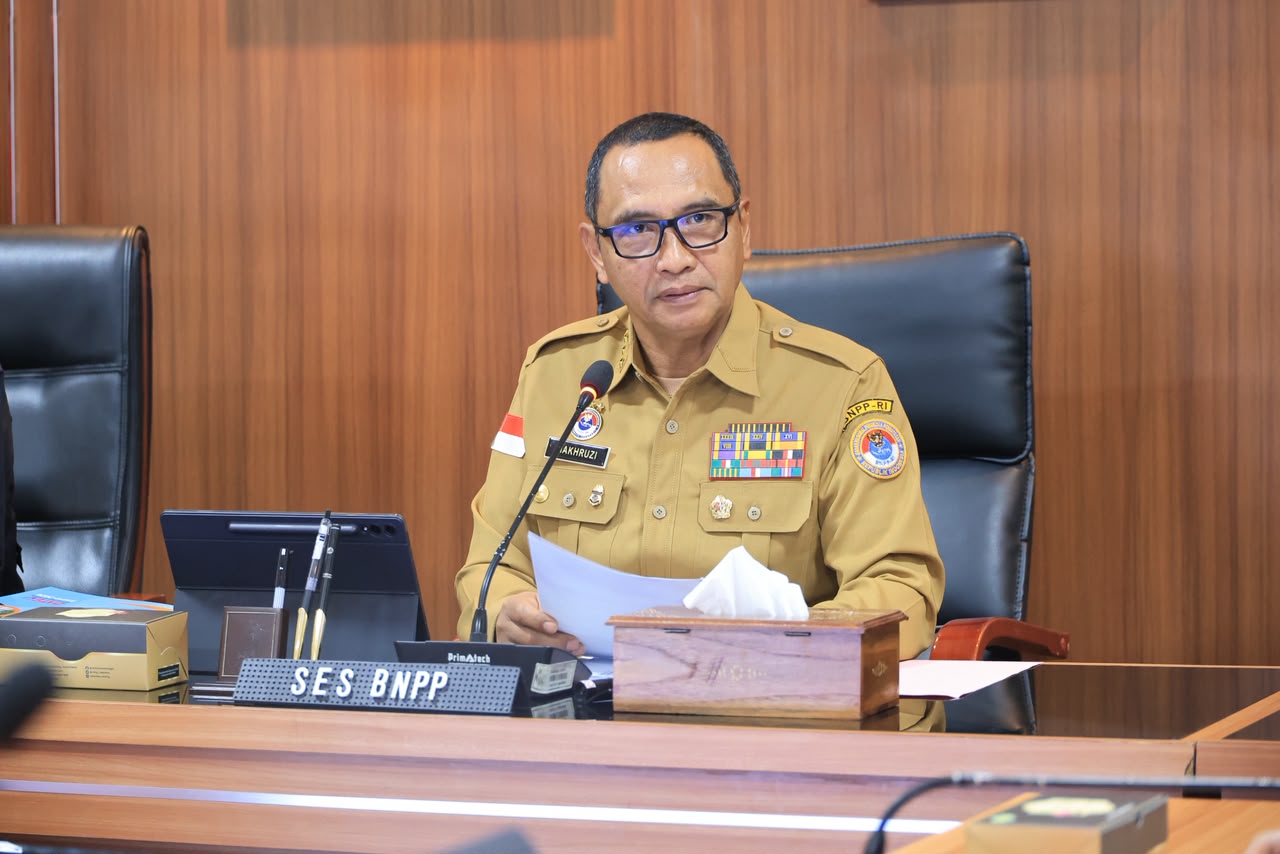
The National Border Management Agency (BNPP) of the Republic of Indonesia, together with the National Research and Innovation Agency (BRIN), has discussed the development of a decentralisation and regional autonomy model that is adaptive to the specific characteristics of border regions.
This forum served as a space to exchange views regarding the need for border governance that can be adjusted to the characteristics, potential, and challenges of each respective area. The audience, led by the Secretary of BNPP RI, Makhruability Rahman, took place at the BNPP RI Permanent Secretariat Meeting Room on Tuesday (8/9/2026).
Makhruzi stated that the management of border areas has two main dimensions: security and prosperity. He noted that the complexity of issues in border regions requires the involvement of various ministries and agencies, as well as synergy between the central and regional governments.
“Managing border areas cannot be handled by a single institution. It is the responsibility of cross-ministries/agencies as well as central and regional governments, so coordination is the key word in handling borders in Indonesia,” said Makhruzi.
During the audience, Makhruzi outlined the strategic direction for the management of National Border Areas and Border Regions (BWN-KP) for 2025–2029. This includes the management of national borders, cross-border activities, border area development, and institutional strengthening.
The scope of BWN-KP management covers 204 priority border sub-districts, 22 National Strategic Activity Centres (PKSN), and 26 National Border Posts (PLBN). Of these, 15 PLBNs have been built, three are yet to be constructed, and eight are included in the third phase of the development plan.
Additionally, there are 111 Outermost Small Islands (PPKT), with 2abilities 28 of which are under special attention, consisting of 11 uninhabited and 17 inhabited islands. These conditions demonstrate the diverse characteristics of the regions, which require policy approaches tailored to the needs and capacity of each area.
Makhruzi cited the handling of transportation in inhabited outermost islands as an example, which requires an integrated approach considering accessibility, logistical continuity, and territorial sovereignty. He noted that such diversity is a key consideration in formulating border management policies.
BRIN Senior Lead Researcher, Prof. Siti Zuhro, stated that the complexity of issues in border areas must be accompanied by a governance design capable of adjusting authority to regional characteristics. Such an approach is necessary because border regions possess different conditions, potentials, risks, and needs.
“Borders include land borders and sea borders. Their characteristics and uniqueness differ. Their potentials are also diverse,” said Siti.
Siti explained that BRIN is developing the concept of an ‘Adaptive Asymmetric Decentralisation Model for Border Governance’ as an approach that allows the distribution of authority to be carried out adaptively accordingity to the characteristics of border regions. This model encompasses policies, institutions, and governmental instruments tailored to the conditions and capacity of the regions.
The model consists of five main components: structural context, core governance model, adaptive-asymmetric decentralisation mechanism, differentiated border governance, and governance outcome.
These components cover aspects of geopolitics and security, socio-economic disparity, legal and institutional frameworks, distribution of authority, fiscal capacity, coordination, supervision, and the strengthening of governmental capacity.
“Border area management needs to emphasise adaptive authority distribution. We cannot continue with ‘business as usual’. We must utilise digital tools and train our human resources,” said Siti.
Through the ‘differentiated border governance’ approach, the characteristics of land and sea borders are placed within different management frameworks. Land borders place more emphasis on security, connectivity, and cross-border social relations, whereas sea borders focus on maritime sovereignty, the marine economy, and maritime area surveillance.
Siti also emphasised the importance of strengthening regional fiscal capacity, governability, coordination, guidance, and supervision. A multilevel governance approach is deemed necessary to ensure that the division of roles and the implementation of policies between the central and regional governments proceed effectively.
The audience also discussed several research agendas, including identifying border management issues from the perspective of decentralisation and regional autonomy, gathering stakeholder experiences, and testing the relevance of the Adaptive Asymmetric Decentralisation model against empirical field conditions.
The discussions between BNPP RI and BRIN are expected to provide a foundation for developing border governance that is more suitable for the characteristics of each region, while simultaneously supporting development efforts that address the needs of communities in border areas.