
BNPB Urges Integration of Disaster Risk Maps into Spatial Planning and Infrastructure Policies
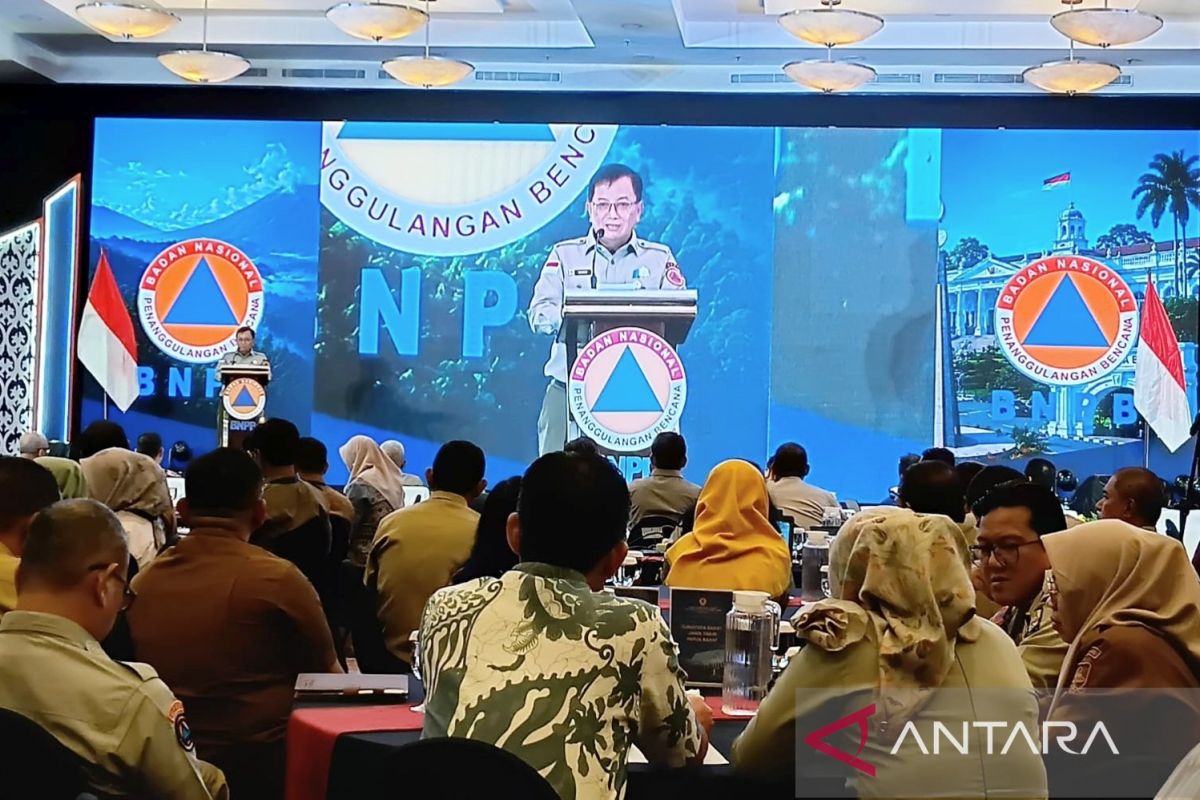
The National Disaster Management Agency (BNPB) has recommended that regional governments integrate disaster risk maps as a reference in formulating spatial planning and infrastructure development policies.
BNPB Principal Secretary Rustian in Bogor, West Java, on Tuesday said the measure is important to prevent development that creates new risks while increasing regional resilience in facing disasters.
“Integrating disaster risk maps into spatial planning and infrastructure development policies is an important step towards creating a more resilient Indonesian nation,” he said while opening the BNPB 2026 Technical Coordination Meeting (Rakortek) in Bogor, which runs from 10–13 August 2026.
According to Rustian, disaster management policies at the central and regional levels need to be aligned so that disaster risk reduction becomes part of development planning.
The technical coordination meeting, he said, serves as a strategic forum to synchronise policies while strengthening cross-sector coordination because disaster management requires the involvement of various parties.
“Disaster handling requires the involvement of many factors and elements so that it can be integrated fully and aligned with the direction of national development,” he said.
Rustian explained that resilience-based development requires multidisciplinary collaboration involving government, academics, the business community, the public, and the media.
Such collaboration is needed to pool resources, strengthen preparedness literacy, and accelerate response when disasters occur.
With integrated cooperation, he said, disaster management is expected not only to be oriented towards crisis handling but to develop into a culture of disaster risk reduction in community life.
The BNPB 2026 Technical Coordination Meeting was attended by 120 participants from 37 provinces. Participants comprised 41 representatives of provincial development planning, research, and innovation agencies (Bapperida), 32 provincial disaster management agencies (BPBD), and 37 representatives of other components.
The activity aims to strengthen coordination and programme synchronisation between BNPB, BPBD, and stakeholders based on the capacity of each region.
Assistant for Government and People’s Welfare of the Bogor City Regional Secretariat Eko Prabowo said each region has different risk characteristics, geographical conditions, resources, institutions, and fiscal capacity.
Therefore, he said, disaster management policies must be adaptive and tailored to the needs of each area.
“Disaster management is not only the government’s responsibility when a disaster occurs, but is a shared responsibility that requires planning, capacity building, coordination, and continuous collaboration,” he said.
He expressed hope that Bogor City’s Disaster Resilience Index (IKB) achievement, which ranks third in West Java, can inspire other regions in strengthening disaster management policies and programmes.