
BNPB Reveals 96.07 Hectares of Land Still Burning Across Six Provinces
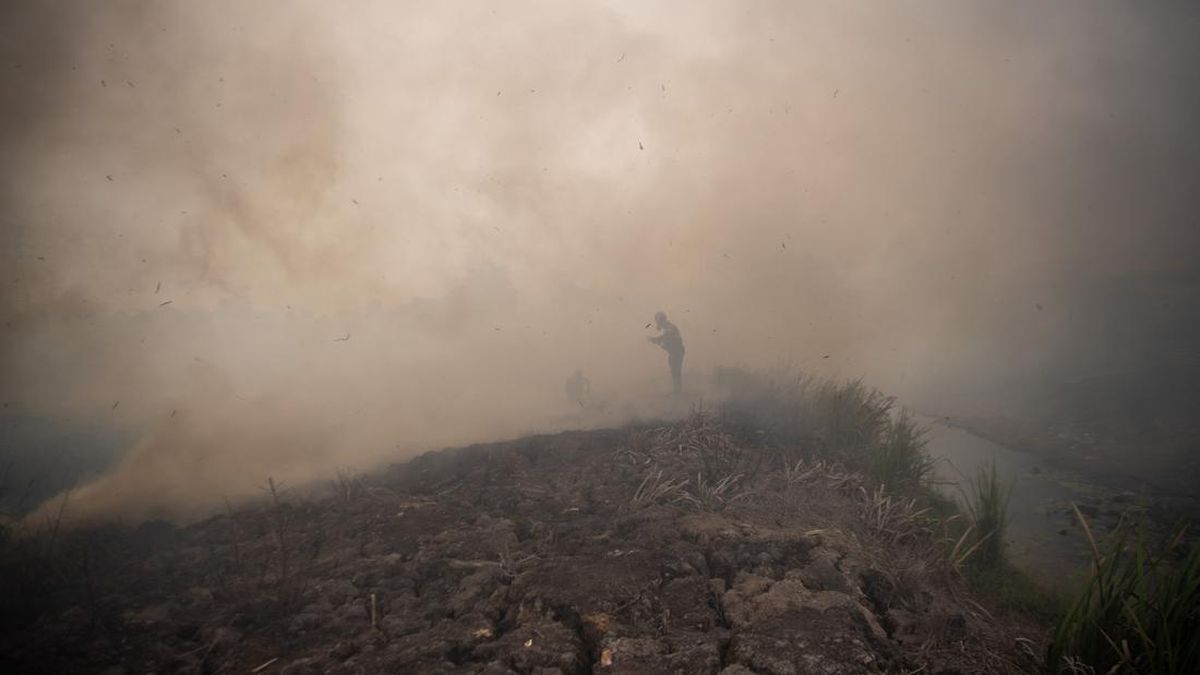
The National Disaster Management Agency (BNPB) has reported that the total area of land affected by forest and land fires (karhutla) across six provinces has reached 527.6 hectares. This figure is based on monitoring as of 28 September. Of this total, 431.53 hectares have been successfully extinguished, while the remainder remains active.
“431.53 hectares have been successfully extinguished through ground operations covering 369.03 hectares and aerial operations covering 6lar 62.5 hectares. Meanwhile, the area of land that remains unextinguished is recorded at 96.07 hectares,” said the Acting Head of the BNPB Disaster Data, Information, and Communication Centre, Berton SP Panjaitan, in a written statement released on Wednesday (30/9).
Berton noted that compared to data from 27 September, the remaining unextinguished land has decreased by 62.29 hectares from the previous 158.36 hectares. The largest decrease was recorded in Central Kalimantan by 46.70 hectares, followed by South Kalimantan by 17.74 hectares, Jambi by 1.50 hectares, and West Kalimantan by 1 hectare. However, an increase in unextinguished land was observed in South Sumatra by 4.15 hectares and Riau by 0.5 hectares.
Berton stated that fire management continues through the deployment of ground task force personnel supported by various firefighting equipment. This includes fire pumps, floating and portable pumps, hoses, water tankers, operational vehicles, heavy equipment, personal protective equipment, drones, GPS, and communication tools.
For ground operations, personnel have been deployed across six priority provinces with varying strengths. Riau has deployed 14,837 personnel, South Kalimantan 7,927, South Sumatra 11,026, Central Kalimantan 4,686, Jambi 5,984, and West Kalimantan 14,575.
“These forces support efforts for direct firefighting, fire spot containment, wetting, and land cooling, particularly in peatland areas which have the potential to harbour underground embers,” said Berton.
In addition to ground operations, the BNPB is also optimising aerial support through patrols, Weather Modification Operations (OMC), and water bombing. The aerial fleet includes 56 units, consisting of 13 patrol/OMC units and 43 water bombing units.
On the other hand, Berton revealed that fire management in Kalimantan faces several obstacles, including fires in peatlands, limited access and water sources, strong winds, and haze that reduces visibility and limits aerial patrols and water bombing execution.
To address this, teams are continuing firefighting, containment, wetting, and peat cooling, placing portable water tanks, optimising pumps and alternative water sources, and utilising thermal drones and water injection or surfactants to detect and extinguish underground fires. “Water bombing operations are prioritised once visibility conditions meet safe flight standards,” Berton added.
Meanwhile, in the Sumatra region, management challenges include dry and peatland conditions, limited water sources, difficulty reaching the fire front, changing wind directions, and the readiness of some water bombing fleets.
Berton stated that efforts include the construction of reservoirs and water catchment canals, the creation of fire breaks, opening access to fire spots, and ongoing firefighting and cooling. Additionally, the BNPB is optimising and repositioning water bombing fleets to operate based on priority scales.
However, Berton noted that the implementation of Weather Modification Operations (OMC) also faces challenges, such as uneven potential cloud growth and low water vapour content in some areas. Consequently, monitoring cloud growth is being conducted continuously alongside the Meteorology, Climatology, and Geophysics Agency (BMKG).
Furthermore, Berton noted that the haze caused by the fires has impacted air quality, reduced visibility, increased health risks, and necessitated adjustments to educational activities in several regions.
“Management efforts include regular monitoring of air quality and visibility, distribution of masks to the public, increased readiness of health services, and the implementation of situational distance learning according to the conditions of each region,” he said.
Moreover, Berton mentioned that the BNPB, together with ministries, agencies, local governments, the TNI (National Armed Forces), Polri (National Police), and related parties, continues to strengthen coordination in fire management by optimising both ground and air resources.
“This synergy is directed towards accelerating firefighting, preventing the spread of fires, and minimising the impact of smoke on health and community activities,” he concluded.