
BNPB Emphasises Science-Based Collaboration to Prevent Disasters from Becoming Humanitarian Tragedies
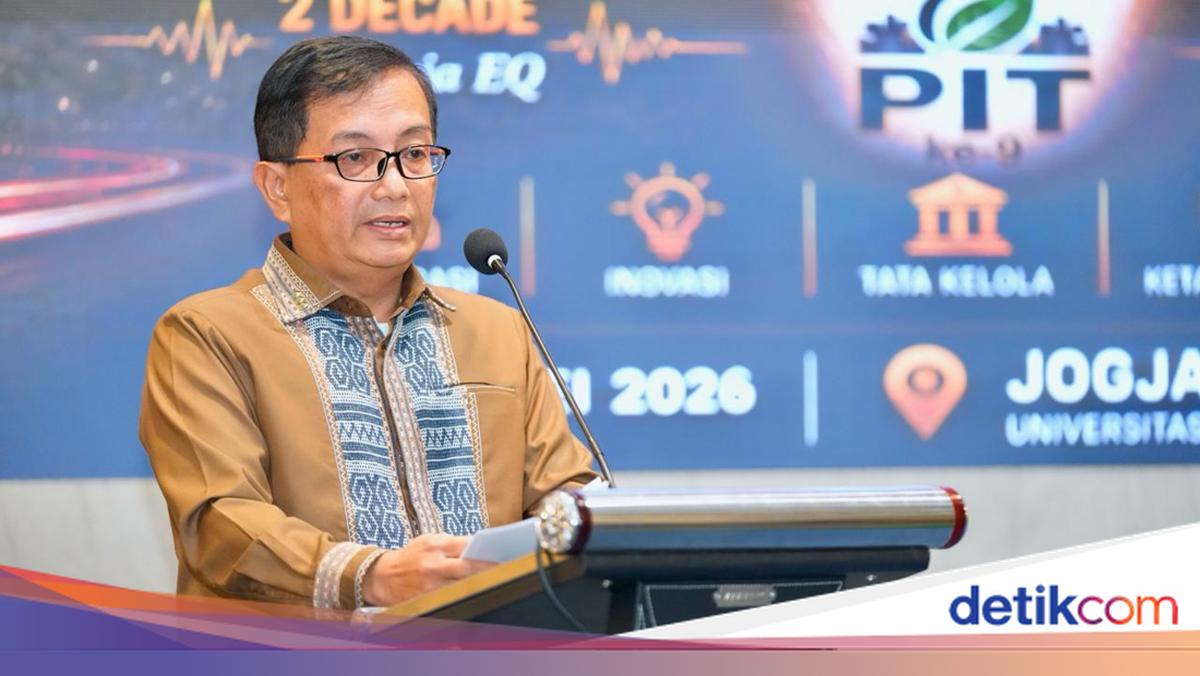
The National Disaster Management Agency (BNPB) has emphasised the importance of collaboration and science-based policies as preventive measures to ensure that disasters do not turn into humanitarian tragedies.
This was stated by BNPB’s Chief Secretary, Rustian, before academics, researchers, and disaster practitioners at the 9th Annual Scientific Meeting (PIT) of the Indonesian Disaster Experts Association (IABI) at Universitas Muhammadiyah Yogyakarta (UMY) on Wednesday (6/5/2026).
“We cannot prevent disaster events. But we can prevent their impacts and escalation into large-scale humanitarian tragedies. This can only be achieved through strong risk governance, solid collaboration, and shared commitment based on scientific knowledge,” Rustian explained in a written statement received by detikJogja today.
Furthermore, Rustian addressed the gap between the quality of national-level disaster management policies and their implementation at the local level.
“We still face implementation gaps between good national policies and practices at the local level,” he stated.
He identified three root problems causing the policy quality gap: early warning systems that are not yet fully end-to-end, suboptimal integration of cross-sectoral risk data, and weak local capacities for tactical and operational emergency responses. He noted that these conditions lead to the fragility of local government basic services precisely when disasters occur.
The floods and landslides that struck Aceh, North Sumatra, and West Sumatra in November 2025, Rustian continued, serve as the most recent evidence of these issues. Rustian described the events as a reminder that Indonesia’s disaster risks are now systemic and multidimensional, resulting from interactions between hazards increasingly worsened by climate change impacts.
“Readiness in coordination at the central level does not automatically enhance tactical and operational readiness at the local level,” he asserted.
Rustian outlined five elements of governance that need immediate strengthening. These include being inclusive by involving all societal layers, including vulnerable groups; collaborative across institutions and disciplines; and based on scientific knowledge as the foundation for decision-making.
Additionally, adaptive to climate change and oriented towards reducing systemic risks that break the chain of basic service failures. He stressed the urgent need to develop multi-hazard early warning systems.
Yogyakarta Sultan HB X Reveals Ancestral Javanese Early Warning System
At the event, the Governor of the Special Region of Yogyakarta (DIY), Sri Sultan Hamengku Buwono X, revealed an early warning system possessed by Javanese society before the advent of seismographs. The Sultan stated that this early warning draws from philosophy and practices of observing nature passed down across generations, with ‘Eling lan Waspodo’ at the core of this ecological knowledge system.
‘Eling’ is awareness of humanity’s position in its relation to nature, where humans are not rulers of the earth but part of it. ‘Waspada’ is vigilance born from long collective experience in reading natural signs.
The Sultan also reminded attendees not to focus solely on data screens and risk graphs but to utilise the knowledge of ‘Titen’. ‘Titen’ is the practice of observing, marking, and remembering patterns of natural behaviour consistently from generation to generation.
“The knowledge of ‘Titen’ is the most communal early warning system that has ever existed,” stated the Sultan, as read by Agustinus.
The Sultan reinforced this by referencing several academic sources. He quoted Fikret Berkes, who in his work Sacred Ecology describes such knowledge as Traditional Ecological Knowledge, recognised by the Intergovernmental Panel on Climate Change (IPCC) and UNESCO as a valid complement to modern science in disaster management and climate change.
The Sultan offered criticism of disaster governance approaches that have relied on technical foundations. Referencing Nobel laureate in Economics Elinor Ostrom, who demonstrated that local communities can manage risks more sustainably than centralised systems, the Sultan asserted that truly resilient governance must be rooted in collective memory and local wisdom.
“Truly resilient governance is that which is rooted in the collective memory of society and the local wisdom of the place where we stand,” he emphasised.
At the forum, the Sultan received a Lifetime Dedication Award from IABI for his long contributions to disaster management in Indonesia. The award was accepted by GKR Hayu on behalf of the Sultan.
GKR Hayu described disasters as one of two issues that have always received special attention from the Sultan, alongside cultural matters.
GKR Hayu exemplified how the Sultan, as a regional head during the 2006 DIY earthquake, took command, coordinated aid, and continued contributing experience to subsequent disaster events.
“Thank you; today his contributions are recognised by IABI with this award,” GKR Hayu concluded.
UMY Highlights University’s Role in Disaster Mitigation
UMY also highlighted the role of campuses in disaster mitigation. UMY encouraged universities to bridge science and on-the-ground policies.
This was conveyed by UMY’s Vice Rector for Quality, Reputation, and Partnerships, Slamet Riyadi, at the opening of the 9th Annual Scientific Meeting (PIT) of the Indonesian Disaster Experts Association (IABI) on the UMY campus on Wednesday (6/5).
“We hope to build closer collaboration among stakeholders and produce policy recommendations that are not only conceptual but also implementable and have real impacts on enhancing the resilience of Indonesian society,” Slamet said in a written statement received by detikJogja today.
According to Slamet, universities