
BNI Reports 24.4% Credit Growth, Net Profit Reaches Rp10.8 Trillion in First Half of 2026
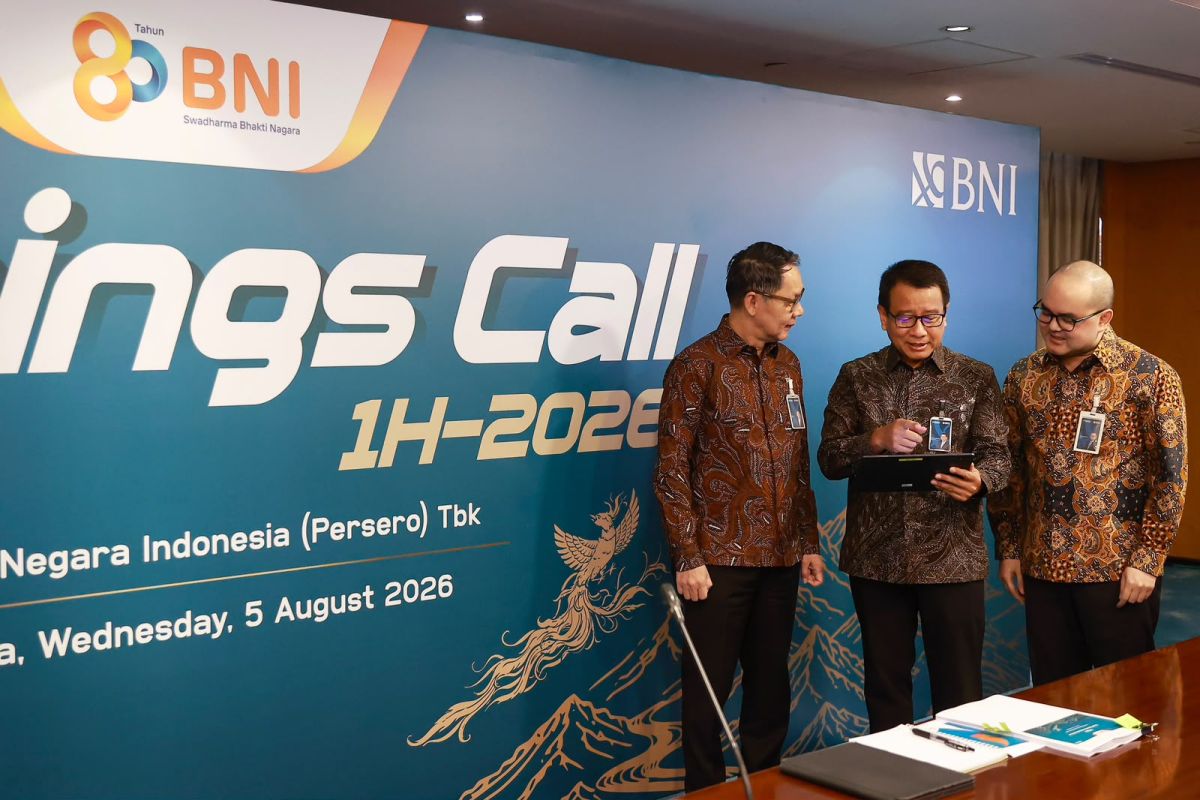
PT Bank Negara Indonesia (Persero) Tbk (BNI) recorded credit growth of 24.4 per cent year on year (yoy) to Rp968.5 trillion, which also contributed to the company’s profit growth to Rp10.8 trillion in the first half of 2026.
BNI President Director Putrama Wahju Setyawan said the company continues to strengthen its business fundamentals through a quality-oriented growth strategy, reinforcement of core business, and sustained organisational and digital transformation.
“Amid an increasingly dynamic business environment, BNI is directing its resources towards sectors and ecosystems with healthy growth prospects. This approach allows the company to maintain asset productivity whilst enhancing the relevance of our services for customers in every segment,” said Putrama in a statement in Jakarta on Wednesday.
He explained that this business development direction aligns with the state-owned enterprise transformation agenda under the coordination of Danantara Indonesia, which emphasises strengthening company fundamentals, implementing professional governance, and creating value on a sustainable basis.
With credit growth of 24.4 per cent, BNI kept its non-performing loan (NPL) ratio at 1.9 per cent.
Furthermore, BNI Finance and Strategy Director Hussein Paolo Kartadjoemena explained that the credit growth was supported by an increasingly diversified portfolio across various economic sectors and business segments, ranging from corporations and medium-sized enterprises to micro, small and medium enterprises (MSMEs) and consumers.
“The increase in revenue comes not only from credit expansion, but also from transaction growth, cash management solutions, digital services, and other commission-based activities. This diversification of income sources is important to maintain BNI’s profitability resilience under various economic cycle conditions,” said Paolo.
According to him, credit expansion is carried out selectively, taking into account industry prospects and the risk profile of each debtor in order to maintain a balance between business growth and portfolio quality.
He said this intermediation strategy runs in tandem with strengthening the funding structure. Amid tight liquidity competition, low-cost funds, or current account savings accounts (CASA), grew 11.2 per cent annually, keeping the CASA ratio at 65.4 per cent.
The strengthening of the funding structure also drove cost of funds efficiency, reflected in the decline in the cost of third-party funds to 2.56 per cent, compared with 2.78 per cent in the same period the previous year.
As of the first half of 2026, BNI’s net interest income (NII) grew 14.2 per cent annually to Rp22.3 trillion, whilst fee-based income (FBI) rose 14.2 per cent to Rp9 trillion.
The growth of both revenue sources drove pre-provision operating profit (PPOP) to Rp18.5 trillion, the highest in BNI’s history for a first-half period. The company’s net profit was recorded at Rp10.8 trillion.
On the digital front, the number of users of the digital banking application wondr by BNI reached 15.1 million by the end of June 2026, with transaction volume growing 110 per cent year on year.
Meanwhile, in the wholesale segment, BNIdirect users reached 280,000, with transaction volume rising 17 per cent annually to Rp6,039 trillion.
The company has implemented the Branch, Region and Area Value Empowerment (BRAVE) programme across all operational areas to strengthen the function of branch offices as sales centres, improve network productivity, and optimise business potential in each region.
In terms of asset quality, the loan at risk (LAR) ratio improved from 11 per cent to 8.1 per cent, whilst the NPL ratio remained at 1.9 per cent.
BNI Risk Management Director David Pirzada said this asset quality is the result of disciplined and consistent risk management, from the determination of priority sectors and debtor feasibility analysis to post-disbursement monitoring.
“Risk management is carried out from the stage of determining priority sectors, debtor feasibility analysis, through to post-disbursement monitoring. BNI also continues to strengthen its early warning system so that any change in risk profile can be identified and addressed more quickly,” said David.