
BMKG Warns East Nusa Tenggara to Stay Vigilant as Coastal Residents Urged to Learn Self-Evacuation
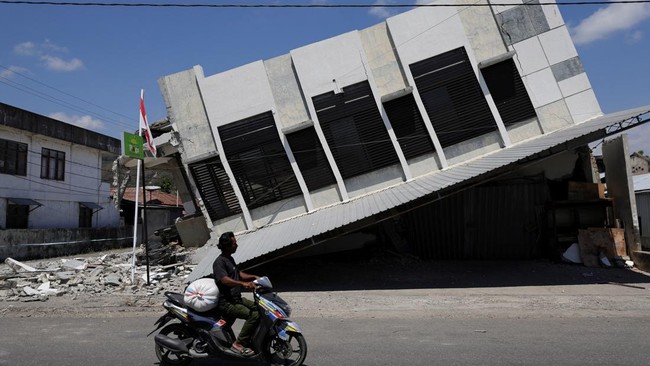
Jakarta, CNBC Indonesia — The Meteorology, Climatology, and Geophysics Agency (BMKG) has reminded residents of East Nusa Tenggara (NTT) to remain vigilant given the characteristics of the region, even though seismic activity following the earthquake and tsunami of 15 August 2026 has decreased significantly.
BMKG recorded 15,722 aftershocks during the 30 days following the main M7.7 tremor, ranging in magnitude from M0.9 to M6.2. According to BMKG’s Acting Deputy for Geophysics, Ardhasena Sopaheluwakan, 190 of these were felt by the public.
Aftershocks are predicted to continue during this significant decay phase. BMKG has urged the public to remain alert and calm, and to continue monitoring official information as the rehabilitation and reconstruction process in affected areas gets under way.
“Based on the results of monitoring and analysis of the latest earthquake data, the frequency of daily and weekly aftershocks shows a declining pattern and has entered a decay phase,” said Ardhasena in BMKG’s official statement on the Flores M7.7 post-earthquake update, Tuesday (15/9/2026).
On the weekly aftershock graph, he added, the decay pattern is clearly visible, with the frequency of earthquakes decreasing week by week.
“Week one recorded 5,011 events, week two 4,267, week three 3,158, week four 2,421, and week five has so far recorded 864,” he explained.
BMKG reminds of high seismic potential in NTT
Meanwhile, BMKG’s Director of Earthquakes and Tsunamis, Wijayanto, explained that aftershocks are generally divided into several groups. First, earthquakes of M5.0 or above (26 events, or 0.2 per cent) were felt quite widely and had the potential to affect vulnerable buildings.
“Earthquakes in this category are becoming increasingly rare and have not been recorded in the past week,” said Wijayanto.
Second, earthquakes measuring M4.0 to less than M5.0 totalled 476 events, or 3.0 per cent. According to Wijayanto, earthquakes in this category can still be felt across a fairly wide area but have little potential to cause significant damage.
“Their frequency has continued to decline after entering the fourth to fifth week following the main earthquake,” he said.
Third, Wijayanto continued, earthquakes measuring M3.0 to less than M4.0 numbered 3,308 events, or 20.9 per cent. Earthquakes in this category are generally felt locally and do not cause damage.
“Activity is expected to continue for the next six to seven weeks with a steadily decaying frequency,” he said.
The fourth group, earthquakes of less than M3.0, dominated aftershock activity with 11,993 events, or 75.9 per cent.
“Most of these earthquakes were only detected by the seismograph network and were not felt by the public. Activity in this category is expected to continue for several more months,” he said.
Wijayanto stressed that these estimates represent statistical decay trends.
“They are not precise predictions of when earthquake activity will end, nor forecasts of the timing of the next earthquake,” he said.
“The public is urged to remain wary of the characteristics of the NTT region, which does indeed have a high level of seismicity,” said Wijayanto.
He added that after the main earthquake on 15 August 2026 at 04:58:24 WIB, BMKG issued a tsunami early warning just 2 minutes and 16 seconds after the main tremor struck.
The earthquake’s epicentre was located approximately 30 km north-east of Nagekeo, NTT, at a depth of 15 km. The shallow earthquake was triggered by activity on the Flores Back-Arc Thrust with a thrust fault mechanism.
Tsunami risk on the Flores Back-Arc Thrust
The Head of BMKG’s Centre for the Standardisation of Meteorological, Climatological and Geophysical Instrumentation, Rahmat Triyono, also reminded the public that tsunami arrival times can be extremely fast, particularly in the Flores Back-Arc Thrust region.
“This needs attention because BMKG’s early warnings may be issued at the very moment tsunami waves are already reaching land,” he said.
“The best early warning is public awareness of tsunami potential. It is therefore essential to build awareness among communities on NTT’s northern coast to carry out independent evacuation,” Rahmat stressed.
As a result of the M7.7 earthquake, BMKG, through 16 tsunami gauge stations in NTT, West Nusa Tenggara (NTB) and South Sulawesi, recorded tsunami wave rises at several points, including Pota (1.60 metres), Reo (1.61 metres), Bulukumba (0.54 metres), Selayar (0.40 metres) and Sape (0.56 metres).
Tsunami survey results showed tsunami traces along the northern coast of Flores. BMKG recorded the highest tsunami run-up at 2.68 metres in Selama Village, followed by Tadho Tengah at 2.42 metres, Tompong Hamlet at 2.39 metres, and Nangadero at 2.24 metres. The furthest inundation reach was 145 metres at Nampar Sepang, 136 metres at Selama Village, and 60 metres at Tadho.
BMKG also noted that the tsunami struck a number of areas and damaged 23 houses, including two homes swept away by the tsunami in Selama Village. The tsunami also struck residents’ houses in Nampar Hamlet, Tadho Village and Nangadero Village.
BMKG revealed that despite the damage, there were no fatalities from the tsunami because residents evacuated immediately after receiving the Tsunami Early Warning.
Casualties of the NTT M7.7 earthquake
According to the official website of the National Disaster Management Agency (BNPB), the M7.7 earthquake killed 142 people: 48 from the direct impact of the earthquake, and 94 from indirect impacts. A further 1,603 people were injured or fell ill, and 46,461 residents were forced to evacuate.
The earthquake also damaged 103,427 houses.
Source: jawawa.id (https://jawawa.id/newsitem/bmkg-warns-east-nusa-tenggara-to-stay-vigilant-as-coastal-residents-urged-to-learn-self-evacuation-1789473234)
Originally published by CNBC Indonesia (https://www.cnbcindonesia.com/news/20260915163517-4-768146/bmkg-ingatkan-ntt-waspada-warga-pesisir-diminta-belajar-evakuasi), translated from Indonesian