
BMKG Warns Bogor is Disaster-Prone, Notes Rising Trend in Seismic Activity
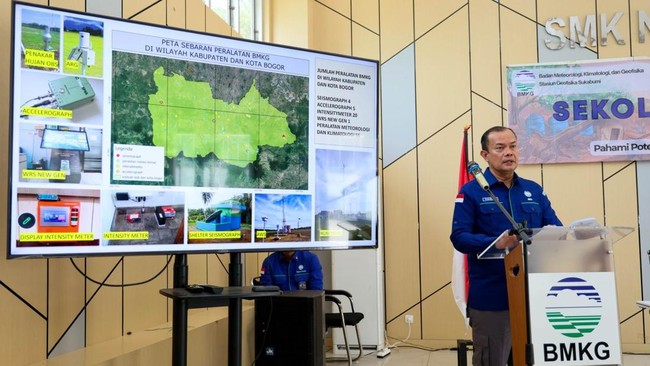
The Meteorology, Climatology and Geophysics Agency (BMKG) has recorded an upward trend in earthquake activity in the Bogor area and its surroundings. The public and all stakeholders are therefore urged to remain on alert and improve their disaster literacy.
At the same time, said BMKG Head Teuku Faisal Fathani, the agency is focusing on continuously strengthening community preparedness against the threat of earthquakes through its Earthquake Field School (SLG) programme. Most recently, an SLG was held at SMKN 1 Leuwiliang in Bogor Regency on Wednesday (29/7/2026).
Faisal said the SLG forms part of efforts to improve public understanding of earthquake potential, encourage the use of disaster information to reduce disaster risk, and serve as a learning platform for communities to recognise earthquake hazards in their area, understand correct self-rescue measures, and build a culture of disaster preparedness from an early stage.
These efforts are expected to support disaster risk reduction and strengthen community resilience in facing the threat of earthquakes.
Moreover, he added, Bogor and its surroundings are an area with a high level of vulnerability to disasters, both earthquakes and landslides.
“Bogor Regency is one of the areas with a fairly high level of earthquake vulnerability because it lies near an active land fault. Based on BMKG data for 2025, 99 earthquakes were recorded in the Bogor area and its surroundings, ten of which were felt by residents,” Faisal said in a statement on the BMKG’s official website, quoted on Thursday (30/7/2026).
“Between 2009 and 2025, we have also seen a rising trend in seismic activity in this area. This shows that the threat of earthquakes is a real phenomenon that requires our collective attention,” he added.
He also recounted the history of earthquakes that have struck the Bogor area, where destructive earthquakes have previously occurred.
One of these was the earthquake of 1834, estimated at around magnitude 7.0, which caused extensive damage, including to the Bogor Palace. In addition, a magnitude 4.8 earthquake struck on 9 September 2012, centred near Cianten, south of Leuwiliang. Although it was a shallow and relatively small earthquake, he said, the event damaged around 560 houses and left three residents with minor injuries.
“That experience is a reminder that preparedness must be continuously built so that we do not repeat the same events in the future,” he said.
For that reason, he continued, BMKG continues to strengthen its monitoring systems in the Bogor area to support disaster mitigation efforts. According to Faisal, 29 main geophysical instruments have been installed to monitor earthquake activity and shaking levels, supported by 56 meteorological and climatological instruments to provide weather and climate information as part of an integrated disaster service.
However, Faisal insisted, technology alone is not enough to reduce disaster risk without communities that understand how to save themselves during an earthquake.
“The Earthquake Field School is BMKG’s way of ensuring that regional governments, regional disaster management agencies (BPBD), and communities in earthquake-prone areas are increasingly aware and ready to respond to potential hazards as well as official early warning information from BMKG. This aligns with the global initiatives ‘Early Warning, Early Action’ and ‘Early Warnings for All’,” he explained.
“This activity not only provides an understanding of earthquakes, but also builds a culture of disaster preparedness within communities and the school environment. I invite all participants to take part in this activity earnestly, engage in active discussion, and use the knowledge gained as a foundation to strengthen resilience in their own communities,” Faisal said.
By 2026, the BMKG Sukabumi Class III Geophysics Station has held four Earthquake Field Schools: in Cibinong and Parung (Bogor Regency) in 2025, Bekasi City in June 2026, and again in Leuwiliang (Bogor Regency) in July 2026.
“This is proof that Bogor Regency remains one of BMKG’s priority areas in strengthening the capacity of regional governments and communities to face the threat of earthquakes,” Faisal said.
On the same occasion, Member of the House of Representatives (DPR RI) Commission V Marlyn Maisarah commended the high level of public participation in Bogor Regency in the activity. She stressed that disaster preparedness is a shared responsibility requiring the active involvement of all elements of society.
“Bogor Regency is prone to natural disasters such as earthquakes and landslides. We cannot turn a blind eye to that. This potential demands preparedness that is not only reactive but also proactive and sustainable,” she asserted.
She expressed hope that the Earthquake Field School programme would not only be held in schools but also expanded to government offices, public institutions, and community groups, so that more people understand self-rescue procedures during an earthquake.
Source: jawawa.id (https://jawawa.id/newsitem/bmkg-warns-bogor-is-disaster-prone-notes-rising-trend-in-seismic-activity-1785408804)
Originally published by CNBC Indonesia (https://www.cnbcindonesia.com/news/20260730163709-4-755167/bmkg-ingatkan-bogor-rawan-bencana-ada-tren-peningkatan-kejadian-gempa), translated from Indonesian