
BMKG warns all of Central Java to be on alert for meteorological drought
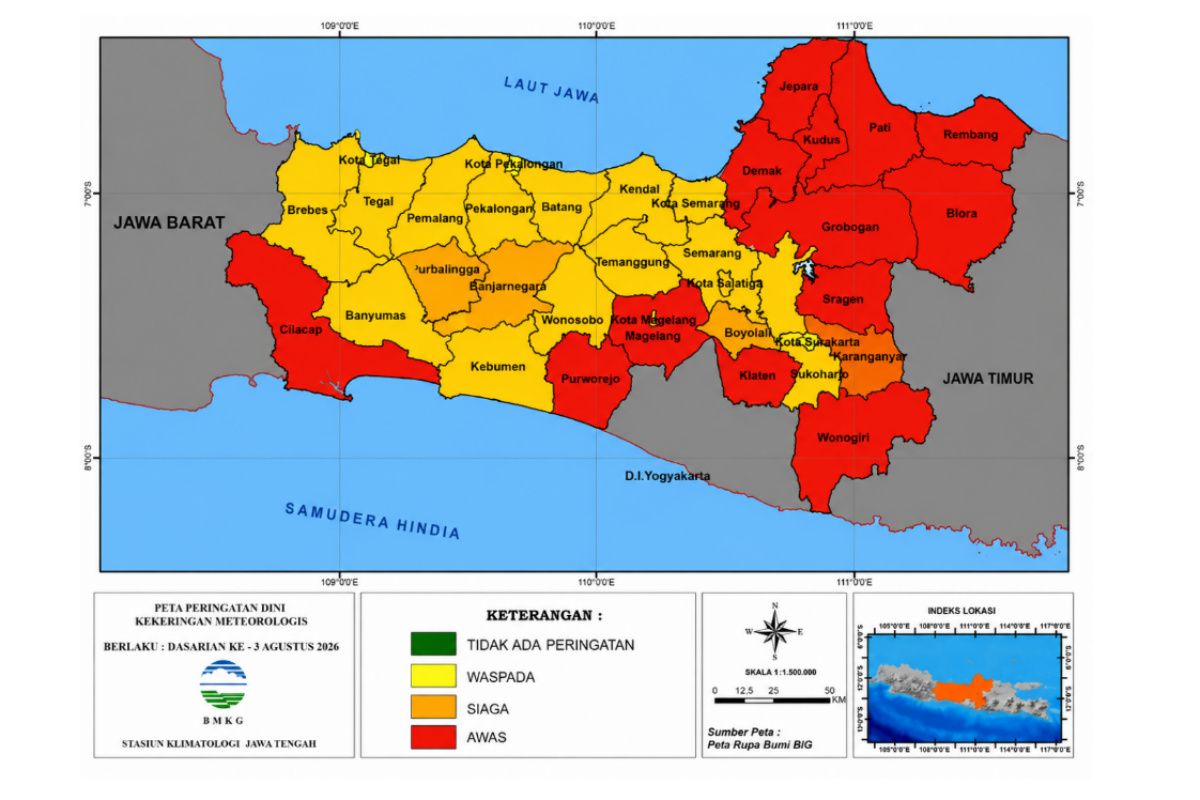
The Meteorology, Climatology and Geophysics Agency (BMKG) Central Java Climatology Station has reminded all regions of Central Java to be on alert for potential meteorological drought with low rainfall in the third ten-day period of August 2026.
Head of the BMKG Central Java Climatology Station Goeroeh Tjiptanto, when contacted from Cilacap on Sunday, said that based on data updated as of 17 August, the probability of rainfall in the low category of below 50 millimetres per ten-day period across all of Central Java is more than 90 percent.
“Meanwhile, based on the meteorological drought early warning map for the period 21-31 August 2026, the warning status is divided into Awas, Siaga, and Waspada,” he said.
He said the Awas status covers Demak, Kudus, Grobogan, Jepara, Pati, Rembang, Blora, Sragen, Karanganyar, Purworejo, Klaten, Magelang, Cilacap, and Wonogiri.
The Siaga status covers Brebes, Tegal, Pemalang, Pekalongan, Batang, Kendal, Banyumas, Purbalingga, Banjarnegara, Wonosobo, Kebumen, Temanggung, Semarang, Boyolali, Sukoharjo, Semarang City, Salatiga City, and Magelang City.
Meanwhile, the Waspada status is assigned to Tegal City, Pekalongan City, and Surakarta City.
“Waspada status is an early warning when rain has not fallen for at least 21 days. The public is urged to conserve water use and limit consumption for non-urgent needs,” Goeroeh said.
He said Siaga status indicates that rain has not fallen for at least 31 days, so water sources such as shallow wells, rivers, and small reservoirs are beginning to shrink.
According to him, these conditions can also affect the agricultural sector and require stricter irrigation management.
“The Awas status is the most critical condition when rain has not fallen for at least 61 consecutive days. The soil becomes very dry, water sources are at risk of drying up, and drought can threaten the basic needs of the community,” he said.
He said all of these statuses are accompanied by a rainfall forecast of less than 20 millimetres per ten-day period with a probability of more than 70 percent.
Under Awas status, he said, local governments and relevant agencies need to anticipate a clean water crisis through regular water distribution.
“The public is also asked to prioritise water for drinking and cooking,” he said.
He said drought also increases the threat of crop failure on rain-fed agricultural land. Therefore, farmers are advised to consider more drought-resistant crops and not to force commodities that require large amounts of water.
In addition, the risk of fire increases due to the abundance of dry material, so the public is asked not to clear land by burning and not to discard cigarette butts carelessly.
Drought conditions can also increase the risk of dehydration, diarrhoea, skin diseases, and respiratory tract disorders due to limited clean water and exposure to dust.
“BMKG predicts that all regions of Central Java will remain in the low rainfall criteria of 0-50 millimetres per ten-day period until the end of September 2026, with early September mapped as the driest phase,” Goeroeh said.