
BMKG Says Indonesia Remains Critical: Sumatra to Papua in the Red, El Nino Very Strong
Jakarta, CNBC Indonesia — The Meteorology, Climatology and Geophysics Agency (BMKG) has revealed that September 2026 is a critical phase for forest and land fires (karhutla) in Indonesia. BMKG has urged all parties to remain vigilant against the still-dominant dry weather, the influence of El Nino, and the high number of hotspots.
Separately, the Ministry of Forestry (Kemenhut) disclosed that the number of hotspots with high confidence nationally saw a significant decline on Monday (7/9/2026). Data from the ministry’s SiPongi monitoring system detected 386 high-confidence hotspots, down 288 points from 674 on 6 September 2026.
In the six priority provinces, the decline was most evident in Central Kalimantan and West Kalimantan, while South Sumatra is currently the region with the highest number of high-confidence hotspots, prompting intensified operations.
However, the ministry stressed that a hotspot is an indication of a surface temperature anomaly detected by satellite and does not necessarily indicate a single fire incident. One fire event can be detected as several hotspots. Therefore, all indications must still be verified through ground checks and monitoring of actual conditions in the field.
“There are three main factors that require our collective attention: the still-dominant dry conditions, the high potential for forest and land fires especially in Sumatra and Kalimantan, and the beginning of smoke spread detected in a number of regions. For this reason, September remains a critical phase that demands collective preparedness,” said BMKG head Teuku Faisal Fathani, quoted on Tuesday (8/9/2026).
Beyond the rise in hotspots, BMKG has also detected smoke spread in parts of Sumatra and Kalimantan with the potential to affect air quality. Faisal warned that monitoring of fine particulate matter (PM2.5) concentrations shows increases in several locations affected by fire activity. In addition, the Sentinel-5P satellite has detected increased carbon monoxide emissions over Sumatra and Kalimantan, with plumes tracked as far as Sarawak, Malaysia.
“This situation warrants attention because it directly relates to air quality and public health. Therefore, fire sources must be controlled as early as possible,” he said.
Meanwhile, BMKG predicts that El Nino will persist until early 2027. According to the Analysis of Atmospheric Dynamics for the Third Ten Days of August 2026, released by BMKG on 2 September 2026, the ENSO index (three-month average) for JJA (June-July-August) stands at 2.2, indicating an El Nino of very strong intensity.
BMKG has also issued an early warning for meteorological drought for the first ten days of December 2026. The highest “Awas” (beware) status applies to several regencies in parts of southern Sumatra, most of Java and Nusa Tenggara, most of Kalimantan, and parts of Sulawesi and the Maluku Islands.
Faisal reminded of the El Nino effect taking hold while Indonesia is in the dry season.
“Its impact is visible in the increasing number of days without rain in various regions,” he said.
“Until early September, most of Indonesia remains in the dry season, while the rain that has occurred is generally localised and has not yet been able to improve drought conditions evenly,” he added.
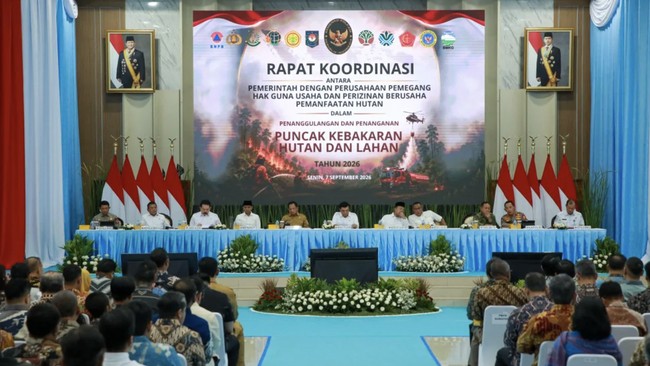
He made the remarks at a Coordination Meeting between the Government and Concession-Holding Companies on Preventing and Handling the Peak of Forest and Land Fires in 2026, held at Graha Marinir Panti Perwira, the Office of the Coordinating Ministry for Political and Legal Affairs in Jakarta, on Monday (7/9/2026). The meeting was chaired by Coordinating Minister for Political and Legal Affairs Djamari Chaniago.
Faisal detailed BMKG analysis showing that the potential for rain cloud formation between 6 and 13 September remains relatively low across most of Indonesia, especially in Java, Bali, Nusa Tenggara, southern Sumatra, and parts of Sulawesi and South Papua.
He said this indicates that the opportunity for natural rainfall to help extinguish fires remains limited.
He also reminded that a number of regions require particular attention, including South Sumatra, Riau, Jambi, West Kalimantan, Central Kalimantan, South Kalimantan and East Kalimantan.
According to the Fine Fuel Moisture Code release, which maps the flammability of the top layer of the ground surface for 9 September 2026, BMKG analysis shows that almost all of Indonesia, from Sumatra to Java, falls into the easily and highly easily flammable categories.
However, several locations are classified as Safe or Moderate in terms of the flammability of the surface layer.
Faisal further said BMKG is conducting Weather Modification Operations (OMC) together with BNPB, ministries and agencies, regional governments, state-owned enterprises and other relevant parties as one of the efforts to handle forest and land fires.
“OMC is not only used for fire mitigation, but also supports water resource management and national food security. Operations are carried out adaptively based on atmospheric conditions and the needs of each region,” Faisal affirmed.
“BMKG stands ready to continue providing information support, early warnings and OMC services based on the latest atmospheric conditions. We hope this information can strengthen coordination and mitigation measures across ministries, agencies, regional governments, the business community and society,” he said.
Meanwhile, Coordinating Minister for Political and Legal Affairs Djamari Chaniago emphasised that tackling forest and land fires is a shared responsibility that must be carried out consistently by all parties.
“Efforts to prevent and handle forest and land fires are not only an institutional responsibility, but also a moral, professional and legal responsibility that must be upheld by all parties,” he stressed.
He also warned that Indonesia still faces the impact of El Nino, which could prolong dry conditions in a number of regions, so all mitigation measures must be carried out in a measured way, using BMKG information and analysis as the basis for decision-making.
Source: jawawa.id (https://jawawa.id/newsitem/bmkg-says-indonesia-remains-critical-sumatra-to-papua-in-the-red-el-nino-very-strong-1788850273)
Originally published by CNBC Indonesia (https://www.cnbcindonesia.com/news/20260908114832-4-766120/bmkg-sebut-ri-masih-kritis-sumatra-papua-memerah-el-nino-sangat-kuat), translated from Indonesian