
BMKG Raises Strong El Niño Probability, First Planting Season Predicted to Be Delayed
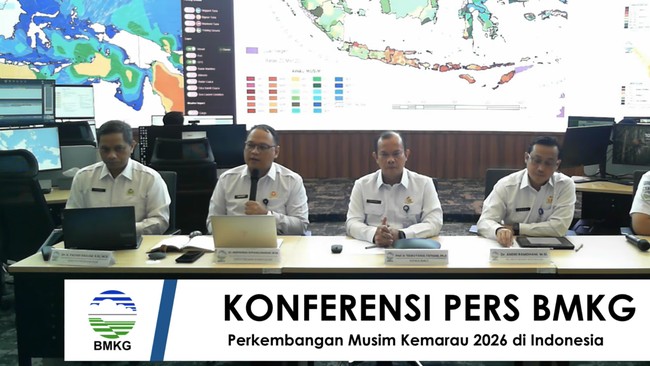
The Meteorology, Climatology, and Geophysics Agency (BMKG) predicts that the 2026 Dry Season will trigger a delay in the first planting season. Nevertheless, BMKG stressed that farmers can still exploit opportunities during this prolonged dry season.
BMKG Deputy for Climatology Ardhasena Sopaheluwakan explained that monitoring results on the season’s progression at the end of May 2026 showed that out of 699 Seasonal Zones (ZOM) in Indonesia, 200 Seasonal Zones, or 11.83 percent of the country’s land area, are currently experiencing the Dry Season.
From the monitoring results of the El Niño phase in Indonesia by BMKG in the Pacific Ocean until the end of May 2026, Ardhasena explained that the sea surface temperature anomaly value in the Pacific was +1.0. Meanwhile, sea surface temperature monitoring in the Indian Ocean showed an IOD Index of -0.56.
‘The sea surface temperature anomaly in the central and eastern Pacific Ocean has passed the neutral threshold for 5 periods of ten days. BMKG predicts that the El Niño phenomenon will soon become active and will persist until early 2027,’ Ardhasena said during a press conference on the Development of the 2026 Dry Season in Indonesia, broadcast on the BMKG Youtube channel on Wednesday (10/6/2026).
‘With the probability of El Niño intensity reaching the Moderate category currently at 98 percent. And the probability of reaching the Strong category currently at 62 percent,’ he continued. This figure has increased, as the previous probability of a strong El Niño was less than 20 percent.
Furthermore, Ardhasena added, in the Indian Ocean there is a chance of a Positive Indian Ocean Dipole (IOD) phenomenon occurring in the period from June to November 2026.
‘The El Niño phenomenon, as we know, causes climate deviations in various parts of the world, not just in Indonesia, with different patterns and impacts,’ he stated.
‘For the Indonesian region, it is affected by El Niño suppressing rainfall. So conditions are generally drier from June 2026 to January 2027. However, it should be noted that around October 2026 we will already be entering the Rainy Season. So, this is just a general picture of El Niño’s impact,’ Ardhasena explained.
Continuing the prediction from March 2026, he said, the 2026 Dry Season in Indonesia will be drier, or Below Normal. According to Ardhasena, this condition could occur across most of Indonesia’s land area, specifically in 482 ZOM or 56.18 percent of the country’s territory.
‘These areas include most of Sumatra, all of Java, most of Kalimantan, Bali, West Nusa Tenggara, most of East Nusa Tenggara, most of Sulawesi, North Maluku, Maluku, and parts of Papua Island,’ he elaborated.
‘We predict the duration of this 2026 Dry Season to be longer, so it remains consistent with the information we conveyed last March,’ he explained. He detailed that 437 ZOM, or 48.77 percent of Indonesia’s land area, is predicted to experience a longer Dry Season. Meanwhile, 70 ZOM, or 8.32 percent of Indonesia’s territory, will experience a 2026 Dry Season equal to normal, and 79 ZOM, or 9.23 percent of Indonesia’s territory, is predicted to experience a 2026 Dry Season shorter than normal.
Regarding the impact on Indonesian agriculture and BMKG’s recommendations, Ardhasena said that in facing this Dry Season, BMKG urges the optimisation of technical irrigation in regions where irrigation exists, as well as adjusting to agricultural commodities that are adaptive to dry conditions, such as horticultural crops suited to arid conditions.
‘Facing this long Dry Season means that the first planting season could be delayed,’ said Ardhasena. ‘However, during this dry period, farmers can also adapt by planting horticultural crops that are also suitable during this dry period. So there are still many things that can be done to face this dry season.’