
BMKG Predicts Active El Niño from Mid-2026 to Early 2027
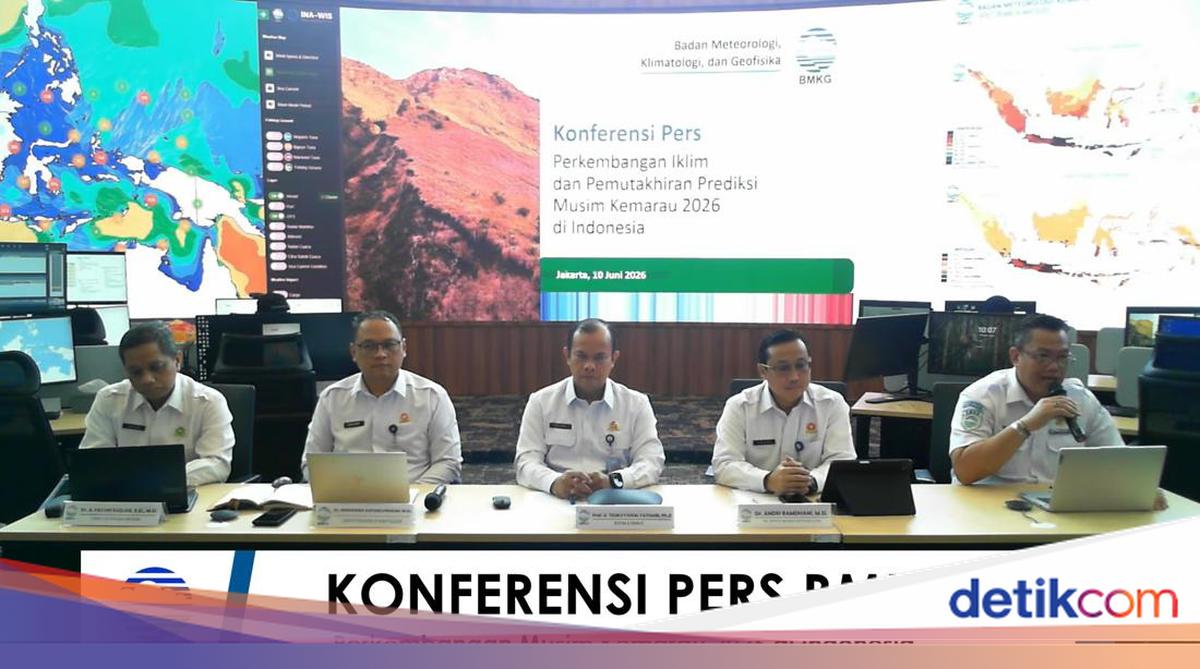
The Meteorology, Climatology, and Geophysics Agency (BMKG) predicts the El Niño phenomenon will soon become active from mid-2026 until early 2027. BMKG has requested that relevant stakeholders immediately begin anticipating and mitigating the impacts of El Niño, which can suppress rainfall.
“The El Niño prediction is for it to occur starting mid-2026, with a 98% probability of reaching moderate intensity and a 62% probability of strong intensity,” said BMKG Head Teuku Faisal Fathani during a press conference on Wednesday (10/6/2026).
BMKG asked the government to promptly anticipate and mitigate the impacts of El Niño, which could affect rainfall suppression. “The preparation of this updated information is intended as a reference to support risk planning and mitigation across various sectors, including food, water resources, energy, the environment, forestry, disaster management, and fisheries,” he said.
He noted that this information from BMKG could be utilised to optimise various opportunities arising during the dry season, such as increased horticultural commodity productivity, enhanced potential for salt production due to supportive climatic conditions, and increased fish catches in several waters affected by upwelling phenomena.
BMKG Deputy for Climatology Ardhasena Sopaheluwakan stated that monitoring in the Pacific Ocean as of the end of May 2026 showed a positive sea surface temperature anomaly of +1.0, while monitoring in the Indian Ocean indicated an IOD index of -0.56. BMKG recorded that the sea surface temperature anomaly in the central and eastern Pacific Ocean has exceeded the neutral threshold for five dasarian (10-day periods). Consequently, BMKG predicts the El Niño phenomenon will become active soon.
“BMKG predicts that the El Niño phenomenon will soon be active and persist until early 2027, with the likelihood of El Niño intensity reaching the moderate category currently at 98% and the strong category at 62%,” Ardhasena said.
Meanwhile, in the Indian Ocean, a positive IOD phenomenon is possible during the period from July to November 2026. Ardhasena explained that the El Niño phenomenon does not only cause climate deviations in Indonesia but also in various parts of the world, with different impact patterns and periods.
“For the Indonesian region, which is shown in brown on the map, we are affected by suppressed rainfall, so conditions are drier generally from June to January. However, it should be noted that around the end of October, we will already be entering the rainy season, so this is a general picture of how El Niño characteristics influence the world’s climate,” he said.
Furthermore, BMKG also updated its prediction for the 2026 dry season, which is overshadowed by El Niño conditions. BMKG stated that in the near future, several Indonesian regions will enter the dry season. “BMKG has updated its dry season prediction; in the coming months, more regions of Indonesia will enter the dry season,” he said.
Regions predicted to enter the dry season in June, or in the immediate future, total 198 seasonal zones, covering 31.6% of Indonesia’s land area. The details include most of Sumatra, West Kalimantan, most of Banten, the southern part of DKI Jakarta, the central and western parts of Central Java, a small part of East Java, the southern part of West Kalimantan, most of Central Kalimantan, the central part of South Kalimantan, parts of East Kalimantan, parts of Sulawesi, parts of Maluku, parts of West Papua, and eastern Papua.
In July, BMKG estimates that 66 seasonal zones, covering 7.26% of Indonesia’s land area, are predicted to enter the dry season. These include the western part of Jambi, East Kalimantan, the eastern part of South Kalimantan, most of Sulawesi, and parts of Maluku.
“Compared to the long-term climatological average, the onset of the 2026 dry season has the same trend as stated in the press release from March 2026, which is a tendency to be earlier in 308 seasonal zones, covering 39.77% of Indonesia’s land area,” he said. “Meanwhile, those that are normal are 165 seasonal zones, covering 17.03% of Indonesia’s land area, and regions that are delayed total 113 seasonal zones, covering 9.52% of Indonesia’s land area,” he added.