
BMKG Predicts 2026 Dry Season Potentially Less Severe Than 1997 El Niño
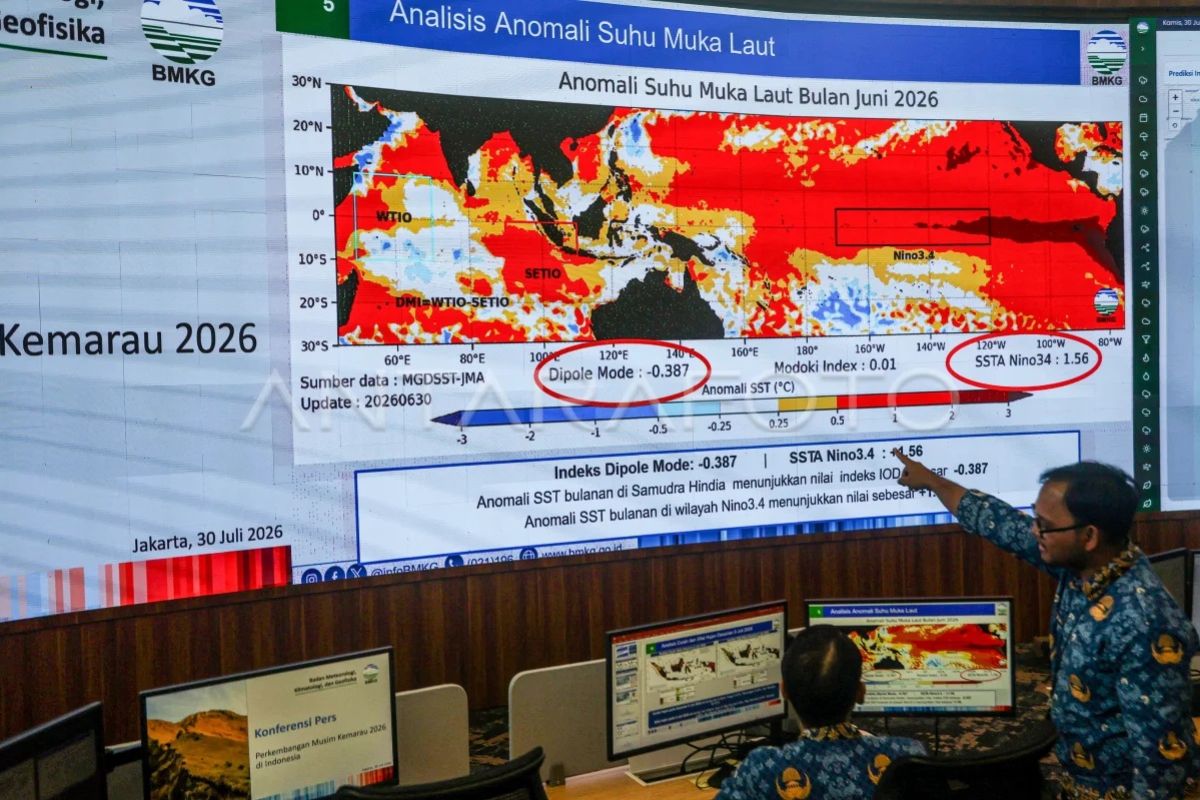
The Meteorology, Climatology, and Geophysics Agency (BMKG) estimates that the 2026 dry season is potentially not as dry as during the 1997 El Nino, even though the current El Nino has entered the strong category.
Speaking at a National Dialogue organised by the Ministry of National Development Planning (PPN)/National Development Planning Agency (Bappenas) in Jakarta on Tuesday, BMKG’s Acting Deputy for Climatology and Director of Climate Change Fachri Radjab said that, based on a comparative analysis of monthly rainfall probabilities, the 2026 dry season is generally expected to be no drier than the 1997 El Nino period.
Nevertheless, BMKG has noted that several regions such as Kalimantan, Papua, and Java could experience drier conditions in September–November 2026 compared with 1997.
He explained that in August 2026, dry conditions showed no higher probability of being drier than in 1997. However, from September to November 2026, a number of regions have a fairly high probability of being drier, including most of Kalimantan and Papua with chances reaching 80–90 per cent, several areas in Java in October, and several other areas in November.
BMKG predicts the peak of the 2026 dry season will occur between August and September. Around 54 per cent of Indonesia’s territory is expected to experience the peak of the dry season in August, whilst other regions will experience it in September.
In addition to comparing with the 1997 El Nino, BMKG is also examining the characteristics of the 2026 El Nino against several previous events.
Fachri said that, based on a comparison with three El Nino events over the past 15 years — in 2015, 2019, and 2023 — the 2026 dry conditions are expected to more closely resemble the 2023 El Nino pattern.
Fachri stated that although the 2026 dry season is expected to be less severe than the 1997 El Nino, the government still needs to remain vigilant about knock-on effects, one of which is the increased risk of forest and land fires (karhutla).
According to him, as land conditions become increasingly dry, the potential for hotspots to emerge also rises.
Based on BMKG monitoring up to 2 August 2026, approximately 5,690 hotspots have been recorded spread across several regions of Indonesia.
“We also need to anticipate this, considering that in August and September we will enter the peak of the dry season. This means the potential for hotspots will also increase further,” said Fachri.
BMKG previously stated that the 2026 El Nino has entered the strong category and still has the potential to intensify into a very strong event.
The impact of the phenomenon is mainly felt in areas south of the equator, such as East Nusa Tenggara, West Nusa Tenggara, Bali, Java, southern Sumatra, and southern Papua.
To anticipate the impact of El Nino, BMKG continues to strengthen mitigation measures, one of which is through weather modification operations (OMC) to maintain water availability and reduce the risk of drought.
The weather modification operations are being carried out in cooperation with relevant ministries and agencies to channel additional water supplies to a number of reservoirs that serve raw water needs, agriculture, and hydroelectric power plants (PLTA).
Source: jawawa.id (https://jawawa.id/newsitem/bmkg-predicts-2026-dry-season-potentially-less-severe-than-1997-el-nino-1785833845)
Originally published by Antara (Indonesian) (https://www.antaranews.com/berita/5679211/bmkg-prediksi-kemarau-2026-berpotensi-tidak-sekering-saat-el-nino-1997), translated from Indonesian