
BMKG: Jabodetabek to be pilot project for impact-based weather warnings
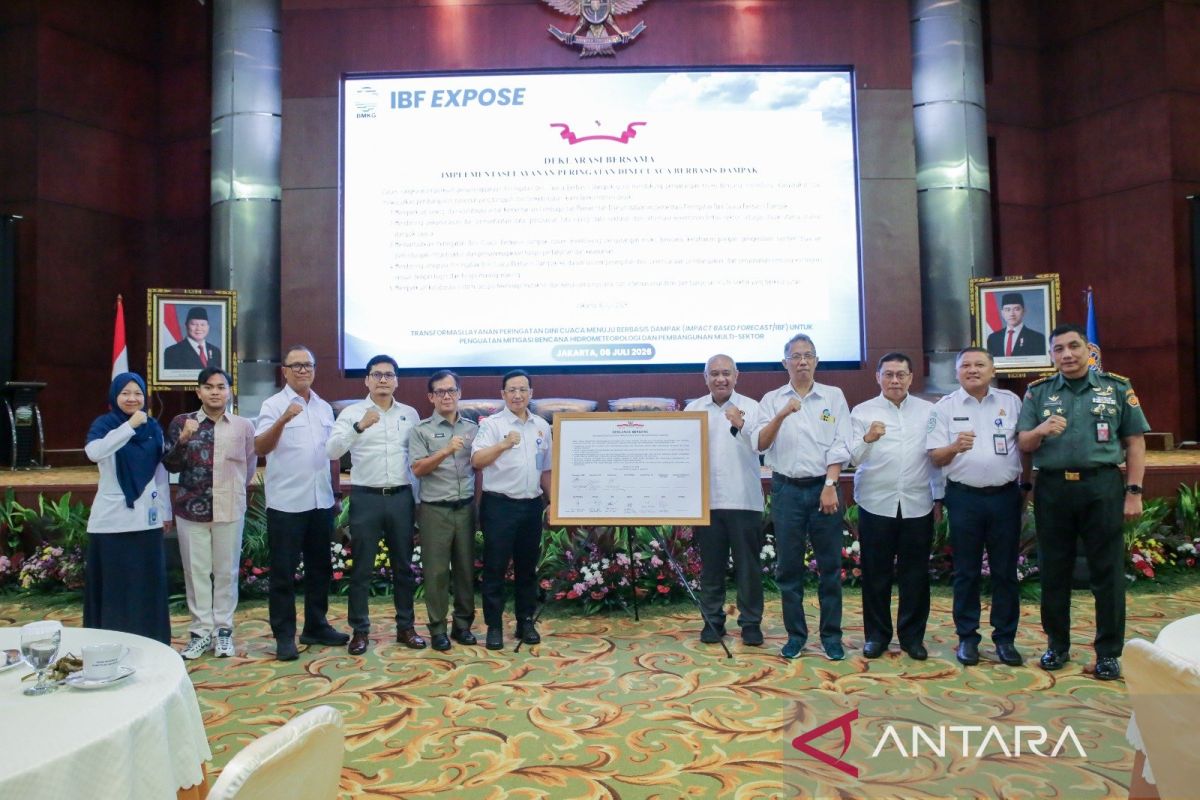
The Meteorology, Climatology and Geophysics Agency (BMKG) has revealed that the Greater Jakarta area (Jabodetabek) will be the pilot project for the implementation of an impact-based forecast (IBF) early warning system. Speaking at the IBF Expose 2026 event in Jakarta on Tuesday, BMKG Head Teuku Faisal Fathani stated that the launch of this pilot project in the metropolitan region marks a significant momentum in transforming the national weather information system.
‘The organisation of the 2026 IBF Expose aims, among other things, to obtain technical input for refining the methodology of quantifying potential weather impacts as part of the preparation for the IBF pilot project in the Jabodetabek area and its surroundings,’ he said. Faisal explained that this transformation through the IBF approach is necessary because global climate change has demonstrably increased the frequency and intensity of extreme weather events. Through this new system, early warnings issued by BMKG will no longer merely convey potential weather hazards but will also detail the potential risks that communities may face.
He further explained that strengthening the implementation of IBF has been a government focus since late 2025, particularly following the Senyar Cyclone, which exacerbated the impacts of flash floods and landslides in Aceh, West Sumatra, and North Sumatra. ‘During the Plenary Cabinet Meeting following the Senyar Cyclone on 15 December 2025, BMKG proposed the importance of developing an impact-based early warning system as part of efforts to strengthen national resilience in facing hydrometeorological disasters,’ he revealed. The development of IBF also aligns with the global initiative from the World Meteorological Organization through the Early Warnings for All programme, which promotes strengthening integrated early warning systems oriented towards public protection.
However, Faisal noted that the successful implementation of IBF requires close collaboration between BMKG, ministries and agencies, local governments, academics, the business sector, and the community. ‘Disaster risk management must be carried out in an integrated manner without sectoral barriers. There is one principle we cannot abandon regarding disasters: disaster is everybody’s business. BMKG cannot work alone,’ he added. Meanwhile, Acting Deputy for Meteorology at BMKG, Andri Ramdhani, explained that the essence of the IBF system is integrating weather information with sectoral vulnerability data and local conditions. ‘The early warning system is no longer sufficient if it only answers what the weather will be like, but it must be able to answer what impacts might be caused and what actions need to be taken,’ he said. To support the reliability of this pilot project in Jabodetabek, BMKG has officially established close collaboration with the Geospatial Information Agency regarding the utilisation of precise regional mapping data. Furthermore, infrastructure readiness is being strengthened through the utilisation of High Performance Computing supercomputer technology capacity and the operation of more than 10,800 main equipment units across Indonesia. ‘Through this approach, weather information is integrated with exposure data, vulnerability, regional capacity, local conditions, and other sectoral information. Thus, the resulting warnings become more relevant, contextual, and can be directly used by decision-makers to carry out rapid and measured mitigation oriented towards real action,’ he asserted.