
BMKG Issues New Warning, Deep Red Spots Emerge Across Java
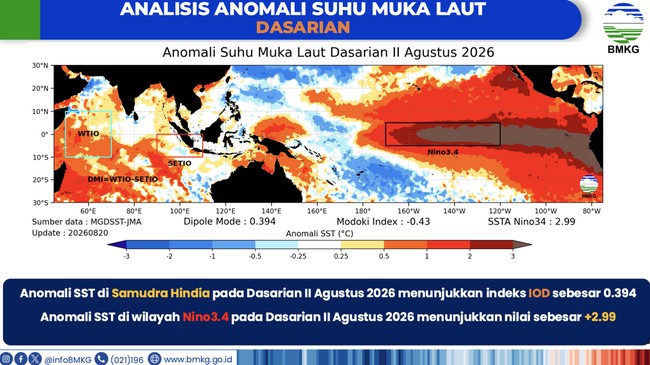
The Meteorology, Climatology and Geophysics Agency (BMKG) has released its latest Atmospheric Dynamics Analysis for the second dasarian of August 2026. In the analysis released on Monday (24/8/2026), BMKG confirmed that a very strong El Niño is currently occurring. This is indicated by the Sea Surface Temperature Anomaly (SSTA) value in the Nino3.4 region, which reached +2.99 on a dasarian basis (monthly ENSO), up from +2.20 in July. At the same time, the Indian Ocean Dipole (IOD) index, which measures sea surface temperature phenomena in the Indian Ocean, stood at +0.394, up from +0.242 in July. BMKG predicts that El Niño will persist until early 2027, and the positive IOD phase will last at least until October 2026.
According to BMKG’s official website, the combination of El Niño and a positive IOD will cause the dry season to become drier, with low to very low rainfall. These conditions will trigger drought, disrupt the availability of clean water sources, disturb agriculture, and increase the risk of forest and land fires. Consequently, BMKG has issued an early warning for meteorological drought, effective for the third dasarian of August 2026. The warning categories are as follows: ‘Waspada’ (Alert) for several areas in central and northern Kalimantan, small parts of Sulawesi and Maluku, and southern Papua; ‘Siaga’ (Standby) for several areas in southern Sumatra, western and central Java, most of Kalimantan, parts of northern and southern Sulawesi, most of the Maluku islands, and southern Papua; and ‘Awas’ (Warning) for most of Java and Nusa Tenggara, as well as small parts of South Kalimantan and Maluku.
BMKG noted that as of the second dasarian of August 2026, 79.9% or 559 Seasonal Zones (ZOM) in Indonesia are already experiencing the dry season. The affected regions include parts of Aceh, North Sumatra, most of Riau, parts of the Riau Islands, Bengkulu, Jambi, South Sumatra, the Bangka Belitung Islands, Lampung, Banten, DKI Jakarta, West Java, Central Java, DI Yogyakarta, East Java, Bali, NTB, NTT, West Kalimantan, most of East Kalimantan, Central Kalimantan, South Kalimantan, North Kalimantan, Gorontalo, North Sulawesi, Central Sulawesi, West Sulawesi, most of South Sulawesi, most of Southeast Sulawesi, North Maluku, Maluku, Southwest Papua, West Papua, Papua, Highland Papua, and South Papua.
Regarding rainfall predictions, BMKG recorded that 90.29% of rainfall analysis in Indonesia falls into the low rainfall category, with 88.91% being below normal. For the third dasarian of August 2026, BMKG warned that rainfall in parts of Sumatra, Java, Bali, NTB, NTT, most of Kalimantan, Sulawesi, North Maluku, Maluku, and Papua will be in the low category, less than 50 mm per dasarian.
BMKG also revealed that as of the second dasarian of August 2026, some areas in Indonesia are experiencing extremely long periods without rain, exceeding 61 consecutive days. ‘Indonesian regions are currently experiencing days without rain ranging from very short to extremely long categories. The longest dry spell of 110 days occurred at the Pajangan Agricultural Extension Centre (BPP) rain post in Bantul Regency, DI Yogyakarta,’ BMKG stated. The agency reported that long dry spells occurred at 782 points, very long dry spells at 1,112 points, and extremely long dry spells at 792 points.