
BMKG: Forest Fire Smoke Affects Air Quality in South Sulawesi
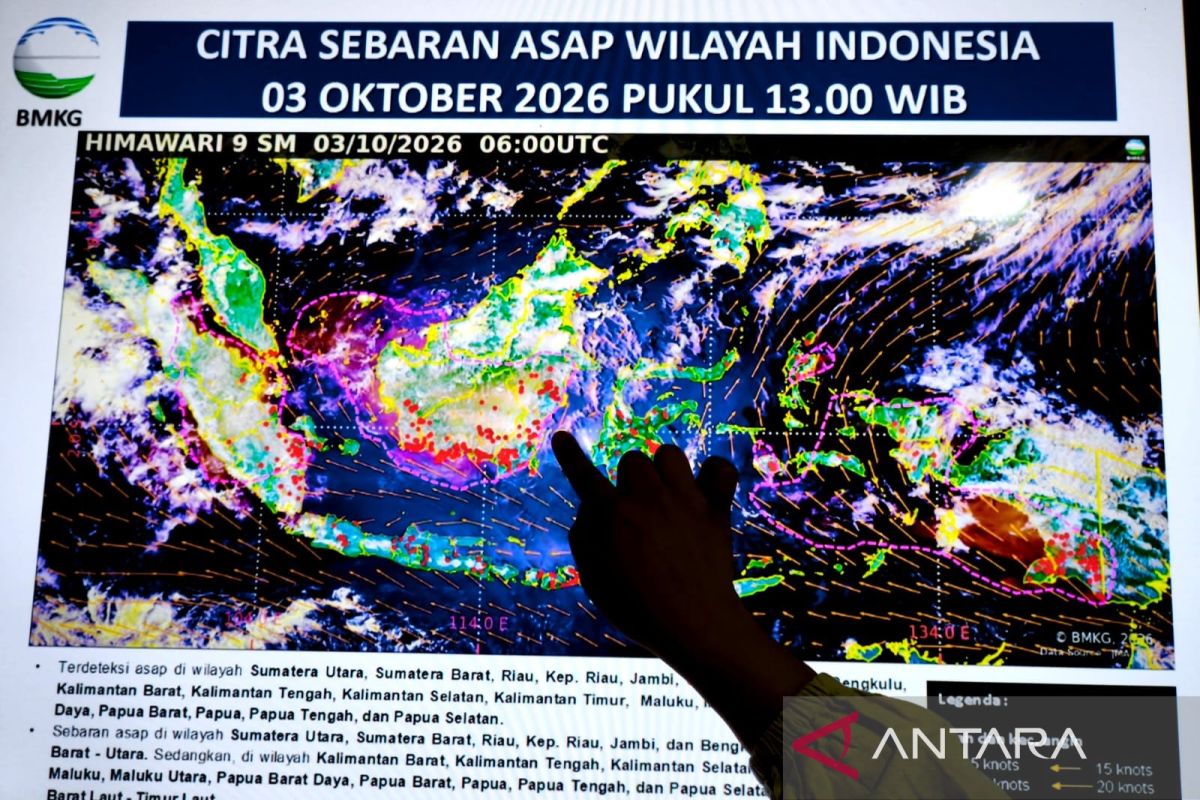
The Meteorology, Climatology, and Geophysics Agency (BMKG) Region IV Makassar has stated that the impact of forest and land fires (Karhutla) is affecting air quality in the South Sulawesi region.
“Regarding air quality, our observations over the last few days at the BMKG Climatology Station in Maros have shown levels ranging from moderate to unhealthy,” said BMKG IV Makassar Forecaster Asriani Idrus at the agency’s office in Makassar on Saturday.
An analysis of wind maps shows that the distribution of fire smoke is visible from the dominant easterly winds. However, data from the Automatic Weather Station (AWS) in the Paotere region indicates that winds are also dominated by westerly directions. According to the forecaster, the wind direction carrying smoke in recent days has shifted from southwest to northwest, though wind patterns remain highly variable.
She noted that dirty air brought by westerly winds typically occurs from the early hours of the morning until approaching midday. Conversely, air conditions usually return to normal during the afternoon and evening as easterly winds prevail. “Sometimes it is easterly, which may lead to cleaner air. However, the PM 2.5 (2.5 micrometre particulate matter) indicators have dropped. If the wind shifts to a westerly direction, smoke particles are likely to enter the South Sulawesi region,” she explained.
Asriani noted that smoke is a primary factor affecting air quality. Smoke drifting from southern Kalimantan, as well as from Papua and Maluku, has the potential to enter Sulawesi via wind currents. “There are two factors. If the wind is easterly, smoke from Papua or Maluku may arrive. If the wind suddenly shifts to a westerly direction, smoke from Kalimantan is likely to enter because it is closer,” she elaborated.
BMKG is continuously monitoring weather and wind forecasts for the next 24 to 72 hours. However, conditions may fluctuate depending on the wind direction carrying smoke from active fire hotspots in Sulawesi and surrounding areas. “We are monitoring closely, and the unhealthy air quality may persist over the next few days, as the fire hotspots remain very intense,” she added while presenting a smoke monitoring map.
In addition to weather changes, high temperatures are another contributing factor. Hot weather persists in Makassar and its surrounding areas. During this dry season, temperatures in South Sulawesi typically range between 30-35 degrees Celsius.
BMKG is now using a new indicator to determine heat levels, known as the air temperature index. This method differs from traditional thermometer readings as it uses a combination of several meteorological parameters, including wind direction, air temperature, humidity, and radiation. “The heat we feel is the body’s response to the pressure caused by environmental heat,” she explained.
Consequently, BMKG advises the public to wear masks and clothing that does not absorb heat when leaving their homes to avoid health risks associated with the current weather conditions.
Previously, Air Quality Index (AQI) data from the agency’s monitoring site at approximately 10:25 WITA showed that air conditions in Makassar and its surroundings were at a moderate level. The PM 2.5 particulate matter concentration was recorded at 71 µg/m³ (micrograms per cubic metre), which is categorised as unhealthy.