
BMKG: Forest and Land Fire Haze Has Moved Away from Greater Jakarta
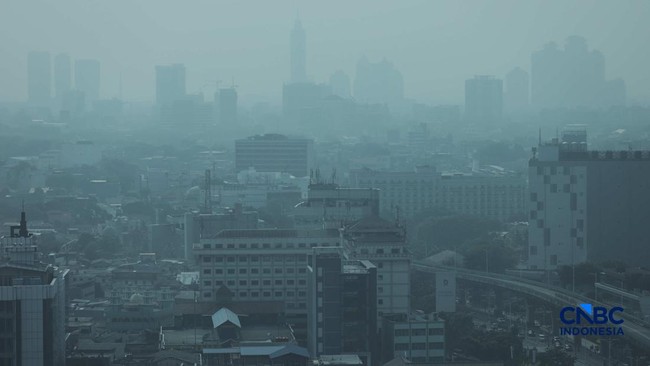
Jakarta — The Meteorology, Climatology and Geophysics Agency (BMKG) said smoke from forest and land fires had begun moving away from western Java, including Jakarta, Bogor, Depok, Tangerang and Bekasi (Greater Jakarta), on Saturday, 17 October 2026.
However, BMKG continued to detect residual smoke over Banten’s west coast at an altitude of around 10,000–18,000 feet, or 3–5.4 kilometres.
BMKG Chief Secretary Guswanto explained that changes in wind direction and weakening winds at that altitude had affected the movement of smoke away from Java. He stressed that smoke detected by satellite did not necessarily indicate an increase in pollutant concentrations at ground level, and said there was no need for the public to panic.
“Nevertheless, BMKG urges the public to remain alert and monitor air quality in their local areas. BMKG continues to monitor atmospheric conditions and provide the latest information to help the public take precautionary measures,” Guswanto said in a written statement.
Measurements of fine particulate matter (PM2.5) in Kemayoran, Jakarta, ranged from 46.7 to 109.7 µg/m³, putting levels in the moderate to unhealthy categories.
Meanwhile, air quality data from the Environment Ministry’s Air Pollution Standard Index (ISPU) showed conditions in Jakarta ranging from good to unhealthy, with PM2.5 the critical parameter. The ISPU readings were 49 (good) in Marunda, 60 (moderate) in Tanah Abang, 103 (unhealthy) in Kelapa Gading, 116 (unhealthy) in Menteng and 120 (unhealthy) in Kebun Jeruk.
BMKG Deputy for Meteorology Andri Ramdhani said smoke remained visible across much of Sumatra and Kalimantan, central and southern Sulawesi, the Maluku Islands and most of Papua. In those areas, the smoke was moving towards the north-west and north-east.
The conditions were linked to hotspots still being detected in several parts of Indonesia. Monitoring on 16 October 2026, from 00:00 to 23:59 Western Indonesian Time, recorded 478 hotspots with a high confidence level.
South Sumatra had the highest number, with 189 hotspots, followed by East Java with 89, South Papua with 63, and West Kalimantan and Central Kalimantan with 26 each.
“Nevertheless, the daily number of hotspots in Central Kalimantan fell significantly compared with monitoring on 15 October 2026, from 485 to 26. This shows a decrease in the number detected in the area, although the risk of forest and land fires should still be taken seriously,” Andri said.
BMKG Head Teuku Faisal Fathani urged the public to be alert to hot weather, dry conditions and the potential for air quality to deteriorate because of fire haze. Residents should stay hydrated, use sunscreen when outdoors in direct sunlight and limit outdoor activities if air quality worsens.
“People in areas affected by haze are also advised to wear an appropriate mask to reduce exposure to smoke particles, particularly children, older people and those with respiratory conditions,” he said.
Satellite imagery on Friday, 16 October 2026, showed that fire haze had briefly entered western Java, including Greater Jakarta, but did not remain for long or affect air quality at ground level. Monitoring at 08:00, 10:00 and 13:00 on Saturday showed the haze in the area gradually moving away.
Source: jawawa.id (https://jawawa.id/newsitem/bmkg-forest-and-land-fire-haze-has-moved-away-from-greater-jakarta-1792237815)
Originally published by CNBC Indonesia (https://www.cnbcindonesia.com/news/20261017173345-4-777107/bmkg-asap-karhutla-sudah-menjauh-dari-jabodetabek), translated from Indonesian