
BMKG: Five Regions in NTB on Alert for Meteorological Drought
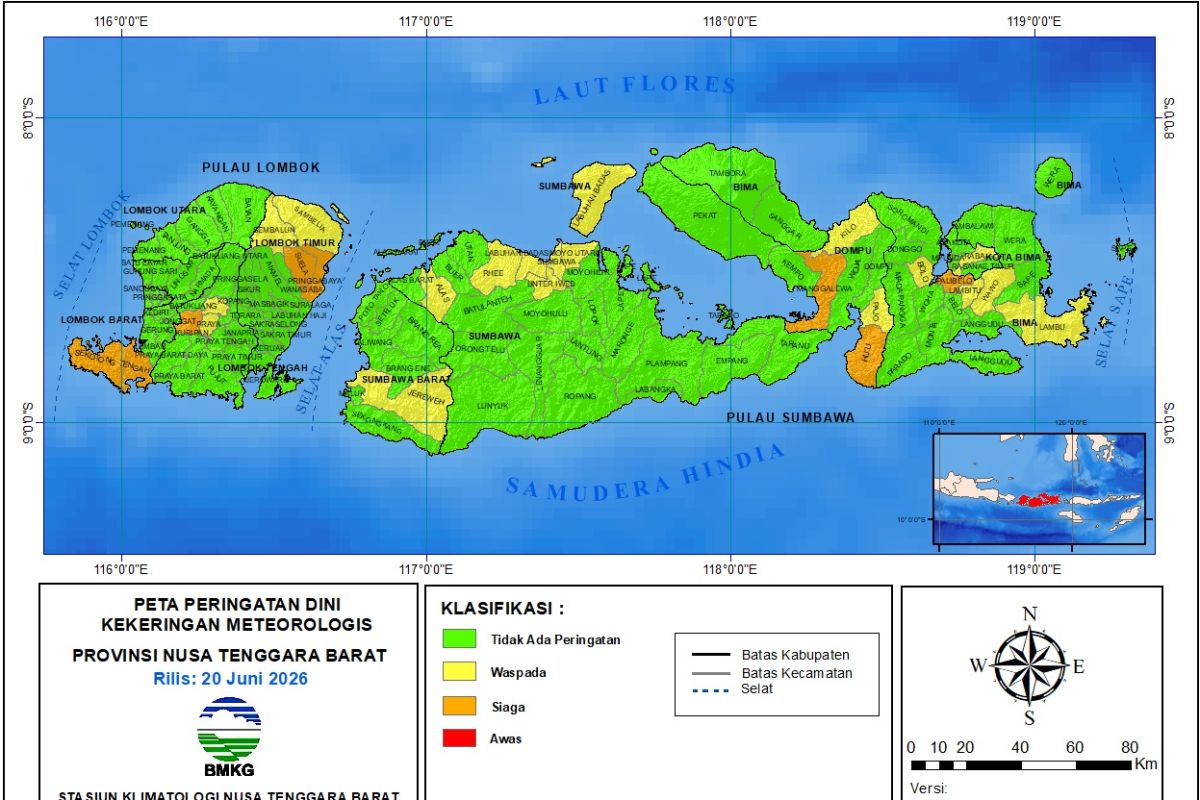
Mataram (ANTARA) - The Meteorology, Climatology and Geophysics Agency (BMKG) has stated that five areas in West Nusa Tenggara (NTB) are currently on alert status for meteorological drought, coinciding with the extended period of days without rain due to the influence of the global El-Nino climate pattern. “Consecutive days without rain are generally in the medium to very long category,” said Suci Agustiarini, Forecaster at the NTB Climatology Station, in Mataram on Saturday. The areas entering the drought alert level include Sekotong District in West Lombok Regency, Jonggat District in Central Lombok Regency, Pringgabaya and Suela Districts in East Lombok Regency, Hu’u and Manggalewa Districts in Dompu Regency, and Palibelo District in Bima Regency. The longest period of days without rain was recorded at the Muhammad Salahuddin Meteorological Station in Bima Regency, reaching 35 consecutive days and falling into the very long category. The BMKG has also designated several districts in Central Lombok, East Lombok, West Sumbawa, Sumbawa, Dompu, Bima Regency, and Bima City at the meteorological drought warning level. Suci urged the public to use water wisely to anticipate a clean water crisis, in connection with the expanding areas entering the alert and warning levels due to the increasingly prolonged days without rain. In the third dekad of June 2026, or the period 21-30 June, the BMKG forecasts that the chance of rainfall exceeding 20 millimetres per dekad remains limited, with a probability of around 10 to 40 percent in parts of Lombok Island and Sumbawa Island. The BMKG is asking the public to increase vigilance against the risk of forest, land and residential fires by not burning indiscriminately and not leaving sources of fire unattended. Based on the results of IOD monitoring conducted by the BMKG in the last dekad, the IOD is in a negative category with an index of minus 0.49 and has the potential to shift towards positive from August to December 2026. The SST anomaly in the Nino3.4 region shows ENSO is in the Moderate El-Nino category with an index of +1.40. “El-Nino is predicted to persist in the Moderate category with a 100 percent probability and potentially strengthen to a strong El-Nino with an 86 percent probability until the end of 2026,” concluded Suci.