
BMKG Claims Ability to Issue Earthquake Warnings Before Shaking is Felt
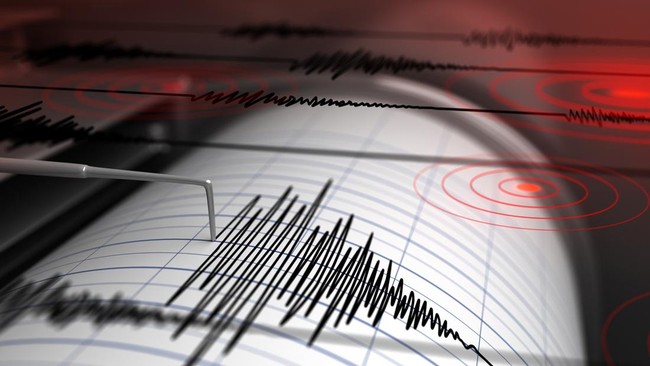
The Meteorology, Climatress, Climatology, and Geophysics Agency (BMKG) claims it can issue warnings for earthquakes before tremors are felt by the public or warning recipients. This was revealed through a post on BMKG’s official Instagram account, @infobmkg.
How does it work? BMKG issues earthquake warnings before shaking is felt through InaEEWS, an early warning system developed by the agency. It is stated that this system can provide a few seconds of lead time before stronger earthquake waves arrive.
“Sensors detect the initial waves, then the system processes the information to send warnings for potential tremors of intensity IV MMI or higher,” wrote BMKG, as quoted on Tuesday (6/10/2026). “A few seconds can be precious time to protect oneself and seek a safe place,” BMKG added.
It was explained that InaEEWS, or the Indonesia Earthquake Early Warning System, is an early warning service for earthquakes before shaking is felt, thereby providing time to take self-rescue actions.
How InaEEWS Works and Reasons for Not Receiving Notifications
In terms of operation, immediately after an earthquake occurs, the nearest sensors detect the initial earthquake waves (P-waves) and send the data to the system centre. This data is immediately analysed to estimate the earthquake’s parameters and impact.
“If the estimated impact meets the threshold, the system will send an early warning through dissemination channels such as the InaEEWS Mobile App to recipients in areas at risk of being affected before the earthquake shaking is felt,” explained BMKG.
However, BMKG added that this system is still under development. Consequently, its operational area is still limited. There are plans to continue developing the system so that its operational services can expand further and reach all regions of Indonesia.
“Currently, InaEEWS operates limitedly in West Java, Banten, Jakarta, and Lampung,” stated BMKG. “This service provides early warnings for significant earthquakes felt with a minimum threshold of MMI IV or higher. These areas were chosen because the sensor density and communication system networks are already adequate.”
Therefore, BMKG clarified that if users have downloaded the app but do not receive notifications or earthquake warnings from BMKG, several factors could be the cause. First, the earthquake does not meet the minimum requirement of MMI IV or higher. Second, the user is located in a ‘blind zone’, resulting in delayed warnings. Third, there are issues with the settings or network on the mobile device.
BMKG also reminded the public that if they feel earthquake tremors, they should not wait for an early warning from InaEEWS or BMKG. They should immediately perform safety actions: Drop, Cover, and Hold On.
What is a Blind Zone?
A blind zone is a location very close to the earthquake’s epicentre. This is why, even if the InaEEWS app is installed on a phone, users may not receive or may receive earthquake warnings late.
The blind zone is acknowledged as one of the challenges in developing InaEEWS.
Furthermore, there are issues regarding the optimal integration between increasing the density of earthquake sensor networks and the reliability of super-fast communication systems for precise real-time data processing, in order to improve the accuracy and speed of early warnings.
Another challenge, according to BMKG, is increasing public understanding regarding EEWS and ensuring rapid and appropriate response actions to the early warnings provided to reduce earthquake risks.
Can earthquakes be predicted?
The answer is not yet.
BMKG explained that an earthquake is an event involving the vibration of the earth due to the sudden release of energy within the earth, characterised by the fracturing of rock layers in the earth’s crust. The energy accumulation that causes earthquakes is generated by the movement of tectonic plates. The resulting energy is radiated in all directions as earthquake waves, so the effects can be felt on the earth’s surface.
It was added that Indonesia is an earthquake-prone area because it is traversed by the meeting point of three tectonic plates: the Indo-Australian Plate, the Eurasian Plate, and the Pacific Plate.
Characteristics of earthquakes according to BMKG include:
Occurring in a very short duration
Specific locations of occurrence
Consequences that can cause disasters
Potential to recur
Not yet predictable
Unpreventable, but the resulting impacts can be mitigated.