
BMKG Chief Issues Latest Warning: El Niño Strengthens, When Will It End?
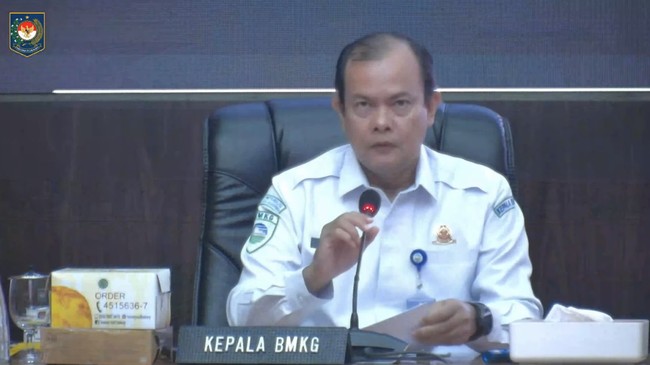
The Head of the Meteorology, Climatology, and Geophysics Agency (BMKG) has provided the latest update regarding the El Niño climate phenomenon currently affecting Indonesia. This condition, characterised by rising sea surface temperatures in the Pacific Ocean, leads to reduced rainfall across the Indonesian archipelago.
According to the official, El Niño does not only impact Indonesia’s climate; it also causes drier conditions in Indonesia, Australia, Oceania, and northern South America. Conversely, regions such as Japan and southern North America will experience wetter conditions.
“This El Niño phenomenon is a global phenomenon resulting from anomalies in world climate dynamics,” stated Faisal during the 2026 Regional Inflation Control Coordination Meeting, broadcast on the Ministry of Home Affairs (Kemendagri) YouTube channel on Monday (29/06/2026).
“Since March, BMKG has released information regarding the El Niño phenomenon that would occur in Indonesia,” he added.
In this regard, Faisal noted that BMKG utilises standard terminology used by international meteorological and climatological agencies, categorising the phenomenon into Weak, Moderate, Strong, and Very Strong El Niño.
“BMKG does not assign specific names to El Niño; we refer to it by its category. Currently, as of June, through the end of June 2026, the ENSO index is +1.6, indicating warm conditions in the Pacific Ocean, which has exceeded the Neutral threshold for seven ten-day periods,” he explained.
“Therefore, BMKG predicts a 98% probability that El Niño intensity will reach the ‘Strong’ level, before gradually declining,” said Faisal.
Previously, BMKG had increased the probability of a strong El Niño from less than 20% to 62%, indicating an increasing likelihood of the phenomenon reaching the ‘Strong’ category.
Regarding when El Niño will end, Faisal emphasised that the El Niño phenomenon and the dry season are two distinct entities.
“In Indonesia, the rainy and dry seasons occur every year. However, El Niño can occur every 3 to 7 years, depending on global atmospheric conditions and situations,” he explained.
“The El Niño phenomenon typically lasts approximately 9 to 12 months. It can be longer or shorter depending on various conditions. Therefore, it is estimated that the El Niño which began in May 2026 will end in May next year (2027),” said Faisal.
Consequently, Faisal added, the 2027 dry season in Indonesia will not coincide with the El Niño phenomenon.
“What we need to be wary of is when the El Niño phenomenon occurs simultaneously with the dry season. This results in significantly less rainfall, as we are experiencing this year,” he clarified.
“Please understand that if El Niño lasts 9 to 12 months, it does not mean we will face a drought for 9 to 12 months. The dry season will still continue until approximately October. When the rainy season arrives in November and beyond, the El Niño phenomenon will not have a significant impact on rainfall conditions in Indonesia,” concluded Faisal.