
BMKG: Aftershocks from North Maluku M7.6 Quake to Subside within 2-3 Weeks
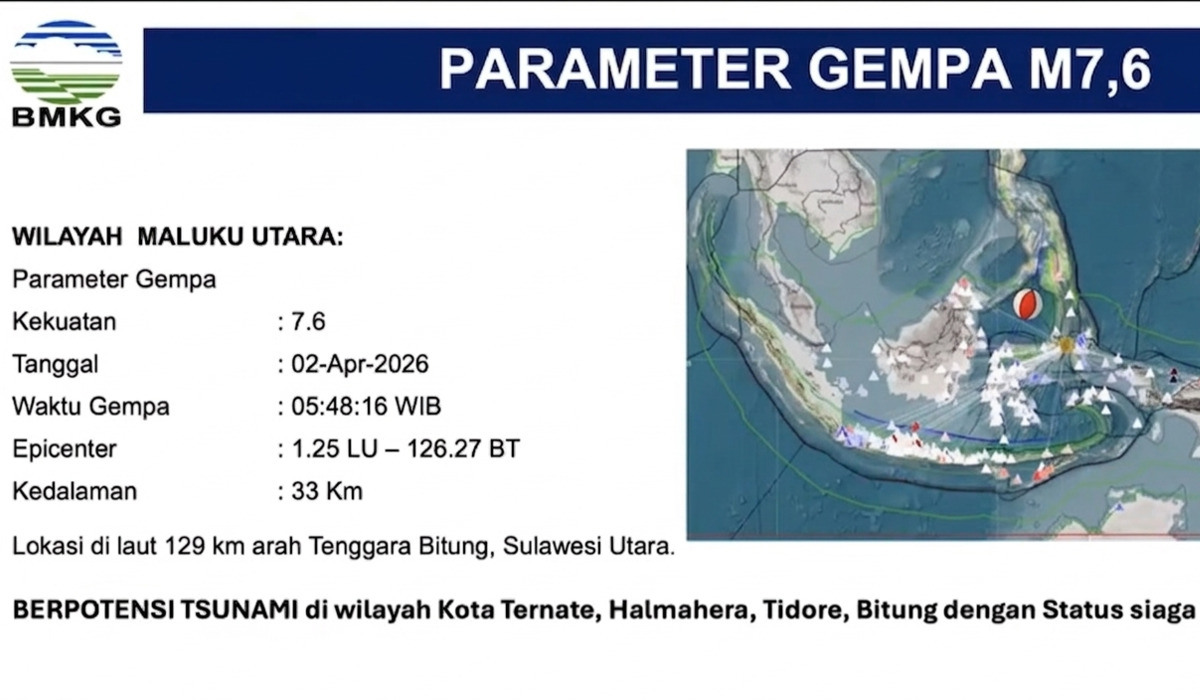
The Indonesian Agency for Meteorology, Climatology, and Geophysics (BMKG) predicts that the frequency of aftershocks following the main earthquake of magnitude (M) 7.6 in North Maluku will continue to show a significant downward trend. Based on the latest statistical analysis, the entire series of tectonic earthquake activities in North Maluku is estimated to fully subside within the next two to three weeks.
BMKG’s Deputy for Geophysics, Nelly Florida Riama, revealed that based on monitoring results up to 9 April 2026 at 06:00 WIB, a total of 1,378 aftershocks have been recorded. Of the thousands of these activities, 25 earthquakes were felt by the public.
Daily data shows a consistent decline in seismic activity since the main earthquake on 2 April 2026. On the first day, 394 earthquake events were recorded. This number continued to drop to 91 earthquakes on the sixth day and 63 on the seventh day.
“Although the trend shows a decline, the intensity of earthquakes during this decay period is fluctuating. Felt vibrations may occasionally still occur before conditions are truly stable,” Nelly stated in her official remarks on Thursday (9/4).
A joint BMKG survey team from the Centre, the Regional IV MKG Main Office, to the Technical Implementation Units (UPT) in North Maluku and North Sulawesi is still continuing to validate impacts in the field. Macroseismic surveys confirm that the highest shaking level reached scale VII MMI in the Batang Dua Island Subdistrict.
In addition to shaking, field officers have verified traces of tsunami inundation with heights ranging from 0.5 to 1.5 metres. The affected areas include Bitung, Lembeh Island, North Minahasa, and Southeast Minahasa.
These findings also prove the accuracy of the “Alert” level Early Tsunami Warning issued by BMKG during the event.
To ensure public safety during the recovery period, BMKG is carrying out microzonation measurements to map soil vulnerability to potential liquefaction and landslides. This step is accompanied by massive socialisation to counter hoax information that triggers panic.
Acting Director of Earthquakes and Tsunamis at BMKG, Rahmat Triyono, urged the public to remain vigilant but not to panic. He emphasised the importance of avoiding buildings that have experienced structural damage or significant cracks.
“The public must also stay away from hillside areas prone to landslides due to post-earthquake soil instability. Ensure information is only sourced from official BMKG channels,” Rahmat concluded.