
BMKG: 482 Seasonal Zones Classified as Drier Dry Season
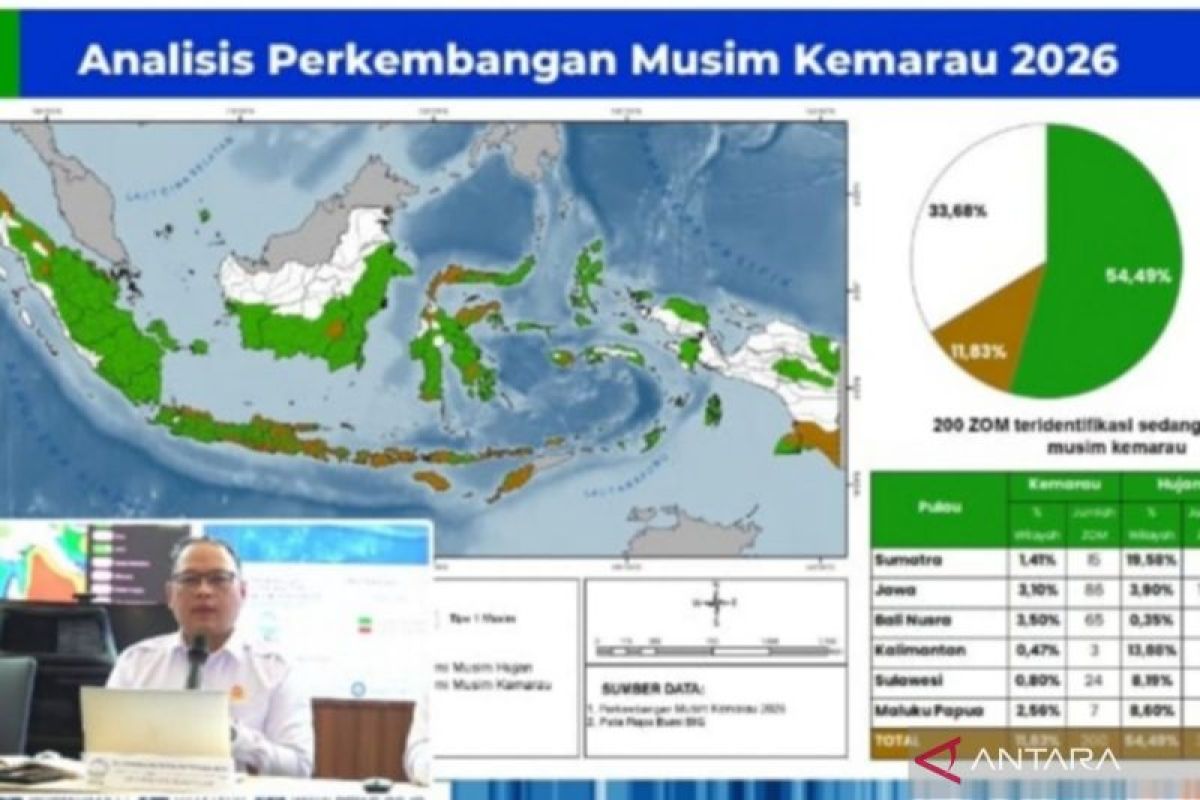
Jakarta (ANTARA) - The Agency for Meteorology, Climatology and Geophysics (BMKG) has mapped 482 Seasonal Zones (Zom) in Indonesia, covering 56.18 per cent of the national land area, which are predicted to experience a dry season that is below normal or significantly drier.
BMKG Deputy for Climatology, Ardhasena Sopahello, during a press conference regarding the “Development of Indonesia’s 2026 Dry Season” in Jakarta on Wednesday, explained that the affected areas dominate almost all major population and agricultural centres south of the equator.
Ardhasena explained that the climate characteristics in these hundreds of seasonal zones are generally influenced by monsoon patterns, which feature one peak rainy season and one highly contrasting dry season trough.
Based on BMKG’s updated data as of the end of May 2026, the expansion of drought-affected areas has begun in 200 seasonal zones (11.83 per cent of land), identified by brownish colours on the national climate distribution map.
The movement of these dry zones is projected to surge drastically this June, entering 198 new seasonal zones or equivalent to 31.6 per cent of the land area, covering regions from southern DKI Jakarta to most of Kalimantan.
Entering July, the dry season movement is expected to spread to an additional 66 seasonal zones, including western Jambi, East Kalimantan, eastern South Kalimantan, most of Sulawesi, and North Maluku.
Conversely, BMKG has detected local anomalies due to extensive topographical effects in seven seasonal zones (0.68 per cent of land) that are actually above normal or wetter, specifically in Bengkulu, northern and southern Gorontalo, and small parts of East Nusa Tenggara (NTT).
Ardhasena stated that the division of these seasonal zones is based on calculations using long-term normal rainfall reference periods between 1991 and 2020 to ensure regional data accuracy.
Consequently, BMKG has urged regional policymakers to closely examine this seasonal zone vulnerability map as the primary database for developing specific emergency plans in their respective areas.
Source: jawawa.id (https://jawawa.id/newsitem/bmkg-482-seasonal-zones-classified-as-drier-dry-season-1781071105)
Originally published by Antara (Indonesian) (https://www.antaranews.com/berita/5601900/bmkg-482-zona-musim-masuk-kategori-kemarau-lebih-kering), translated from Indonesian