
BMKG: 25 Regencies/Cities in Central Java Under Severe Drought Warning
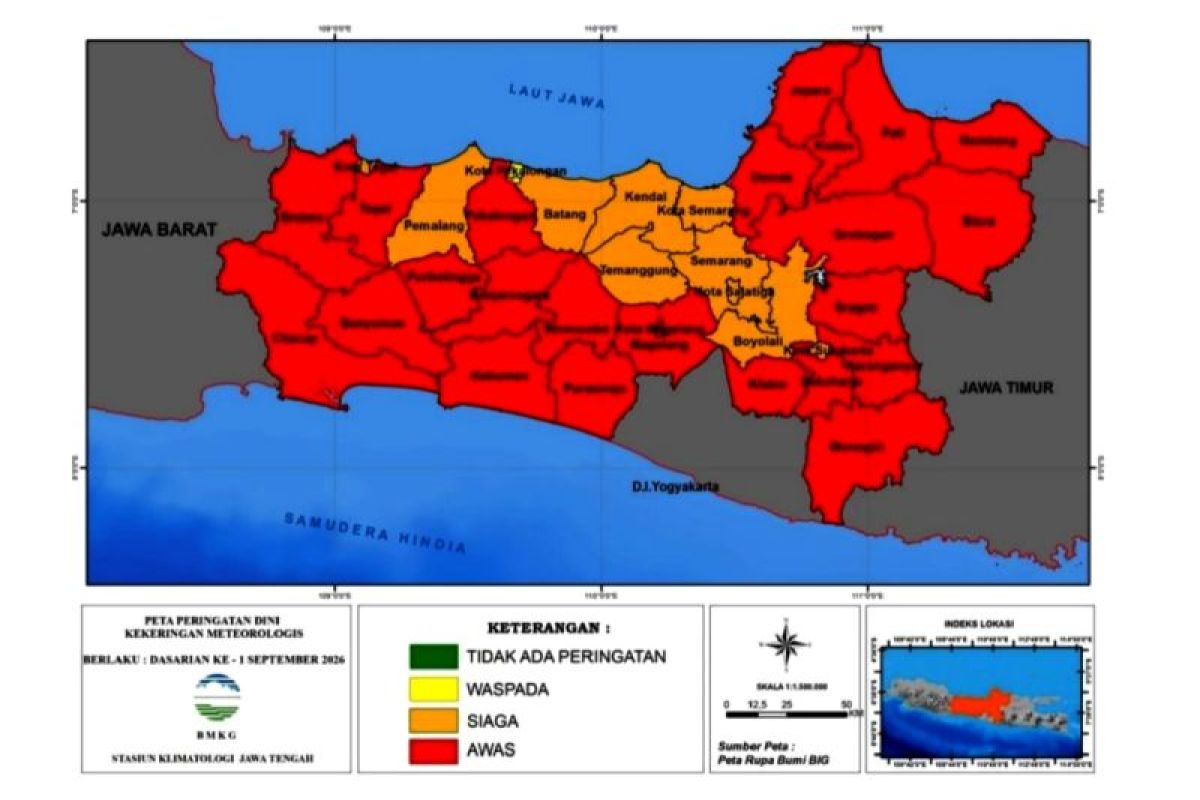
The Meteorology, Climatology, and Geophysics Agency (BMKG) has warned that 25 regencies and cities in Central Java are under a ‘Severe’ (Awas) meteorological drought status for the first ten-day period of September (1–10 September 2026).
Goeroeh Tjiptanto, Head of the BMKG Central Java Climatology Station, stated from Purwokerto, Banyumas Regency, on Thursday, that the public and local governments need to increase vigilance regarding the potential impacts of drought.
“Based on BMKG monitoring, the areas under ‘Severe’ status include Cilacap, Brebes, Tegal, Banyumas, Purbalingga, Pekalongan, Banjarnegara, Kebumen, Wonosobo, Magelang, Magelang City, Purworejo, Klaten, Sukoharjo, Wonogiri, Karanganyar, Sragen, Grobogan, Blora, Rembang, Pati, Jepara, Kudus, and Demak,” he said.
He explained that the ‘Severe’ status represents the most critical condition, occurring when there has been no rainfall for at least 61 consecutive days.
“Meanwhile, areas under ‘Alert’ (Siaga) status include Tegal City, Semarang City, Salatiga City, Surakarta City, Pemalang, Batang, Kendal, Semarang Regency, Temanggung, and Boyolali. Additionally, Pekalongan City is under ‘Watch’ (Waspada) status,” he added.
He noted that the ‘Alert’ status indicates a worsening condition where rainfall has not occurred for more than a month, or at least 31 days.
Under the ‘Alert’ status, surface water sources such as shallow wells, rivers, and reservoirs are likely to shrink, which may begin to impact the agricultural sector. He urged the community to conserve water usage and limit its use for non-essential needs during this stage.
“All these statuses are accompanied by a prediction of rainfall of less than 20 millimetres per ten-day period, with a probability of more than 70 per cent,” he said.
Regarding the areas under ‘Severe’ status, he stated that local governments and relevant agencies must immediately anticipate the potential clean water crisis, for instance, through the scheduled routine distribution of water using tanker trucks.
Furthermore, the public is requested to prioritise the use of available water for basic needs, particularly drinking and cooking, and to conserve usage for other purposes.