
Blue Tsunami Rocks Wall Street as Rp45,200 Trillion Vanishes in 24 Hours
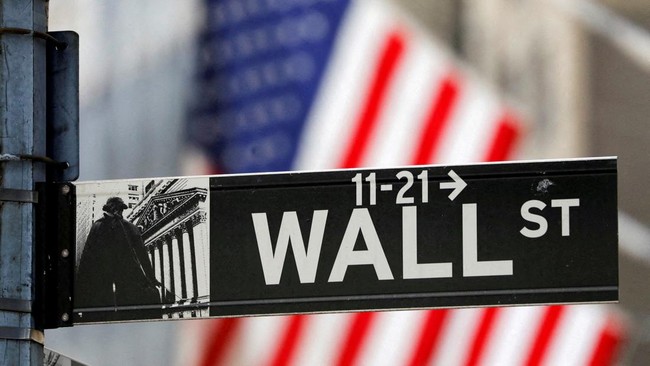
Jakarta, CNBC Indonesia – The Democratic Party’s decisive victory in the US midterm elections has fuelled concerns about the future of the artificial intelligence (AI) industry, sending US stocks tumbling.
Wall Street suffered a major sell-off on Thursday (5 November 2026), as concerns mounted over the continuation of data-centre construction.
According to Reuters and CNBC International, the Nasdaq Composite plunged 5.52% to close at 24,315. The decline was its steepest since the Liberation Day episode in April 2025 and officially pushed the index into correction territory.
The Nasdaq 100 fell 6.4%, wiping US$2.5 trillion, or Rp45,187 trillion, from its market capitalisation (US$1 = Rp18,075). The “blue tsunami”, referring to the Democrats’ party colour, has unnerved investors.
The S&P 500 also slumped 4.36% to 7,353.73.
The Dow Jones Industrial Average shed 1,833.06 points, or 3.44%, to 51,523.06. The fall erased more than all the gains the Dow had recorded in the previous day’s sharp rally following the US midterm election results.
All three major Wall Street indices recorded their worst daily performance since April 2025. The small-cap Russell 2000 also fell 4.45%, entering correction territory.
The sell-off followed an initially positive market reaction to the US election results. Investors are now beginning to worry about the impact of the Democrats’ decisive victory on technology policy, particularly the expansion of AI infrastructure.
The Nasdaq Composite has fallen nearly 12% from its record close on 6 October. A market is technically in correction territory when an index drops at least 10% from its most recent peak.
Technology shares have also fallen for two consecutive days. Since mid-October, the Nasdaq Composite has recorded five declines of more than 500 points.
Democratic Victory Fuels Fears for AI Industry
The Democrats’ strong gains in the US Congress, alongside their success in several gubernatorial elections, have raised concerns that the AI industry will face tighter scrutiny.
Investors fear new policies and growing public opposition could slow data-centre construction. These facilities underpin the AI industry’s expansion, which requires enormous computing capacity.
One prominent advocate of restrictions on data-centre construction is Vermont Senator Bernie Sanders, who is aligned with the Democrats. He has called for a nationwide moratorium on data-centre construction.
In a post on X on Wednesday night, Sanders said Americans did not want technology-company oligarchs to damage the environment, eliminate jobs and threaten humanity’s future.
Michael O’Rourke, chief market strategist at JonesTrading, said a slowdown in data-centre construction would remain a major concern for markets following the election results.
“The main message from these election results, particularly after Democrats won many gubernatorial seats, is that a slowdown in data-centre construction will remain a major issue weighing on markets,” he said, according to Reuters.
Public opposition is not without reason. Large-scale data-centre construction is seen as potentially placing a strain on electricity grids and water supplies in surrounding areas.
Bruce Zaro, managing director at Granite Wealth Management, said the permitting process for data-centre projects could become more difficult in future.
Although some projects have already been approved, he said, many others still need permits. Public opposition could become a new obstacle to the industry’s expansion.
UBS analysts estimate that around 30% of the additional US data-centre capacity planned to come online by 2028 could be affected by potential construction moratoriums.
This poses a threat to the AI industry, which relies heavily on the rapid expansion of data-centre facilities.
Chipmakers’ Shares Plunge
Concerns about the future of AI investment immediately hit chipmakers’ shares.
The Philadelphia SE Semiconductor Index (SOX) plunged 12%, reaching its lowest level in more than six months. The iShares Semiconductor ETF (SOXX) fell by more than 12%, its steepest daily decline since the Covid-19 pandemic broke out in March 2020.
Nvidia shares fell 9%, while Advanced Micro Devices (AMD) plunged 17%. Broadcom also slumped 10%.
Qualcomm shares fell 9%, despite the company reporting earnings that exceeded analysts’ expectations. The decline followed a forward earnings outlook viewed as weaker than the market had anticipated.
Software company Oracle’s shares also fell nearly 7%.
Pressure spread to technology giants known as hyperscalers. Amazon and Alphabet each fell 2.2%, while Microsoft dropped 3.6%.
Wall Street’s volatility gauge, the CBOE Volatility Index (VIX), which is known as the market’s fear gauge, recorded its biggest rise since December 2024.
AI Infrastructure Companies Also Take a Beating
The sell-off hit not only chipmakers but also providers of specialised AI cloud-computing infrastructure, known as neocloud companies.
CoreWeave shares plunged nearly 10%, while Nebius fell about 15% and IREN dropped nearly 17%. Data-centre operators Applied Digital and Cipher Digital also slumped by more than 14%.
CoreWeave has become one of the key indicators of investor concerns over the scale of spending and financing in the AI industry.
The company’s funding risks were reflected in the widening of its five-year credit default swap (CDS). According to S&P Global Market Intelligence data, CoreWeave’s CDS spread widened to a record 1,267.9 basis points.
A CDS is a financial instrument that provides protection against default risk. A wider spread signals that the market perceives a greater credit risk for the company.
Intel’s five-year CDS spread also reached a record 149.7 basis points.
Meanwhile, CoreWeave and Nebius shares have each lost at least half their value since the Nasdaq Composite set a record on 6 October.
Pressure also spread to utilities and equipment suppliers connected with data-centre construction. GE Vernova shares fell 7.4%, while Constellation Energy slipped 2.5%.
Bloomberg News also reported that Microsoft is tightening its oversight of several data-centre projects owned by Nebius, IREN and Nscale.
Investors Begin Counting AI’s High Costs
The market turmoil reflects a change in investor sentiment towards the AI industry. Whereas investors previously focused on the technology’s growth potential and substantial returns, attention is now shifting to the scale of investment costs and the risks involved in financing them.
Ted Parkhill, founder and chief executive of Incline Investment Management, described the change in sentiment.
“The market is shifting from simply looking at AI’s potential to calculating how expensive it will be to develop AI,” he said.
AI could indeed transform the world over the long term, he said. But that does not mean all AI-related shares are currently fairly valued.
“The market still faces a lot of volatility,” he said, according to Reuters.
Tim Holland, chief investment officer at Orion, said investors were choosing to step back until they had a clearer picture of how the midterm election results might affect the AI capital expenditure (capex) cycle.
“This sector has been the biggest driver of economic growth we have had for about the past three years,” he told CNBC International.
Holland said investors were now focused on the direction of policy and the stance of the party that had secured a major victory, at both federal and state levels.
Keith Lerner, chief investment officer at Truist Wealth, said Thursday’s sell-off showed that pressure was spreading from technology shares to the wider market.
“Unlike yesterday, we are now seeing technology share selling, on such a large scale, begin to spread more broadly across the market. Market pressure is intensifying,” he said.
The widening pressure was evident in Caterpillar shares, which fell 6%, JPMorgan, which dropped 4%, and Boeing and Nike, both down 2%.
Asian Markets Could Also Be Dragged Down
Several analysts expect selling pressure to continue, including in Asian markets during Friday’s trading.
Japan’s Nikkei and South Korea’s Kospi, both up more than 20% so far this year, were also under pressure following Wednesday’s sell-off in data-centre shares.
The market turmoil has also raised questions about a possible change to the timing of Anthropic’s IPO, which is expected to take place this autumn. A delay to the AI company’s listing could further worsen investor sentiment.
Wall Street’s pressure is therefore no longer simply a matter of technology-share valuation corrections. Markets are now confronting a combination of political concerns, financing risks, high investment costs and uncertainty over the continuation of AI infrastructure construction.
Source: jawawa.id (https://jawawa.id/newsitem/blue-tsunami-rocks-wall-street-as-rp45-200-trillion-vanishes-in-24-hours-1793929836)
Originally published by CNBC Indonesia (https://www.cnbcindonesia.com/research/20261106072023-128-782815/tsunami-biru-guncang-wall-street-rp-45200-t-lenyap-dalam-24-jam), translated from Indonesian