
Blue Fire Phenomenon Suddenly Appears at Mount Papandayan, PVMBG Responds
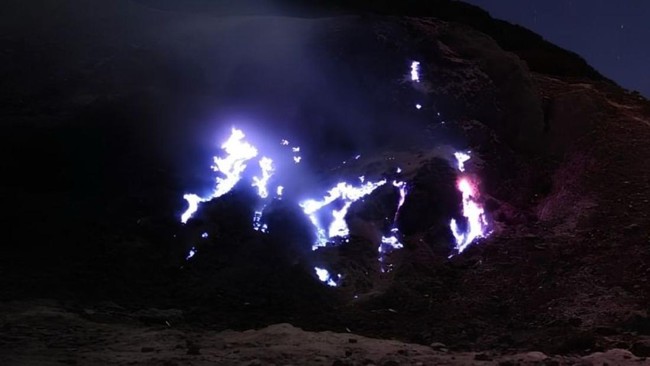
The Centre for Volcanology and Geological Disaster Mitigation (PVMBG) of the Geological Agency, under the Ministry of Energy and Mineral Resources, has spoken out regarding the blue fire phenomenon observed in the Mount Papandayan area, West Java.
The appearance of bluish-purple to bluish-white light is assessed to be a phenomenon of sulphur combustion within the solfatara area of the volcano’s crater.
The Head of PVMBG, Siti Sumilah Rita Susilawati, explained that the blue flame phenomenon was observed on 23-24 September 2026 at several points within the crater area. She explained that the emergence of the blue fire is related to the combustion of sulphur, a similar phenomenon that has previously been reported at the New Crater of Papandayan.
“Based on the Geological Agency’s observations, on 2gsubruary 2026, bluish-purple flames were visible at several points with a fairly wide distribution. On 24 September, the visible flames were fewer and more concentrated, with a bluish-white colour,” she stated in a written report on Friday (25/9/2026).
The agency indicates the possibility of a change in the exit path of hot gases due to the dynamics of the crater structure in recent times. The narrowing of the Manuk Crater opening, accompanied by a reduction in surface smoke, is suspected to have caused hot gases to escape through fissures or other crater walls containing sulphur.
“Since 2025, the Geological Agency has observed that the opening of the Manuk Crater tends to narrow, accompanied by a reduction in visible surface smoke. There is a possibility that this change affects the path of hot gas exit, causing gases to escape through fissures or other parts of the crater walls, including around the location where the flames are now observed,” she explained.
Nevertheless, the agency emphasised that the link between the narrowing of the Manuk Crater opening and the emergence of the blue fire phenomenon still requires more in-depth study. Teams have been deployed directly to the site to conduct field inspections to analyse the phenomenon and map potential hazards.
“Hot gases exiting areas containing sulphur can produce blue flames. However, the relationship between the narrowing of the Manuk Crater opening and the emergence of blue flames still needs to be studied; visual recordings alone are insufficient to confirm it,” she added.
As of now, the volcanic activity status of Mount Papandayan is confirmed to remain at Level I, or Normal. As a security precaution, the Geological Agency advises the public and tourists not to engage in activities or stay within a 500-metre radius of the active crater opening.
“The Geological Agency’s observations to date show that the activity level of Mount Papandayan remains at Level I (Normal). The public and visitors are requested not to carry out activities or stay within a 500-metre radius of the active crater opening, to remain calm, and to follow official information from the Geological Agency and the local government,” she concluded.