
Blue Fire at Mount Papandayan Sparks Concern: Is an Eruption Imminent? Experts Issue Warning
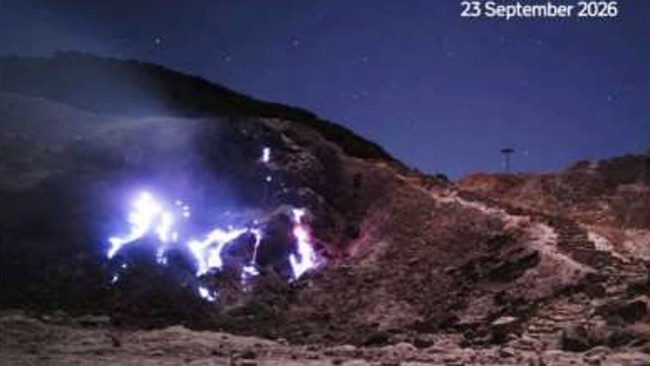
Residents are currently alarmed by the appearance of blue flames, or ‘blue fire’, at Mount Papandayan, West Java. This natural phenomenon occurs as several volcanoes in Indonesia experience increased volcanic activity and eruptions. In Indonesia, a similar famous phenomenon occurs at Ijen Crater in East Java.
Does the sudden appearance of blue fire at Mount Papandayan signal an impending eruption? Mount Papandayan is a type A stratovolcano with a conical shape. According to the Geological Agency, due to the frequently shifting eruption centres, the conical shape has become irregular, leading to the formation of various craters. Currently, Mount Papandayan remains active at Level 1, or Normal status.
The Geological Agency explained that this blue fire phenomenon is not the first of its kind; similar events were recorded on 22 February 2023 and 12 July 2025, both observed on the walls of the New Crater. On 24 September 2026, blue fire was observed again at Mount Papandayan, but in a different location: the Manuk Crater area, which is part of the active crater complex of Mount Papandayan.
Do Not Chase the Blue Fire, It Is Dangerous!
Daryono from the Indonesian Disaster Expert Association warns that the blue fire phenomenon should be understood as a safety message. He added that its appearance indicates that Indonesia is situated in an active volcanic environment with hot gases that can be hazardous.
“Scientifically, blue fire is not blue-coloured lava. The blue flame occurs when gas or sulphur-rich material emerging from fissures and fumaroles at high temperatures undergoes combustion when interacting with oxygen. Because the light is relatively weak, this flame is usually more clearly visible at night,” said Dually, quoted on Monday (28/9/2026).
“The appearance of blue fire does not automatically mean the volcano will erupt soon. This phenomenon more accurately indicates the release of hot gases (degassing) and fumarole or hydrothermal system activity,” Daryono emphasised.
He noted that determining an increase in volcanic activity must still be based on various parameters, such as seismicity, deformation, temperature, and changes in gas composition and flux. “What must actually be watched is the environment where the blue fire is formed,” Daryono stressed.
He warned that around fumaroles, there may be toxic SO₂ and H₂S gases, as well as CO₂, which at high concentrations can reduce oxygen availability. “Gas exposure can cause eye and throat irritation, coughing, shortness of breath, dizziness, nausea, and even loss of consciousness. Wind direction can also change rapidly, so gas that was initially moving away could suddenly move towards hikers,” he explained. “Therefore, do not use the blue fire as a reason to approach the crater for photos or videos.”
What should be done?
Daryono provided the following advice:
Do not approach fumarole holes or fissures emitting gas.
Do not enter areas restricted by officials.
Avoid staying too long in depressions or low-lying areas, as certain gases can accumulate there.
Standard masks cannot be considered adequate protection against high concentrations of volcanic gases.
“When hiking, if you suddenly smell a very pungent sulphur odour, feel eye or throat irritation, dizziness, shortness of breath, or see gas clouds moving towards you, immediately move away from the gas source towards an open area with cleaner air and follow the instructions of officials. Do not wait until symptoms become severe,” he urged. “Blue fire is indeed beautiful, but do not chase it. In volcanic mitigation, safety is more important than getting the best photo. Adhere to safe zones and the official recommendations of PVMBG and the area managers.”
Causes of the Blue Fire
The Geological Agency explained that the appearance of blue fire at the New Heat Manifestation site in the Manuk Crater complex indicates a high release of heat capable of causing the combustion of surface material. Powder resembling combustion ash was found around the location, likely related to the heating or burning of surface material due to heat exposure.
“Kawah Mas, which is near the New Heat Manifestation site, does not show any significant change in gas ratios. Thus, based on gas ratio data, there is no indication of a significant change in the hydrothermal system beneath Mount Papustayan that can be linked to the appearance of the New Heat Manifestation in the Manuk Crater complex,” the Geological Agency explained on 26 September 2026.
It was noted that thermal activity at the manifestation site tends to be decreasing. However, even though thermal activity is declining, the gas conditions around the location still show significant volcanic gas release. Furthermore, the Geological Agency added that the blue fire appeared in the Manuk Crater area, which is near the main hiking trail and towards the camping area—a popular tourist destination within the Mount Papandayan complex—necessitating increased vigilance.
“A pungent sulphur smell can still be detected downwind from the manifestation site, so the presence of gas around the location still has the potential to impact health if directly exposed, particularly in the downwind area,” stated the Geological Agency.
Geological Agency Recommendations
The Geological Agency warned that the potential danger posed by the appearance of blue fire is the eruption and exposure to toxic volcanic gases above threshold levels. The Geological Agency reminds the public around Mount Papandayan, including tourists and hikers, to:
Avoid activities and overnight stays within the active crater openings in the Mount Papandayan complex, namely: Kawah Baru, Kawah Emas, Kawah Nangklak, and Kawah Manuk/Balagadama within a 500-metre radius, especially during cloudy or rainy weather.
Be alert to toxic gases, the concentration of which can increase suddenly.