
Blora Regent Monitors Livestock Trading Ahead of Eid al-Adha 2026
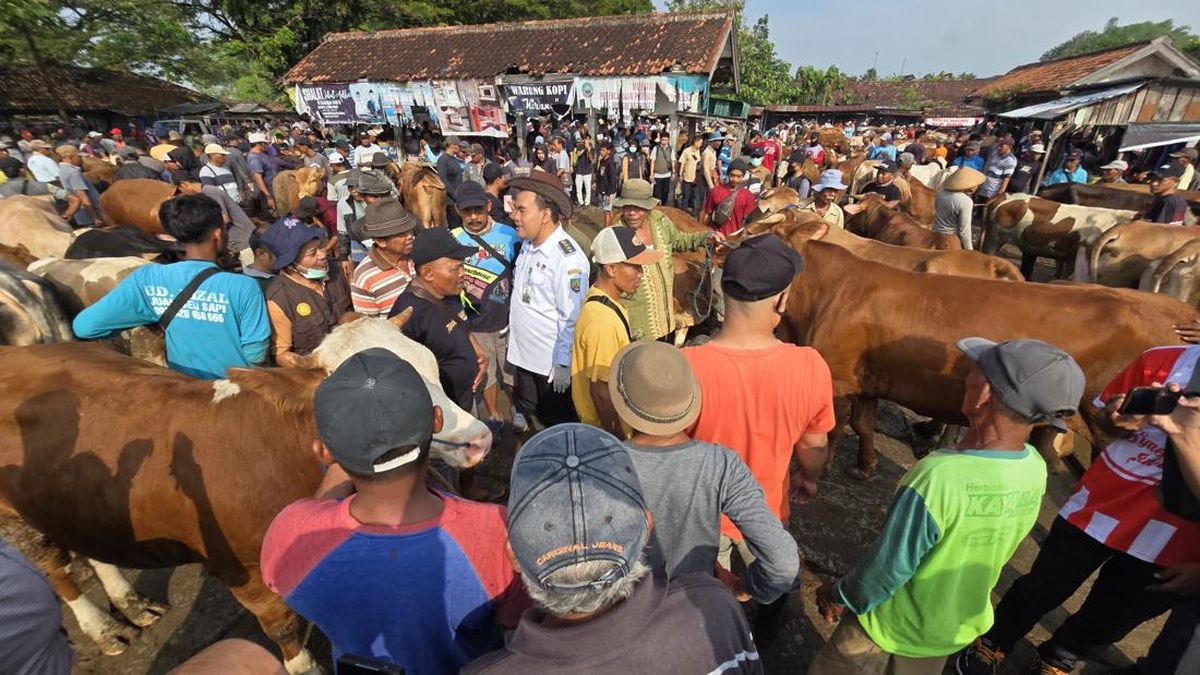
The Regent of Blora, Arief Rohman, ensured the smooth flow of Eid al-Adha livestock trading for the year 1447 Hijri by conducting a direct inspection at the Pasar Pon Blora animal market on Saturday, May 16th. The inspection also aimed to observe the increased economic activity of the community during the sacrificial season.
During his visit, the Regent acknowledged a significant increase in cattle transactions compared to normal days. Under normal conditions, cattle sales average around 300 animals, but in the lead-up to Eid al-Adha, the number of transactions reaches 600-800 cattle.
“In the lead-up to Eid al-Adha, livestock trading activities have increased significantly. This indicates that the community’s economic activity is also very good,” said Arief Rohman in Blora on Saturday, May 16th.
The high demand for sacrificial animals has a positive impact on both livestock farmers and cattle traders in Blora Regency. At the Pasar Pon Blora, the most commonly traded cattle breeds for sacrificial purposes include Limousin, Simmental, and Peranakan Ongole (PO).
The majority of the cattle sold are male cattle weighing between 400-600 kilograms, with an average price of around IDR 15 million per animal. The estimated turnover at Pasar Pon Blora during this period is around IDR 9 billion.
Regent Arief reminded traders to maintain the health of the livestock, ensuring that the cattle sold are truly suitable for sacrifice.
“We hope that this trading activity can continue to improve the welfare of local farmers and traders, while also maintaining the stability of the community’s economy,” he said.
In addition to monitoring trading activities, officers also carried out disinfectant spraying on cattle transport vehicles at the Pasar Pon Blora animal market to prevent the spread of livestock diseases.
At the same location, livestock farmers and cattle traders said they were making greater profits compared to normal days due to the high demand for sacrificial animals.
One of the cattle traders, Nopung from the Bogorejo sub-district, Blora, said that he brought seven cattle today and managed to sell them all. “Today I brought seven cattle and they all sold out. The price per animal was IDR 24 million, IDR 19 million, and IDR 13 million. I brought the cattle from Ketringan,” he said.
He also said that cattle prices in the lead-up to Eid al-Adha had started to increase compared to normal days.
“The price this time has increased by more than IDR 1 million. And in the lead-up to Eid al-Adha, it is likely to increase again, especially for small-sized cattle. The increase is quite high, depending on the condition and health of the cattle,” added Nopung.
The animals sold at Pasar Pon must be free from disease, one of which is foot and mouth disease. The Head of Animal Health at Blora, Dr. Rasmiana, said that the Health Office carried out disinfectant spraying before entering the animal market.
She added that if any animals are found to be sick, they will be prevented from being sold and should be taken back home.
“The cattle from Pasar Pon Blora are marketed to various regions in Java, starting from West Java such as Cirebon, Central Java such as Boyolali, Grobogan, Pati, and Blora, to East Java such as Bojonegoro, Lamongan, Tuban, Ngawi, and Lumajang,” said Dr. Rasmiana.
The buying and selling of livestock at the Pasar Pon Blora animal market is considered an indicator of increased community economic activity in anticipation of Eid al-Adha.