
Bloodbath: The JCI’s Fall from a Record 9,100 to Below 4,900
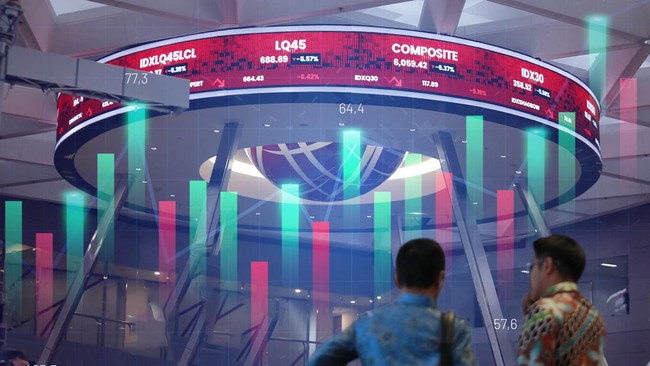
Indonesia’s stock market was again rocked by severe volatility amid persistent selling pressure.
After recording its steepest fall in 28 years last Friday, the Jakarta Composite Index (JCI) slumped again on Monday (19 October 2026), reaching levels last seen during the Covid-19 pandemic.
The JCI opened down 4.31% at 4,961.88. Refinitiv data show that this was close to the level recorded on 5 October 2020, when the index closed at 4,958.77.
In January, however, the JCI was still above 9,100 and had set an all-time high. In just nine months, the index continued to fall, returning to the 4,900 range.
From its record closing level of 9,134.70 on 20 January to Monday’s opening, the JCI had lost around 45.68% of its value, or more than 4,100 points.
Over that period, the index crossed several key psychological thresholds. Its decline was driven by various factors, including profit-taking, concerns over fiscal conditions, rupiah pressure and questions about market transparency raised by MSCI.
Here is the JCI’s path from 9,100 to around 4,900 during 2026.
1. At 9,100: The JCI sets a record high
The JCI began the year by setting an all-time high on Tuesday (20 January 2026).
The index opened at 9,156.19 and briefly reached 9,174.47 before closing at 9,134.70.
The gains were supported in part by gold-mining shares. The day after setting the record, however, the JCI began to retreat.
2. At 9,000: The JCI starts to correct
It did not take long for the JCI to fall from its peak. On Wednesday (21 January 2026), it opened at 9,094.43 and briefly dipped below 9,000, reaching an intraday low of 8,977.68.
Although it subsequently recovered, the JCI still closed down 1.36% at 9,010.33.
The correction came amid profit-taking after several days of gains. A number of large-cap shares also came under selling pressure.
3. At 8,000: Concerns over MSCI
The 8,000 level was breached on Thursday (29 January). The JCI opened at 8,027.83 and briefly fell as low as 7,481.99, before closing at 8,232.20, down 1.06%.
The pressure followed MSCI’s announcement that it would temporarily freeze certain changes to Indonesian equity indices because of concerns over share-ownership transparency and free float.
The announcement heightened investor concerns about the domestic stock market’s prospects. The JCI at one point fell by more than 8%, triggering a temporary trading halt.
4. At 7,000: Fiscal concerns weigh on the market
By mid-March, selling pressure had pushed the JCI below the psychological 7,000 mark.
On Monday (16 March 2026), the index opened at 7,115.45 and fell as low as 6,917.32 intraday. It later pared its losses and closed at 7,022.29, down 1.61%.
Concerns about Indonesia’s fiscal position were among the factors weighing on the market, particularly the risk of the budget deficit exceeding the 3% of gross domestic product (GDP) limit. Global geopolitical uncertainty also affected investor sentiment.
5. At 6,000: The JCI falls by more than 4%
The JCI’s decline continued into June. This time, the index not only fell below 6,000 intraday but also closed beneath that psychological threshold.
On Wednesday (3 June 2026), the JCI opened at 6,207.10 and briefly reached 6,213.80 before plunging to an intraday low of 5,842.00. It ultimately closed down 4.11% at 5,941.07.
The weakening rupiah, nearing Rp18,000 per US dollar, rising global oil prices and concerns about domestic economic conditions all weighed on the index.
6. From 5,000 to 4,900: MSCI sentiment puts the JCI under renewed pressure
Four months later, MSCI-related concerns again shook the domestic stock market.
The JCI plunged 11.57% on Friday (16 October 2026), from an opening level of 5,393.92 to close at 5,185.11. It was the index’s steepest decline in 28 years.
The fall came after MSCI opened a consultation on the possibility of downgrading Indonesia’s stock market from Emerging Market to Standalone Market status. Investors fear such a change could trigger foreign fund outflows from the domestic stock market.
The decline continued on Monday (19 October 2026), when the JCI opened down 4.31% at 4,961.88. The index breached the 5,000 psychological threshold and returned to the 4,900 range.
According to Refinitiv data, that level was close to the closing level of 4,958.77 on 5 October 2020, when the Covid-19 pandemic was still under way.
Amid the market turmoil, the Indonesia Stock Exchange (IDX) also began applying a 7% lower auto-rejection limit (ARB), down from 15%, to limit daily share-price declines.