
Blok M: Tales of scraping a living
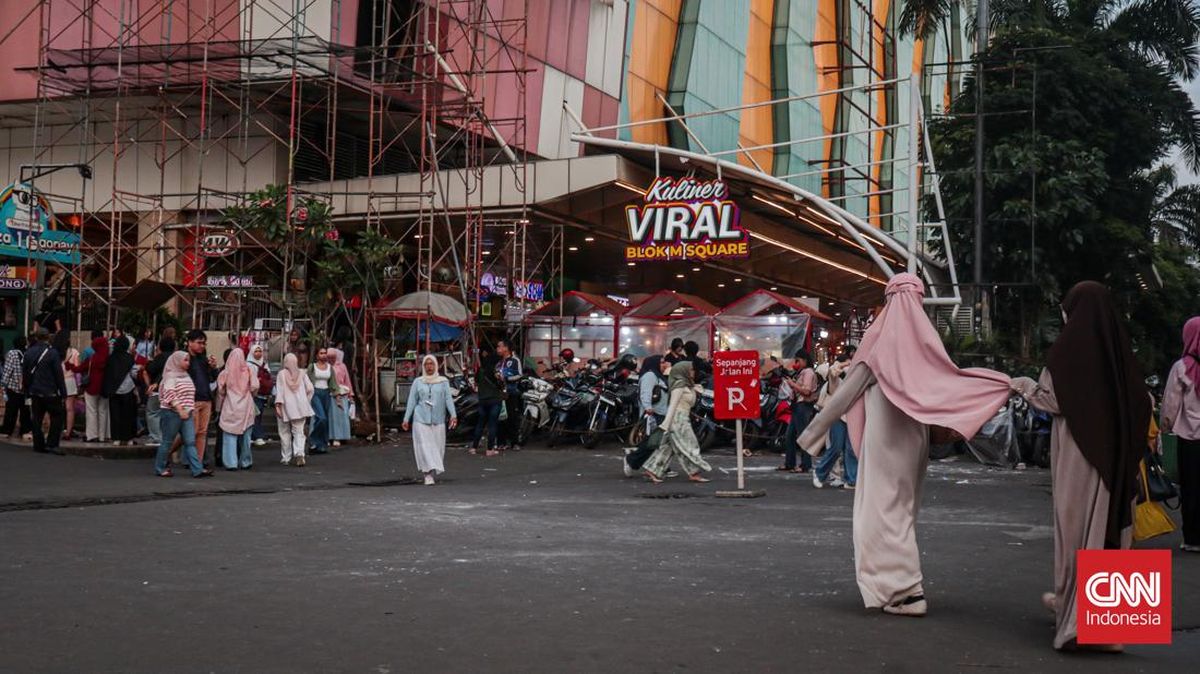
Friday, 22 May 2026. Blok M was bustling that evening. After all, it was Saturday night — often referred to as ‘small Sunday’.
Jakartans poured into Blok M. Some were accompanied by their partners, others still carrying laptop bags after work.
Today, Blok M is known as Jakarta’s hub of trendy culture, where the capital’s hip youth gather.
But this may not apply to Sunardi; for him, Blok M is not a scene hub but a place full of hope. His sole thought is earning money to make ends meet.
Amidst the constant flow of people passing by, Sunardi sat patiently in front of his stall, hopeful.
A bamboo pole tied with yellow string formed a simple shoulder yoke. On top sat an empty krupuk tin holding several packs of semprong and onion crackers.
With this yoke, Sunardi travels dozens of kilometres daily from Cengkareng to Blok M to sell his wares.
He usually arrives at Blok M around midday, coinciding with the Zuhr call to prayer.
He remains there selling until nightfall. Around 9pm, he walks to Blok M Terminal to catch a bus back to Cengkareng.
It’s unclear how many items he sells daily; his earnings are unpredictable.
‘Only five sold today,’ he said with a small laugh.
A few metres from Sunardi’s spot, another hope bloomed from a drinks vendor’s cart.
At the junction behind Blok M Square, Yohana sells bottled drinks and instant coffee — a routine she’s maintained since the end of the Covid-19 pandemic.
Yohana swiftly attends to customers, cutting open coffee packets, pouring them into plastic cups, then adding hot water for immediate serving.
Like hope that must always bloom, Yohana also sells flowers, though this special offering is only available on weekends.
Neatly wrapped bouquets, covered in plastic and newspaper, are displayed. Some bear French inscriptions: ‘C’est la Vie’, meaning ‘That’s life’.
The flowers are elegantly arranged in water-filled buckets, half-submerged to keep them fresh.
Each bouquet sells for Rp50,000, but Yohana believes selling is not just about profit but also usefulness.
Many visitors ask her to make cheaper bouquets with fewer flowers.
After all, Blok M’s location surrounded by schools like SMAN 6 and SMAN 70 ensures a steady stream of students.
Yohana says students buy flowers for graduation celebrations or to please their crushes.
SMAN 6 and SMAN 70 are just across the street from Blok M.
These two schools are among Jakarta’s most prominent. Students are often labelled as trendy.
Raynata’s memories turned back 12 years ago, when she wore the grey-and-white uniform at SMAN 6 Jakarta.
In Raynata’s memory, Blok M 12 years ago was vastly different from today.
Blok M Square and surroundings were far from the trendy coffee shops and viral foods now ubiquitous.
Raynata recalls she only approached Blok M Square for authentic Japanese food.
In her memory, Blok M Hub — now packed with restaurants — was merely a path to the terminal.
‘I rarely went near Blok M Square back then; it was just the terminal,’ Raynata said.
If her school turned left towards Blok M Square, Raynata often turned right towards Langsat Park and Bulungan Sports Hall.
Raynata graduated from SMA 6 in 2017. Moving to Jatinangor meant she no longer frequented Blok M daily.
She noticed Blok M’s significant development, attributing it to improved public transport access.
Twelve years ago, Jakarta’s MRT didn’t exist, nor did the CSW flyover linking Ciledug to Tegal Mampang.
Ride-hailing services were also not yet popular in Indonesia back then.
‘It was difficult before; Busway only operated at Blok M Terminal. People had to be determined to go there,’ she said.
Behind SMAN 6, right next to Bulungan Sports Hall, stands SMAN 70. Faza attended there for three years (2014-2017).
Similar to Tata, Faza rarely visited Blok M Square, avoiding it due to pickpocket risks. Iconic spots like M Bloc Space and Martha Tiahahu Literary Park hadn’t been built then.
‘Blok M Square used to be scary with lots of pickpockets,’ Faza said.
Even if she went there, Faza would stop by Blok M Plaza. Compared to other malls like Pondok Indah Mall or Senayan City, Blok M Plaza was inferior, but still a choice.
‘Back then, going to Blok M Plaza meant watching movies and eating,’ she said.
Twelve years on, Blok M has transformed as remembered by Tata and Faza. The road to Blok M Terminal, now known as Blok M Hub, has been revamped.
Both sides are now lined with viral restaurants featured on social media; during peak hours, arriving hungry is not advised due to lengthy queues.
Blok M Terminal is now a major TransJakarta stop, connecting Jakarta to satellite cities.
Source: jawawa.id (https://jawawa.id/newsitem/blok-m-tales-of-scraping-a-living-1780031155)
Originally published by CNN Indonesia (https://www.cnnindonesia.com/nasional/20260527105128-20-1362773/cerita-para-pengais-rezeki-di-blok-m), translated from Indonesian