
Blaming MSCI for Indonesia’s Poor Market Image
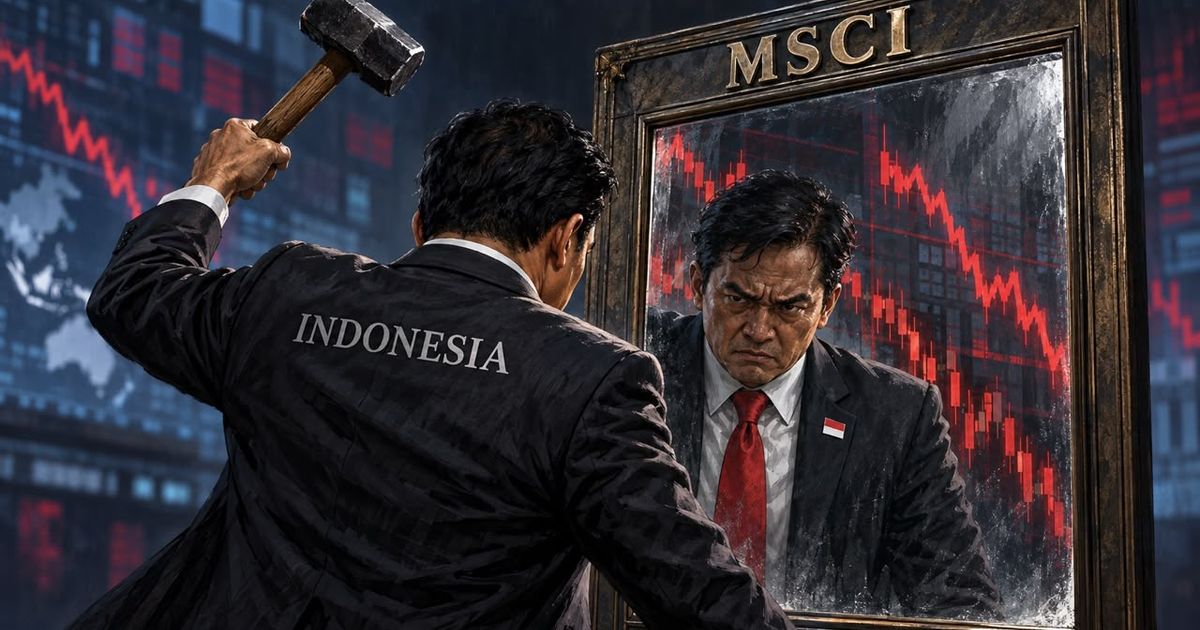
“Investor confidence in Indonesia’s capital market will not recover by attacking the assessor. It will recover when the causes of the poor assessment are addressed.”
JAKARTA, Investortrust.id — The Malay proverb “If the face is ugly, the mirror is smashed” aptly warns some Indonesian elites who are more occupied with blaming MSCI than examining the problems facing the country, including those affecting its capital market. When an unfavourable assessment arrives, accusations emerge that the global index provider is intent on destroying Indonesia’s capital market.
Even if there is a grain of truth in claims about MSCI’s motives, such accusations do nothing to answer the fundamental questions. The effects of MSCI’s assessment should prompt us to look inward. First, are government policies pro-business and pro-market, and do they respect the law? Second, is our market transparent, is trading fair, and are investors’ rights reliably protected?
As President Prabowo has urged, Indonesia must achieve self-sufficiency in food and energy. The country must stand on its own feet in various fields, including industry. But Indonesia, like every other country, cannot be self-sufficient in investment, whether direct or portfolio investment, including investment in its capital market.
No capital market in the world is independent. Capital markets grow through inflows from global investors and foreign funds managed by investment managers and investment companies. Many investment firms around the world rely on MSCI data and assessments.
The Indonesian capital market’s dependence on foreign funds is evident in data from the Indonesia Stock Exchange (IDX). Movements in the Jakarta Composite Index (JCI) generally track foreign investors’ decisions. When there is net buying, the JCI rises; when there is net selling, the index plunges.
Foreign investors’ cumulative net sales on the IDX reached Rp92.09 trillion from the start of the year to Wednesday (21 October 2026), despite recording modest net buying that day. The JCI’s 0.94% gain did little to change the picture of market pressure throughout 2026: the index remained down 38.38%, market capitalisation had shrunk by around Rp6,470 trillion, and every sectoral index had declined. The fall in IDX share prices was the steepest among the world’s exchanges.
Share buy-backs alone will not be enough to lift share prices. When prices are in a downtrend, buy-backs can instead harm companies with limited cash flow. Ordering state-owned enterprises to buy back shares puts pressure on companies that do not have sufficient cash flow. Buy-backs benefit only companies and individuals with enough cash flow to meet their needs for the next four to five years.
Share prices will recover if capital flows in and foreign investors return to net buying. The best response, therefore, is to implement MSCI’s recommendations. Rather than spend time attacking MSCI, it would be far better to improve the capital market and investment climate, strengthen governance and provide legal certainty.
As a global index and investment-analysis provider, the US company is a reference point for global investors allocating funds across countries. It would therefore be highly risky for MSCI to take unjustified action, let alone act merely at the request of particular parties seeking to obstruct and attack Indonesia.
Various sources told Investortrust that the main trigger for MSCI’s threat on 15 October 2026 was talk of nationalisation that showed disregard for the law. Legal uncertainty is investment’s chief enemy. Both foreign direct investment (FDI) and portfolio investment require legal certainty as a fundamental precondition.
The acquisition of PT Bayan Resources Tbk (BYAN) by the Jhonlin Group, owned by Haji Andi Syamsuddin Arsyad, also known as Haji Isam, and which appeared to resemble a hostile takeover, has compounded investment uncertainty in Indonesia. In the transaction, Jhonlin Baratama bought around 10.08 billion BYAN shares from Dato’ Low Tuck Kwong and Elaine Low. The purchase made the Jhonlin Group company a significant shareholder in Bayan Resources.
The substantial price difference in the Jhonlin Group’s purchase of a 30.25% stake in Bayan Resources has raised questions about whether the transaction was fair. The purchase price of Rp2,588 per share was about 79.4% below the regular-market closing price of Rp12,550 on 7 October 2026.
Why did Bayan’s owners agree to sell their shares so far below the market price? Although this does not prove that the sale was forced or that it constituted a hostile takeover, the acquisition of a large stake at below-market value has eroded investor confidence in Indonesia’s capital market.
Before the Bayan case has been resolved, rumours have intensified about a proposed hostile takeover of PT Bank Central Asia (BCA) Tbk shares from the Djarum family. Haji Isam has also been mentioned as a potential buyer. However, given the difficulty he has faced in securing funds to buy Bayan, there is strong speculation that the state or Indonesian government is behind the coal businessman. PT Bank Mandiri Tbk’s willingness to lend to Haji Isam against shares as collateral has further fuelled speculation that Danantara would be the main backer of the takeover.
The Hartono family, owners of the Djarum Group, currently controls 54.94% of BCA through PT Dwimuria Investama Andalan, equivalent to around 67.73 billion shares. This majority stake makes Dwimuria BCA’s controlling shareholder. In addition, BCA data as at 31 December 2025 show that parties affiliated with Dwimuria own 2.49%, bringing Dwimuria’s total ownership with its affiliates to 57.43%.
The transfer of a company’s majority shareholding is commonplace. However, when a publicly listed company gains a new controlling shareholder, the transaction must comply with a tender offer. Every investor, whoever they may be, must follow the tender-offer rules.
Financial Services Authority Regulation No. 9/POJK.04/2018 on the Takeover of Public Companies defines a controller as a party that owns more than 50% of voting shares or has the ability to determine the company’s management and/or policies, directly or indirectly. Accordingly, a shareholding below 50% may still constitute control if it carries the ability to determine the company’s direction.
If a transaction results in a change of control, the new controller is in principle required to conduct a mandatory tender offer, subject to the exceptions set out in the regulation. This mechanism is an offer to buy shares from other shareholders covered by the tender. An initial acquisition may therefore be conducted through a negotiated transaction, followed by a mandatory tender offer after control changes hands.
In principle, a mandatory tender offer protects minority shareholders when the party determining a company’s direction changes. A change of control can bring changes to strategy, dividend policy, asset management or risk profile. Shareholders who do not wish to continue investing under the new controller have the opportunity to sell through a process that provides disclosure and price protection.
The new controller is responsible for making the purchase offer, while shareholders remain free to decide whether to sell or retain their shares. The Financial Services Authority regulation also prohibits different conditions based on a shareholder’s status, unless differences in rights or benefits are attached to the shares.
The Bayan takeover has had a very damaging effect on global investors. The prospect of a state takeover of BCA shares is even more concerning. These actions are seriously eroding global investors’ trust in investment in Indonesia. “If this is not stopped, Indonesia will continue to be penalised by MSCI and global investors,” said a capital-market analyst close to MSCI and global fund managers.
We respect President Prabowo Subianto’s stance in forcefully criticising MSCI. “I will say this to MSCI: the Indonesian nation is not afraid of anyone, and will not be intimidated,” Prabowo said at a plenary cabinet meeting of the Red and White Cabinet in Jakarta on Wednesday (21 October 2026). The meeting provided an opportunity for the President to review the government’s two-year record and outline policy directions for the challenges ahead.
Prabowo mentioned MSCI at the end of his address, after discussing global challenges, the importance of safeguarding national wealth and the need to preserve unity. He said Indonesia continued to face obstacles as it sought to improve people’s lives.
“We continue to be obstructed. What is it? All sorts of things. MSCI. All sorts of things. They want to frighten us,” he said. In his public remarks, the President did not specify which MSCI action or assessment he was referring to.
Prabowo said the government would continue working in the face of such pressure. “We are not afraid. We have strength. We have courage. And we are willing to make sacrifices. We do not know what it means to surrender,” he said.
Not Firm Enough
As of 14 October 2026, MSCI had seen little meaningful progress from Indonesia’s capital market. The Financial Services Authority (OJK) and the IDX were considered insufficiently firm in curbing fictitious share trading, commonly known as stock manipulation or “gorengan” trading.
“I am surprised that market manipulation is not being dealt with firmly straight away. Why wait for MSCI sanctions?” said a businessperson whose company is listed on the IDX. The consequences of such conduct are not limited to good issuers: it damages the Indonesian capital market as a whole by undermining global investor confidence.
High Shareholding Concentration (HSC) can increase vulnerability to fictitious trading, particularly when the shares genuinely available to independent investors are very limited. In such circumstances, relatively small transactions can move prices sharply. If parties controlling shares trade in a coordinated manner to create the appearance of strong demand and high volumes, prices can be set artificially. However, HSC is a risk indicator, not automatic proof of manipulation or wrongdoing by an issuer.
This situation increases investor risk and raises concerns for global index providers. MSCI has cited unclear ownership structures and suspected coordinated trading as reasons for opening a consultation on changing Indonesia’s classification from Emerging Market to Standalone Market.
The issue is not simply the HSC label, but whether ownership is transparent and prices are formed fairly. If a reclassification is implemented, funds tracking the relevant indices would need to adjust their portfolios, potentially adding to selling pressure on Indonesian shares.
Fictitious trading is the manipulation of transactions to create the appearance of market activity or share prices that do not reflect genuine trading, for example, by buying and selling between accounts without changing the beneficial owner. The prohibition is set out in Article 91 of Law No. 8 of 1995 on Capital Markets, as amended by Law No. 4 of 2023 on the Development and Strengthening of the Financial Sector (the P2SK Law), which prohibits creating a false or misleading picture of securities trading, market conditions or securities prices.
Article 92 prohibits two or more securities transactions that create artificial prices to benefit oneself or another party. Thus, transactions without a change in ownership relate to Article 91; they are not the primary definition under Article 92.
Article 93 prohibits materially false or misleading statements or information that affect securities prices, subject to the elements of an offence specified by law. This provision provides a basis for action against misleading information that may accompany “gorengan” share trading.
The regulations are clear, MSCI has issued repeated warnings, and the Indonesia Stock Exchange has acknowledged that fictitious trading occurs. “But why are there no sanctions? Why was a willingness to impose sanctions announced only when MSCI threatened to downgrade Indonesia’s capital market from emerging-market to standalone status?” asked a businessperson, shaking their head.
Improve the Face, Not Smash the Mirror
MSCI’s concerns are specific. In its consultation announcement on 15 October 2026, MSCI highlighted unclear share-ownership structures, suspected coordinated trading and a lack of evidence of adequate enforcement. MSCI acknowledged that reforms were under way, but said institutional investors needed consistent implementation and tangible results. The proposed reclassification of Indonesia as a Standalone Market remains under consultation, not a final decision. The warning, however, is clear: announcing policies is not enough to restore confidence.
The most useful response is therefore to demonstrate the results of reform. If ownership structures are in question, disclose the ultimate beneficial owners. If suspected coordinated trading is undermining price formation, investigate and take action based on evidence. If enforcement is in doubt, show that violations have consistent consequences, whoever is responsible. Market credibility is built through actions that can be scrutinised.
Beyond the technical issues in the capital market, legal certainty determines whether investors are willing to commit funds over the long term. Investors buy shares believing that their ownership rights will be respected, contracts enforced and disputes resolved fairly. When those protections are in doubt, even promising returns may not be enough to keep capital in the market.
In this context, the Bayan takeover and the proposed takeover of BCA shares warrant the attention of the government, the OJK and self-regulatory organisations. Law enforcement must be demonstrated. Takeovers of listed companies must be transparent, open to scrutiny and provide a fair opportunity for parties to defend their interests. Legal certainty means that offenders can be punished while legitimate owners are protected from arbitrary action. Both are foundations of trust.
MSCI is not beyond criticism. Its methodology, data and conclusions can be challenged. If there are errors, Indonesia has the right to present a rebuttal supported by strong evidence. But accusing it of intending to destroy the country without proof merely diverts attention from the work that needs to be done. Challenging an assessment requires data; restoring trust requires a change in conduct.
Defending Indonesia means ensuring its capital market is worthy of trust. Nationalism should be demonstrated through the courage to improve governance, protect investors and enforce the law consistently. A healthy market benefits national companies, domestic savers, workers and Indonesia’s economy itself.
If the face itself is ugly, do not smash the mirror. Improve what it reflects. If the weaknesses lie in our governance and legal certainty, do not make MSCI a scapegoat. Our own failings must be addressed, not blamed on those who point them out.
IDX’s Positive Response
The Indonesia Stock Exchange (IDX) is preparing two new initiatives to strengthen share-ownership transparency and index credibility. The exchange will add affiliation information to its published data on shareholders with stakes of 1% and above, and remove all shares with high ownership concentration (HSC) from the calculation of the Share Price Index.