
BKSPTIS: Favouritism Spreading to High School Level, Private Universities Increasingly Marginalised
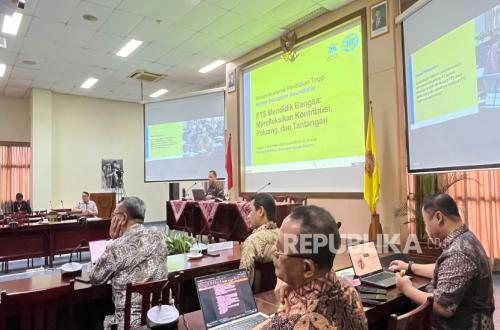
Government policies have been assessed as lacking support for Private Universities (PTS). The General Chairman of the Indonesian Association of Private Islamic Universities (BKSPTIS), Fathul Wahid, stated that practices of favouritism have now spread to the secondary education level (SMA/SMK).
Graduation announcements that frequently highlight the percentage of students entering public universities (PTN) indirectly create a public perception that public universities are inherently higher in quality and superiority. As a result, private universities feel marginalised.
“Education in Indonesia is not yet equal. Meritocracy is important, but only for those who are already on an equal footing. For private universities, especially in peripheral areas, the state must be present with affirmative policies, rather than merely uniformising standards,” said Fosthul during the Higher Education Roundtable themed ‘Private Universities Educating the Nation: Reflecting on Contributions, Opportunities, and Challenges’ at Sanata Dharma University, Yogyakarta, on Tuesday (8/9/2026).
The former Rector of Universitas Islam Indonesia (UII) plans to mobilise widespread support through a public petition on Change.org. This step is intended to ensure that the aspirations of private universities are heard more loudly by policymakers and to encourage significant changes on the ground.
The Chairman of the Indonesian Catholic Universities Association (APTKI), Johanes Eka Priyatna, provided concrete examples of regulations that disadvantage private universities in contrast to the treatment of public universities.
“Sanata Dharma University once opened a Chemistry Study Programme and received funding from South Korea worth Rp 20 billion, but the process took more than three years. Meanwhile, public universities can open new study programmes at any time without needing such permission,” said Eka.
Such policies are feared to diminish the quality of national Human Resource (HR) development. In reality, many private universities were established long before many public universities existed. According to Johanes, existing regulations are perceived as being more about controlling rather than facilitating and providing space for private universities to grow.
The discussion, which involved cross-sector representatives from Christian, Hindu, and Buddhist communities, highlighted various concerns regarding policy direction and the current development of private universities in Indonesia.
Attended by 20 representatives from various universities across Indonesia, the discussion aimed not only to respond to the declining student interest in private universities but also to address serious concerns regarding the quality of Indonesian human resources. University leaders assessed that current higher education governance policies are not being implemented consistently.
The root of the problem stems from limited state budgets for the operation of public universities, which has encouraged the government to grant flexible policies to public institutions so they can collect funds from the public. Consequently, new student admissions in public universities have surged drastically, exceeding their intended capacity.