
BKPM strengthens EV-BESS battery development to drive strategic downstreaming
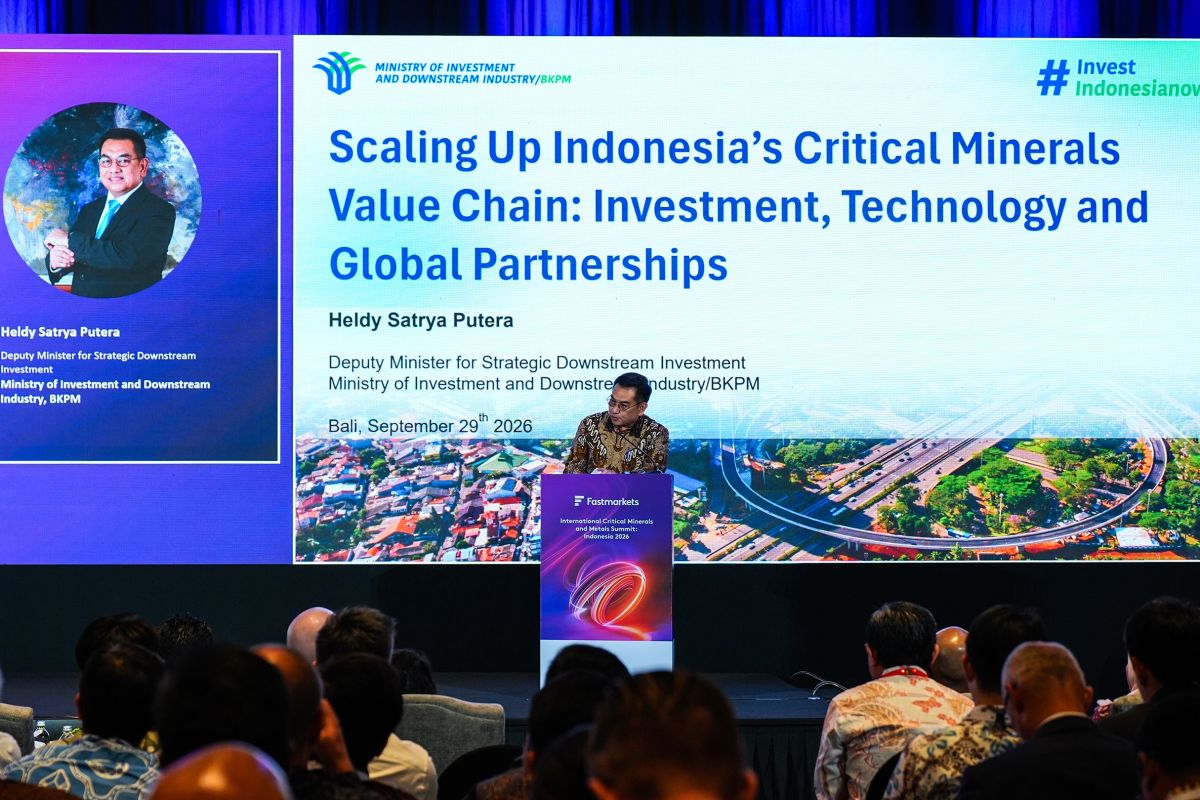
Jakarta (ANTARA) - The Ministry of Investment and Downstreaming/Investment Coordinating Board (BKPM) is strengthening the development of the electric vehicle (EV) battery industry, Battery Energy Storage Systems (BESS), and high-value-added manufacturing as the next phase of strategic mineral downstreaming in Indonesia.
The Deputy for Strategic Investment Downstreaming at the Ministry of Investment and Downstreaming/BKPM, Heldy Satrya Putera, stated that the development of EV batteries and BESS marks the second stage of downstream industry development, following the construction of smelters and refining facilities.
In an official statement received in Jakarta on Wednesday, Heldy noted that the agency has drafted a downstream industry development roadmap covering 2long 28 strategic commodities, with an estimated investment requirement reaching $618.1 billion USD until 2040.
Indonesia’s downstream development is currently being implemented through three strategic stages, with the foundation of mineral processing already established through smelters and refining facilities.
“Currently, our priority is entering stage two, which is expanding development into the electric vehicle battery industry, Battery Energy Storage Systems (BESS), and other high-value-added manufacturing,” he said.
He also noted that downstream investment realisation has reached a significant scale. In the first semester of 2026, downstream investment was recorded at Rp300.1 trillion, representing 29.7 per cent of the total national investment realisation. This figure grew by 6.9 per cent compared to the same period in the previous year.
Of the total realisation, foreign direct investment (PMA) reached Rp212.8 trillion or 70.9 per cent, while domestic investment (PMDN) stood at Rp87.3 trillion or 29.1 per cent.
This achievement demonstrates the progress of Indonesia’s downstream industry and opens opportunities to strengthen the national position within the global critical mineral value chain.
The next stage is directed towards strengthening competitive markets, increasing long-term investment, and enhancing the national industry’s capability to produce products that meet the needs of global buyers.
He mentioned that the agency, in collaboration with Fastmarkets, will organise the International Critical Minerals and Metals Summit (ICMMS), taking place from 27–30 September 2026 in Bali.
The event will bring together government officials, investors, industry players, processing companies, battery material producers, financial institutions, and commodity traders from various countries.
Furthermore, in the nickel processing sector, discussions will cover the economics of High Pressure Acid Leach (HPAL), the competitiveness of sulphuric acid, and various processing technology options.
Meanwhile, the development of precursors and cathodes faces more complex challenges, involving not only raw material availability but also technology, product quality, buyer certainty, and project economics.
Therefore, discussions on battery materials at the ICMMS 2026 will also highlight downstream products that possess market potential and the ability to compete within the global electric vehicle supply chain.