
BKPM says CCS drives decarbonisation and strengthens investment appeal
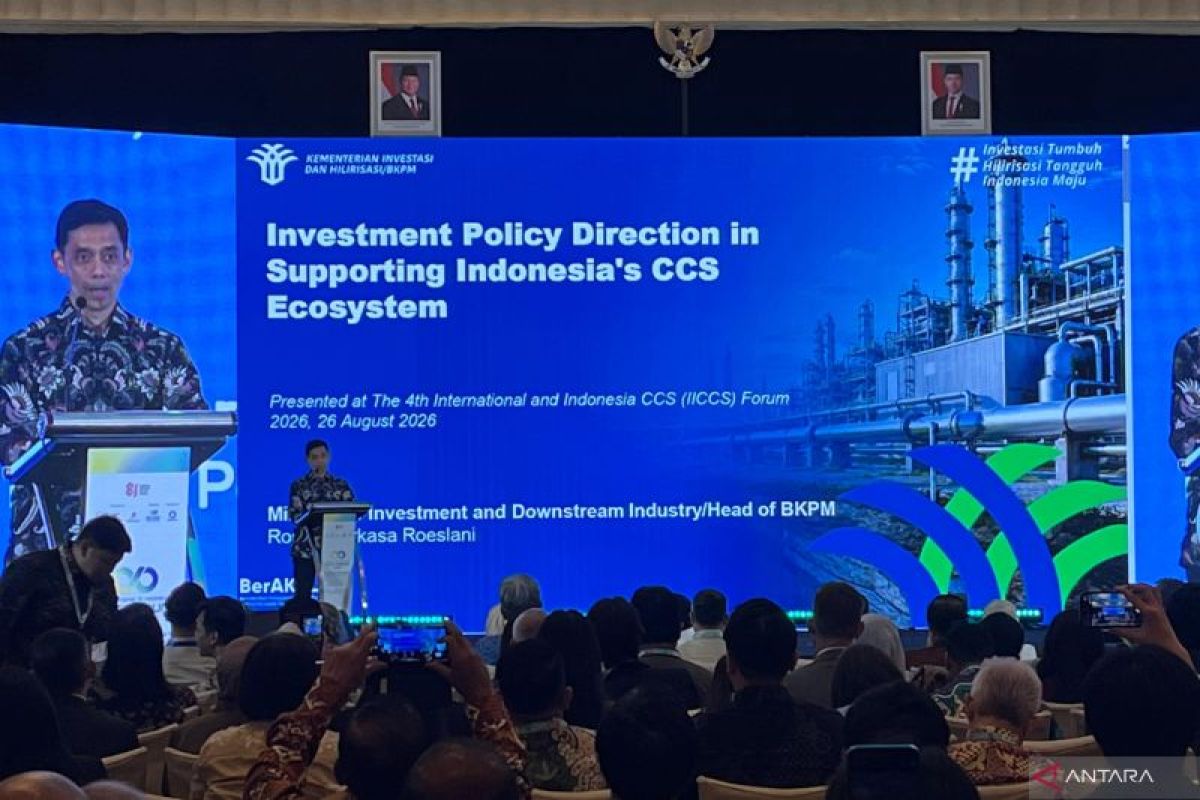
Jakarta (ANTARA) - The Ministry of Investment and Downstreaming/Investment Coordinating Board (BKPM) considers Carbon Capture and Storage (CCS) to be an instrument for driving decarbonisation while strengthening Indonesia’s investment appeal.
Deputy for Investment Planning at the Ministry of Investment and Downstreaming/BKPM Ichsan Zulkarnaen said CCS plays an important role in helping various industrial sectors reduce their carbon footprint in order to remain competitive in the global market.
“So, CCS is strategic because it supports decarbonisation in sectors that find emission reduction difficult, such as oil and gas, cement, fertiliser, petrochemicals, refineries, power generation, and so on, while also increasing the attractiveness of industrial investment,” Ichsan said at the International and Indonesia CCS Forum 2026 in Jakarta on Wednesday.
According to him, the implementation of CCS provides a number of strategic benefits for industry, ranging from emission reduction to maintaining corporate competitiveness in the face of global carbon policies.
He explained that CCS is capable of capturing more than 90 percent of carbon emissions before they are released into the atmosphere. In addition, this technology can also help industry anticipate potential carbon costs or the implementation of carbon taxes in the future.
He assessed that Indonesia holds a strategic position in CCS development because it has a large industrial base as well as abundant carbon storage potential.
Based on current estimates, Indonesia has CO2 storage potential of more than 577.62 gigatonnes spread across a number of regions.
Indonesia also has carbon storage options both onshore and offshore, as well as a strategic position in Asian trade routes.
He revealed that BKPM has mapped a number of potential clusters for CCS development based on the proximity between industrial emission sources and carbon storage locations.
The four clusters include South Sumatra with potential emissions of around 3 million tonnes per annum (mtpa) and identified storage capacity of 584 million tonnes, West Java with emissions of around 13 million tonnes per annum and storage capacity of 612 million tonnes.
Furthermore, East Java with emissions of around 9 million tonnes per annum and storage potential of 345 million tonnes, and Kalimantan with emissions of around 15 million tonnes per annum and storage potential of 1,945 million tonnes.