
BKPDM Kemendikdasmen Strengthens Contextual Education Policy
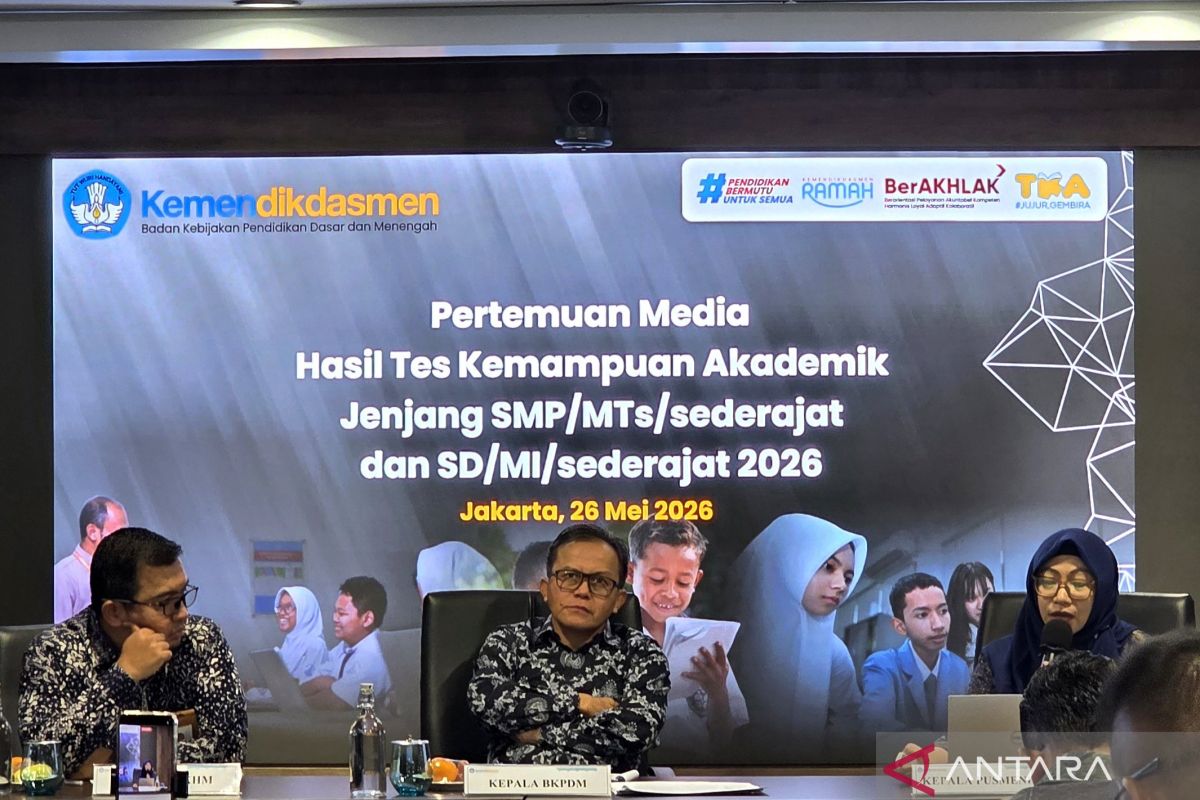
The Basic and Secondary Education Policy Agency (BKPDM) under Kemendikdasmen has stated that the renaming signifies a new direction for national education governance, with policies that are more contextual, data-driven, integrated, and grounded in school learning realities.
BKPDM Kemendikdasmen Head Toni Toharudin in Jakarta on Tuesday said the renaming from the Education Standards, Curriculum, and Assessment Agency (BSKAP) to the Basic and Secondary Education Policy Agency (BKPDM), as outlined in Presidential Regulation No. 6 of 2026, is more than just a name change.
Schools are still struggling to achieve basic literacy, teachers are instructing with limited resources, there are regional disparities in learning quality, and the post-pandemic learning gap remains largely unassessed.
Therefore, he said, BKPDM Kemendikdasmen is not just a body for setting education standards and technical tools, but also a centre for analysis, integration, and policy recommendations to ensure decisions are rooted in real-world needs.
‘Education policies must be closer to the actual conditions in schools. We can no longer formulate policies from the top down but must understand how students learn, the challenges teachers face, and the true quality of classroom learning,’ said Toni.
He added that this mandate transformation shows today’s education challenges can no longer be addressed with purely administrative approaches.
Issues such as learning quality, disparities in educational outcomes, curriculum implementation effectiveness, and evolving future competencies require more precise, adaptive, and contextual policies, he said.
It is at this point that BKPDM Kemendikdasmen’s strategic function becomes increasingly crucial.
Education data is no longer seen as merely administrative support but as a key instrument for comprehensively understanding education issues.
From this data, the government can identify regions needing urgent intervention, track student learning progress, and evaluate which policies are truly effective in schools.
‘We are strengthening policy analysis and recommendation functions to ensure every education programme aligns with on-the-ground needs. This way, policies are not just good on paper but have tangible impacts on learning quality,’ Toni said.
Assessments are no longer viewed merely as tools to measure learning outcomes but as instruments to deeply understand the student learning process.
Thus, education policies can be formulated based on evidence and students’ real needs, not just assumptions.