
BI's Destry Reveals 4 Major Challenges for Central Banks in the Era of AI and Global Fragmentation
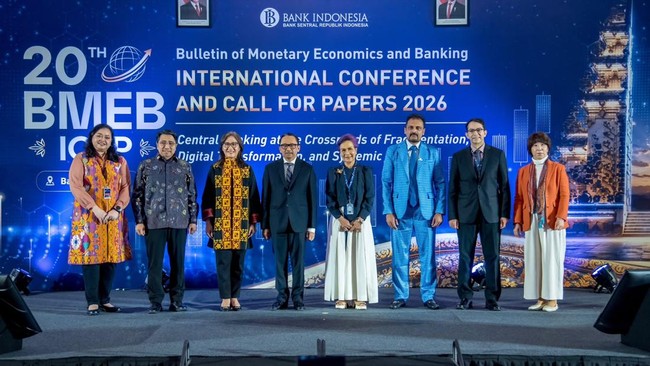
Acting Deputy Governor of Bank Indonesia (BI), Destry Damayanti, has reminded that central banks worldwide face increasingly complex challenges due to geoeconomic fragmentation, accelerating digital transformation and rising systemic risks.
According to Destry, these conditions mean that policy approaches which have so far operated on a sectoral basis are no longer adequate. Central banks are now required to integrate various policy instruments, ranging from monetary policy, macroprudential policy, the payment system and financial markets, to coordination with fiscal policy.
Destry delivered this message whilst opening the 20th Bulletin of Monetary Economics and Banking (BMEB) International Conference and Call for Papers in Bali on 31 July 2026. This year, the conference carries the theme “Central Banking at the Crossroads of Geoeconomic Fragmentation, Digital Transformation, and Systemic Risks”.
Destry affirmed that, to address these challenges, central bank research must be directed towards a number of priority agendas relevant to changes in the global economic and financial landscape.
The first priority is to strengthen understanding of monetary policy transmission amid rising geoeconomic fragmentation affecting global trade, investment and capital flows.
Second is deepening studies on digital finance developments and their implications for central bank policy. These studies encompass digital payment systems, artificial intelligence (AI), financial technology (fintech), crypto assets and digital currencies.
Furthermore, BI also considers it important to develop systemic risk measurement and macrofinancial supervision capable of anticipating various new risks, ranging from cyber threats and climate change to liquidity pressures and cross-country risks.
The fourth agenda is to strengthen institutional credibility and policy communication in order to maintain public trust in the monetary authority.
“Bank Indonesia is committed to continuously strengthening a quality research ecosystem relevant to policy, in order to support evidence-based policymaking amid changes in the global economic and financial landscape,” Destry asserted.
On the same occasion, Deputy Finance Minister Juda Agung highlighted the importance of policy coordination amid rising global uncertainty.
According to Juda, economic authorities face a challenge known as the policy trilemma, namely simultaneously maintaining exchange rate stability, capital flow mobility and monetary policy independence.
Therefore, he emphasised that monetary policy cannot work alone. Economic stability requires support from fiscal policy, macroprudential policy and complementary liquidity management.
Juda viewed strong coordination between authorities as a key factor in maintaining macroeconomic stability whilst sustaining the momentum of national economic growth.
This year’s BMEB conference also highlighted various strategic issues currently of concern to central banks and policymakers around the world.
In the session on geoeconomic fragmentation, academics highlighted the growing influence of global shocks on monetary policy, trade and investment. These conditions were judged to require stronger policy coordination, the use of scenario-based analysis and international cooperation to safeguard economic stability and investment resilience.
Meanwhile, on the theme of digital transformation, discussions focused on the rapid development of digitalisation, artificial intelligence (AI) and financial innovation transforming the landscape of payment systems, money and global financial markets.
Speakers also discussed various forms of digital money, from stablecoins and tokenised deposits to wholesale central bank digital currencies (CBDC). In addition, they emphasised the importance of building a digital financial ecosystem that is more efficient, interoperable and resilient to face future challenges.
The BMEB international conference was attended by researchers, academics, policymakers and various international institutions. The forum served as a platform for exchanging ideas and experiences in formulating policy recommendations to address increasingly complex global economic dynamics.
Interest in the conference was also reflected in the high level of participation in the BMEB 2026 Call for Papers. Bank Indonesia recorded 354 full papers from 34 countries entering the selection process.
Through the forum, BI hopes that collaboration between academics and policymakers can continue to be strengthened in order to produce relevant research and support evidence-based policymaking amid ever-faster changes in the global economy and finance.
Source: jawawa.id (https://jawawa.id/newsitem/bis-destry-reveals-4-major-challenges-for-central-banks-in-the-era-of-ai-and-global-fragmentation-1785894669)
Originally published by CNBC Indonesia (https://www.cnbcindonesia.com/market/20260805071300-17-756609/destry-ungkap-4-pr-besar-bank-sentral-di-era-ai-fragmentasi-global), translated from Indonesian