
Bird's Eye Chilli Prices Surge Nationally, Ministry of Agriculture Provides Unexpected Response
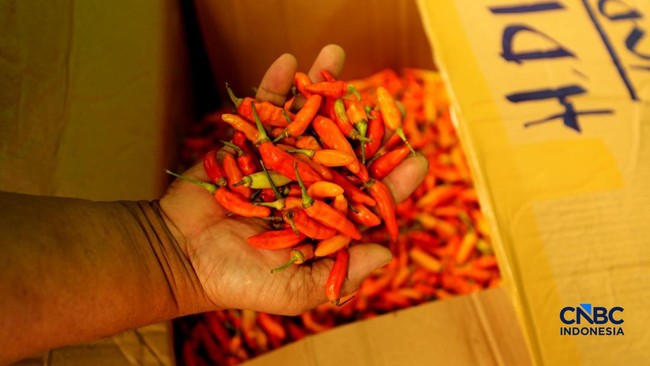
Bird’s eye chilli prices continue to show an upward trend in various regions. The Central Statistics Agency (BPS) noted that as of the third week of September 2026, 265 regencies/cities experienced increases in bird’s eye chilli prices.
Nationally, the price of bird’s eye chilli in the third week of September reached Rp77,596 per kilogram (kg), an increase of 29.85% compared to August. This price is already above the maximum retail price (HAP) ceiling of Rp57,000 per kg.
The rise in bird’s eye chilli prices has become a concern because this commodity falls into the category of high price levels alongside high volatility in the inflation volatility index (IPH). In the BPS matrix, bird’s eye chilli is the only commodity in this category.
In fact, several regions recorded bird’s eye chilli prices far above the HAP ceiling. According to BPS data, prices in East Halmahera reached approximately Rp199,556 per kg, North Halmahera Rp160,000 per kg, Sangihe Islands Rp161,511 per kg, East Bolaang Mongondow Rp144,333 per kg, and North Gorontalo Rp144,444 per kg.
The Director of Vegetables and Medicinal Plants at the Ministry of Agriculture, Sudi Mardianto, stated that from a production standpoint, bird’s eye chilli is actually available in various regions of Indonesia. In the third week of September, national bird’s eye chilli production was estimated to reach 132,926 tonnes.
Approximately 79% of bird’s eye chilli production is located on Java Island, while the remainder is spread across several regions such as Sumatra and Sulawesi.
Although production supply is quite widespread, there is a significant price disparity between the farmer level and the market, particularly in Jakarta.
“Therefore, with such a high difference, there is actually price speculation occurring that is too high,” said Sumbu during the Regional Inflation Control Coordination Meeting on Monday (21/9/2026).
According to Sudi, the government can utilise ‘champion farmers’ to help supply chilli when price intervention is required. Several production centres mentioned include Malang, Sampang, and East Lombok.
“In fact, these champions are already prepared to supply in order to intervene in the price,” he said.
The Ministry of Agriculture also opened the option to divert supplies from production centres in Java to eastern Indonesian regions if price intervention becomes necessary.
“So, if our friends in the eastern region require price intervention, we can bring supplies, particularly from Java, which is relatively closer,” he added.
National Food Agency (Bapanas) Highlights Distribution Issues
Meanwhile, the Deputy I for Food Availability and Stabilisation at Bapanas, Hermawan, stated that national food availability remains maintained until the end of the year.
For bird’s eye chilli, available stocks are projected to reach 60,280 tonnes. However, according to Hermawan, the current issue with chilli is not solely related to national stock availability. Distribution and the balance of supply between regions also pose challenges.
“This means our main challenge currently is not merely national availability, as everything is sufficient until the end of the year. But we must maintain distribution and balance between regions,” Hermawan said on the same occasion.
As one of the efforts to maintain this balance, Bapanas has been mobilising bird’s eye chilli from production centres to regions experiencing price hikes.
One such effort involved sending bird’s eye chilli from East Java to Manado. On 14 September, 2.4 tonnes were sent, followed by another 2.5 tonnes on 20 September.
Thus, the total amount of bird’s eye chilli mobilised from East Java to Manado reached 4.9 tonnes.
“So, a total of 4.9 tonnes was sent from East Java to North Sulawesi or Manado,” he noted.
Hermawan stated that this distribution pattern will continue to be optimised. The government will also use price differences between regions as a basis for determining the direction of supply mobilisation.
“Because we see that sometimes between regencies, one neighbouring regency has quite low prices while its neighbour is quite high,” he concluded.