
Biofertilizer Technology Applied to Strengthen Sustainable Agriculture
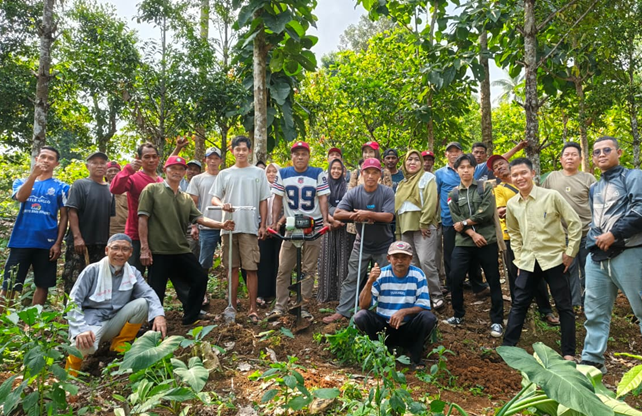
Strengthening sustainable agricultural practices on sloping land is a key step in maintaining food productivity while preventing land degradation. This effort is being realised through a community service programme titled ‘Application of Integrated Soil-Water Conservation and Biofertilizer Technology in Empowering Farmer Groups on Degraded Land for Sustainable Agriculture’.
The programme is being implemented in Gunung Rejo Village, Way Ratai District, Pesawaran Regency, Lampung. The area, situated on mountain slopes and directly bordering Register 19 of the Wan Abdul Rahman Grand Forest Park, faces various challenges, including erosion, surface water runoff, declining soil fertility, and unstable harvest yields.
This activity is part of a Community Service Programme grant under the Community-Based Empowerment scheme, within the scope of Community Partnership Empowerment, funded by the Directorate of Research and Community Service, Directorate General of Research and Development, Ministry of Higher Education, Science, and Technology of the Republic of Indonesia for the 2026 Fiscal Year.
The programme’s chief executive, Ansyori, a lecturer at the Faculty of Agricultural Technology, Universitas Satu Nusa Lampung, stated that the programme is designed to help farmers manage sloping land more productively while maintaining environmental sustainability.
‘On sloping land, erosion can strip away the topsoil, which is crucial for fertility. The impact not only reduces the soil’s water storage capacity but also increases production costs and makes harvest yields unstable. Therefore, soil and water conservation must be combined with the use of locally sourced biofertilizers,’ Ansyori explained.
He detailed that the activities began with field observations in December 2025, involving land condition mapping, identification of local resource potential, and an inventory of the problems faced by farmers. Subsequent stages included socialisation in May 2026, training in late June 2026, and technology implementation in July 2026. The programme will then continue with mentoring, evaluation, and efforts to maintain the sustainability of the activities.
During the implementation phase, farmers received training on various soil and water conservation techniques, such as constructing silt pits, biopores, contour-aligned land cultivation, using mulch, and strengthening erosion-control vegetation. These techniques aim to slow surface water flow, increase soil absorption capacity, and prevent the topsoil from being easily eroded.
Furthermore, farmers were introduced to biofertilizer technology through the production of compost and liquid organic fertiliser. The use of local organic materials is expected to produce environmentally friendly fertilisers that are easy to manufacture and reduce dependence on chemical fertilisers. To support the programme’s implementation, the team also handed over several pieces of equipment, including a chopping machine, a biopore drilling machine, and various supporting tools for compost making, liquid organic fertiliser production, and the application of soil-water conservation technology on agricultural land.
The head of the Sido Makmur Farmer Group, Surahno, assessed that the programme meets the needs of farmers in the Way Ratai area who face challenges in managing sloping land.
‘We hope this activity can help improve soil conditions, reduce land degradation, and increase agricultural yields. With the training and equipment assistance, farmers also become more self-reliant in making organic fertilisers and implementing land conservation techniques,’ he said.
Similarly, the Agricultural Extension Coordinator for Way Ratai District, Subhan Saputra, noted that the involvement of higher education institutions is a crucial factor in accelerating the adoption of appropriate technology among farmers. According to him, managing sloping land requires an approach that not only pursues increased production but also maintains the sustainability of soil and water resources.
Beyond the technical aspects, the programme also encourages the enhancement of farmers’ capacity in farm business management. Participants are mentored to record production costs and harvest yields, compile planting calendars, calculate input requirements, and apply simple standards in land management, biofertilizer production, and the maintenance of conservation infrastructure.
This programme supports the achievement of Sustainable Development Goal 2: Zero Hunger, by strengthening agricultural productivity and local food security. The activity is also aligned with the national Asta Cita vision in promoting national self-reliance through food sovereignty, a green economy, and the sustainable use of local resources.
From a scientific development perspective, the programme supports the applied research and downstream agenda within the National Research Master Plan. The technology developed does not stop at the academic level but is directly applied and mentored at the farmer level, making it a potential community empowerment model that can be replicated in other regions.
Through the integrated application of soil-water conservation and biofertilizer technology, the sloping agricultural land in Way Ratai is expected to be managed more productively, efficiently, and sustainably. The programme also demonstrates the importance of collaboration between universities, agricultural extension workers, and the community in strengthening food security starting from the village level.