
Bioethanol Feedstock for E20 Programme to Vary by Region, Here's Why
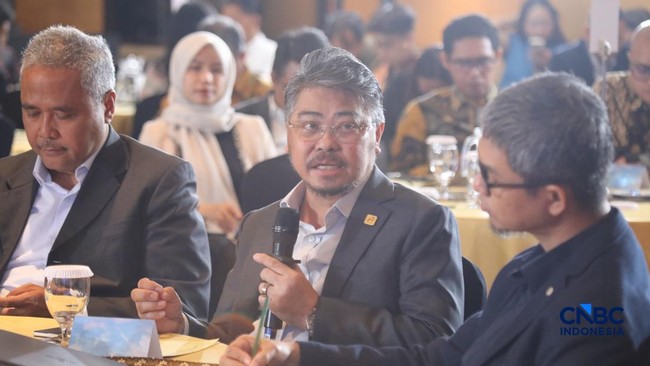
PT Pertamina New and Renewable Energy (NRE) has noted that every region in Indonesia possesses unique potential for raw materials for the 20% bioethanol (E20) programme. Consequently, the company is implementing a multi-region strategy for the supply of E20-blended petrol.
John Anis, President Director of Pertamina NRE, explained that the differences in natural resources across various provinces are a key consideration in determining the types of raw materials to be processed. He stated that this approach, based on local advantages, will strengthen supply chain efficiency to support national energy independence.
“Why multi-region? Because each region has different potential. Some have potential for corn, others for sugarcane, so we will go there,” he said during the CNBC Indonesia Energy Forum in Jakarta.
The aim is to ensure that every production facility has direct access to the nearest plant-based raw material sources, such as sugarcane in East Java or cassava and sorghum in Lampung. Through precise regional mapping, the government hopes that bioethanol production costs can become more competitive and sustainable.
“Our strategy here consists of three pillars: multi-feedstock, multi-generation, and multi-region,” he added.
Pertamina NRE plans to add at least five new processing facilities spread across Central Java, East Java, Lampung, and Sulawesi. In addition to sugarcane and cassava, the company is also exploring the potential of palm sugar and agricultural waste as second-generation raw materials to avoid competition with food supplies.
“We are also testing sweet sorghum; with PTPN, we have checked in Lampung to plant 2 to 4 hectares of sorghum, including research-based sorghum from Japan that is three times more efficient,” he concluded.
Government Targets
The Ministry of Energy and Mineral Resources (ESDM) is preparing a road test plan for petrol blended with 20% bioethanol (E20) to meet the target for mandatory bioethanol blending in Indonesia.
Eniya Listiani Dewi, Director General of New, Renewable Energy, and Energy Conservation (EBTKE) at the Ministry of ESDM, revealed that they have communicated with the Indonesian Automotive Industry Association (Gaikindo) to begin these tests. The goal is to conduct engine testing promptly to assess the readiness of the national automotive industry infrastructure.
“I am asking the association to join us in conducting the E20 road test directly. I have requested the Gaikindo team to do this as soon as possible,” she said at the Ministry of ESDM office in Jakarta.
Before reaching the E20 stage targeted for 2028, the government is currently focusing on completing the implementation of the 5% ethanol blend (E5). Eniya mentioned that the E5 mandate must be operational before December this year to stay on track for the 10% blend (E10) target in early 2027.
“Our main target is to mandate 5% before December, as we are chasing the 10% target for January. The 20% target will follow in January 2028,” Eniya explained.
Currently, the E5 implementation process is only awaiting the issuance of a Ministerial Decree (Kepmen) regarding the allocation volume of the plant-based petrol. The government has also finalised several supporting regulations, including tax exemptions through a Minister of Finance Regulation (PMK) and the simplification of fuel blending business permits.
“For E5, we are just waiting for the allocation decree. The PMK for tax exemption has been issued. Additionally, there is a regulation regarding the simplification of permits, where only a new business identification number (KBLI) is required,” she added.
The ministry is also overseeing infrastructure readiness at PT Pertamina (Persero), particularly regarding the reactor cleaning process to ensure smooth E5 distribution. Technically, Lemigas is still conducting tests on ethanol blending across various octane ratings to find the most appropriate specification for the market.
“The decision for E5 depends on the Minister. I am waiting for Pertamina; there are tests being conducted at Pertamina that have been submitted to Lemigas. We will certainly discuss the ethanol before it is mandated,” she said.
Eniya believes that modern vehicle engine technology is capable of consuming petrol with ethanol blends of up to 30%. However, the government will continue to conduct measured trials to ensure that the energy transition in the transport sector provides optimal efficiency benefits for the public.
“I am confident that current car products can handle up to 30%. This is documented in journals. I am sure 30% is not an issue; the question is in which year we can achieve E10, E20, and eventually E30. That is why I have asked the association to proceed with the road tests immediately,” she concluded.
Source: jawawa.id (https://jawawa.id/newsitem/bioethanol-feedstock-for-e20-programme-to-vary-by-region-heres-why-1782816759)
Originally published by CNBC Indonesia (https://www.cnbcindonesia.com/news/20260630150010-4-746877/sumber-bahan-baku-bioetanol-e20-tiap-daerah-bisa-beda-ini-alasannya), translated from Indonesian