
Biodiesel B50 Becomes Key to Indonesia’s Energy Independence
The survival of a nation and state depends on several important factors, one of which is the ability to secure energy without relying on other countries. Energy self-sufficiency has therefore been a strategic programme of President Prabowo Subianto and Vice-President Gibran Rakabuming Raka’s administration since it was formed on 21 October 2024.
The mandatory B50 biodiesel programme is one of the government’s practical steps towards national energy independence and security. Speaking at the launch of the mandatory B50 programme at the KM 57 rest area in Karawang Regency, West Java, on Thursday (9 July 2026), Prabowo said that amid global challenges and uncertainty, the government was accelerating efforts to achieve national energy independence.
“I am pushing for it; I am demanding energy independence from my team. B40 is not enough. At the time, I was even pushing for B100. But my ministers convinced me, saying, ‘Sir, with B50 alone, we will no longer import diesel from abroad.’ So this is an extraordinary achievement for the nation,” Prabowo said.
Prabowo again emphasised the importance of B50 during a plenary Cabinet meeting at Merdeka Palace in Central Jakarta on Wednesday (21 October 2026). He said that, amid the current rise in global oil prices, Indonesia was fortunate to have other substantial energy sources.
“We still have plenty of coal and geothermal resources, and, in particular, we can make diesel fuel from crops. Our biodiesel will be a great help. We have reached B50,” he said.
“And we will strive for E50 ethanol. Perhaps this year we can only reach E10, then E20 in two years, and E50 two years after that. Once we have E50 and B50, we will not need to import fuel from abroad,” he said.
According to 2025 data from the Ministry of Energy and Mineral Resources (ESDM), Indonesia’s total diesel requirement was 39.15 million kilolitres. Domestic refineries produced 18.56 million kilolitres of diesel, while biodiesel (FAME) production reached 13.16 million kilolitres. Diesel imports amounted to 4.9 million kilolitres.
As of January 2026, demand for blended diesel stood at 39.8 million kilolitres. Under the B40 scheme, demand for pure diesel (B0) was 23.9 million kilolitres. National diesel production reached 26.5 million kilolitres, representing a potential surplus of 2.6 million kilolitres of pure diesel.
This is where the B50 programme becomes urgent: it is designed to replace imports by increasing the share of biodiesel. The programme has also become a symbol of the government’s commitment to building an increasingly independent, resilient and sovereign Indonesia by making optimal use of natural resources for the greatest prosperity of the people.
Technically, B50 blends 50 per cent biofuel made from palm oil with 50 per cent petroleum diesel. Energy and Mineral Resources Minister Bahlil Lahadalia said the policy was about more than simply increasing the biodiesel blend in diesel fuel.
Bahlil said the policy reflected the government’s commitment to diversifying energy sources, adding value to the national economy and strengthening the energy sector’s independence. Indonesia is one of the world’s largest producers of crude palm oil (CPO).
Indonesia should continue to make the most of this resource to generate greater value for the national economy and improve public welfare, he said. Ultimately, the country would be able to reduce diesel imports.
“B50 is not merely a new form of energy; it is part of an energy transformation that optimises Indonesia’s potential to strengthen national energy security as a foundation for the country’s economic development,” said Bahlil, who has also served as Coordinating Minister for Downstreaming and Energy Transition since 1 October 2026.
According to the ESDM Ministry, mandatory B50 is projected to deliver tangible economic benefits compared with B40. Foreign-exchange savings are forecast to rise from Rp133.3 trillion under B40 to Rp170 trillion under B50. The added value generated by the CPO industry is projected to increase from Rp20.92 trillion to Rp23.49 trillion.
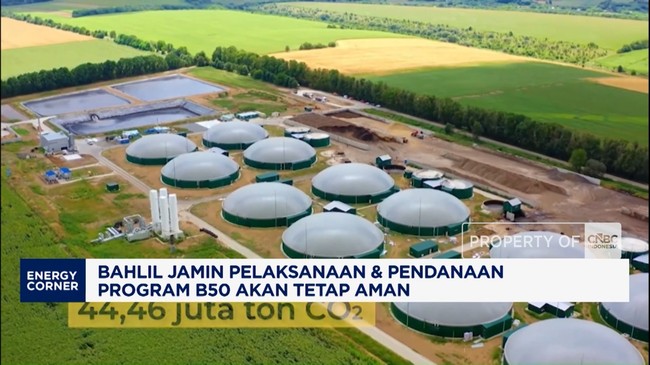
The B50 programme is also expected to support around 2.1 million jobs. To implement it, biodiesel demand is projected to reach 16.7 million–18 million kilolitres, requiring around 15.2 million–16.3 million tonnes of CPO. Environmentally, B50 is forecast to reduce carbon dioxide (CO2) emissions by up to 44.46 million tonnes, more than the 39.66 million-tonne reduction achieved under B40.
The state-owned railway company PT KAI (Persero) has begun adopting B50 in stages. Since January 2026, all diesel-powered locomotives and power-generation trains operated by KAI have used B40. From 1 July 2026, the company began using B50 in all diesel-powered locomotives and power-generation trains serving its long-distance and local services.
KAI Vice-President of Corporate Communications Anne Purba said the move was part of the company’s strategy to improve operational energy efficiency and help reduce carbon emissions from rail journeys.
“Future transport requires increasingly efficient and measurable energy management. By implementing B50, KAI is continuing to optimise energy use through a higher biodiesel content, supporting more sustainable railway operations,” Anne said.
However, despite these encouraging gains, there are challenges that must not be overlooked, said Wisnu Aji Nugroho, a supervisory board member and instructor at the Indonesian Association of Audit Committees. CPO is not only a raw material for biodiesel; it is also essential to cooking oil, the oleochemical industry and exports.
The additional CPO required for B50 must be managed carefully to avoid putting pressure on cooking-oil supplies and prices. The government has sought to address this risk by strengthening the Domestic Market Obligation (DMO).
Trade Ministry Regulation No. 20 of 2026 requires producers to supply packaged cooking oil for household needs before exporting or supplying the biodiesel industry. The effectiveness of this measure will depend on distribution oversight and regular price monitoring.
Looking ahead to 2027, Wisnu advised the government to implement B50 flexibly. If CPO production falls sharply or cooking-oil prices exceed a critical threshold, biodiesel allocations could be adjusted temporarily without abandoning the policy.
“The government should also prioritise food before energy, improve palm-oil productivity without expanding land use, secure biodiesel funding through BPDPKS, and increase strategic stocks of diesel, biodiesel and cooking oil,” he wrote in an opinion piece published by CNBC Indonesia on 16 October 2026.
Challenges on the path to energy independence
In its October 2026 book, Economic Evaluation of President Prabowo’s Two Years in Office, INDEF identified the biodiesel programme as a significant achievement in efforts to reduce dependence on diesel imports.
According to a performance report by the ESDM Ministry’s Directorate General of New, Renewable Energy and Energy Conservation, biodiesel use reached 14.9 million kilolitres in 2025 under the B40 policy, up from about 13.2 million kilolitres in 2024. The government reported estimated foreign-exchange savings of Rp132.81 trillion and an additional Rp20.84 trillion in value from CPO processing.
“However, these estimated foreign-exchange savings should not immediately be interpreted as net economic savings, because the costs of biodiesel incentives, palm-oil feedstock prices, the impact on cooking-oil prices, and production and distribution costs must also be taken into account. A more comprehensive assessment must calculate the net economic benefit, not merely the gross value of import substitution,” INDEF wrote in the report.
According to the INDEF report, the government began implementing B50 nationally in July 2026. Pertamina Patra Niaga reported the first B50 deliveries from the Kasim and Plaju refineries, totalling 12,830 kilolitres.
INDEF said this development demonstrated progress in diversifying energy sources using domestic commodities. However, increasing the biodiesel blend from B40 to B50 also raises demand for palm-oil feedstock and requires production, blending, storage and distribution infrastructure to be ready.
The policy could strengthen energy independence, but it could also intensify competition for palm oil between food, energy and export markets. The government must ensure that increased biodiesel demand is supported by higher plantation productivity and more efficient processing, rather than simply expanding land use in ways that increase environmental pressure.
Source: jawawa.id (https://jawawa.id/newsitem/biodiesel-b50-becomes-key-to-indonesias-energy-independence-1793073037)
Originally published by CNBC Indonesia (https://www.cnbcindonesia.com/news/20261027095409-4-779739/biodiesel-b50-jadi-kunci-indonesia-menuju-kemandirian-energi), translated from Indonesian