
Bima Emphasises Rapid Response and Unified Narrative to Combat Disinformation
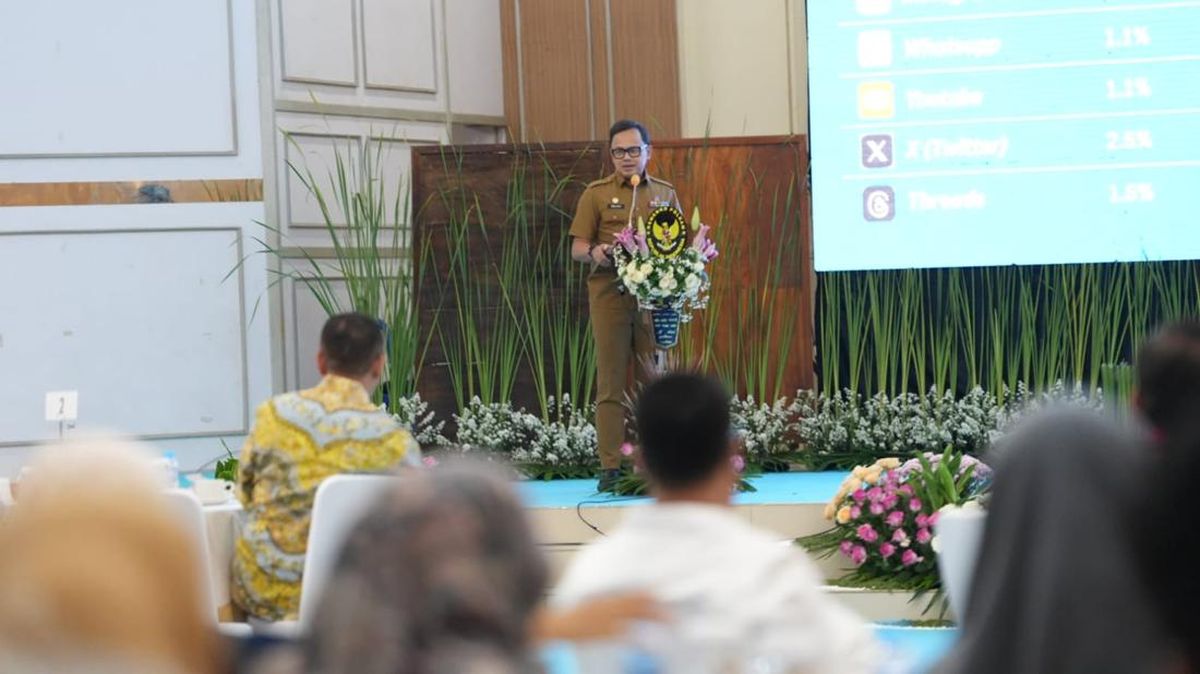
The Deputy Minister of Home Affairs, Bima Arya Sugiarto, has emphasised the importance of rapid response and unified narratives for government public relations, at both central and regional government levels. This principle serves as a vital foundation for addressing disinformation, slander, and hate (DFK), as well as information disruption in the digital age.
According to him, speed in responding is necessary to ensure that information spaces are not left empty and filled with inaccurate narratives. This message was delivered by Bima while representing the Minister of Home Affairs as a speaker at the Coordination Forum themed “Optimising the Role of Ministry/Agency and Regional Government Public Relations in Facing DFK and Information Disertion” at Graha Marinir Panti Perwira, Jakarta, on Tuesday (1/9).
Bima explained that government communication patterns have changed alongside the development of technology and digital media. While the government previously held a dominant role in determining the information delivered to the public, the community now plays a significant role in producing and disseminating information.
He noted that the current challenges are different. “In the past, the media stage was driven by the government,” he said.
He stated that previously, the government designed press releases and maximised channels to reach the public. “Now it is reversed; the public observes, records, uploads, and things go viral, forming a perception, and only then does the government respond. These are two very extreme patterns that we cannot take for granted,” he said.
Bima stated that the speed of response is also crucial to prevent the emergence of speculation and narratives that develop when the government is late in providing explanations. Such conditions can be exploited through the spread of video clips, comments, or narratives from various opposing parties. In this context, Bima appreciated regional governments that have established special units to counter hoaxes and DFK.
“We appreciate several regional governments that have special cyber-hoax units to counter this. We have monitored several cities that already have them. So, as soon as a hoax or DFK appears, they move quickly—not in days, but perhaps in hours—they intervene, and the opinion becomes balanced, and subsequently, the [DFK] disappears,” he said.
In addition to rapid response, Bima emphasised the importance of building a unified narrative within the government environment. He stated that public relations should not merely be involved at the final stage when a policy or programme is already running. Instead, public relations needs to be involved from the beginning through a co-creation process with other regional apparatuses.
“Focus on a single, dominant narrative that is planned and agreed upon from the start,” he added.
Bima also requested that media monitoring be maximised. Media monitoring should not only be used to measure public acceptance of a policy but also to read public sentiment more comprehensively.
To support this, Bima encouraged government public relations to not merely be defensive or reactive in facing disinformation. The government also needs to be more proactive in communicating various achievements and best practices occurring in the regions.